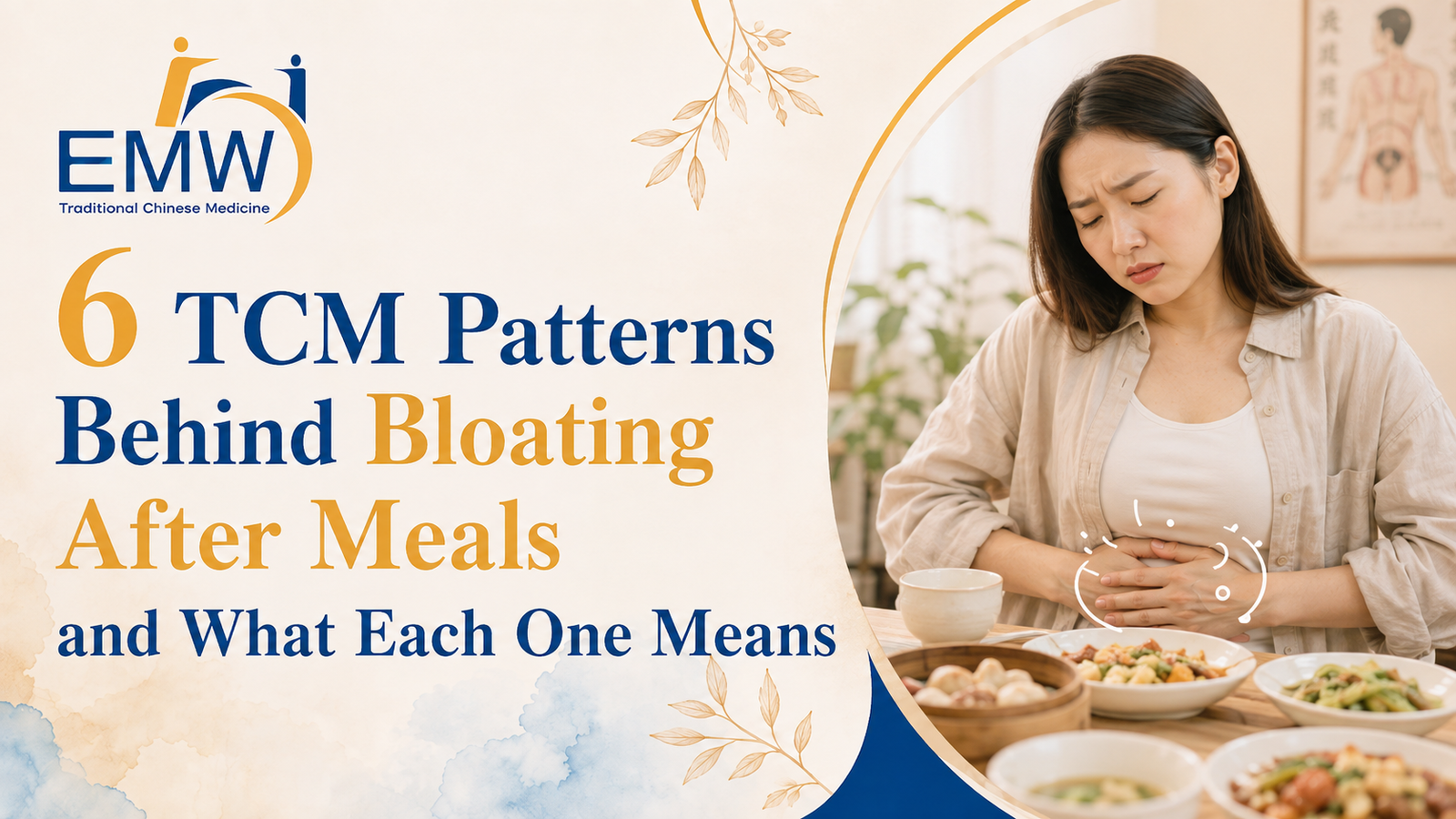
6 TCM Patterns Behind Bloating After Meals and What Each One Means
Bloating after meals is one of the most common digestive complaints.
Some people feel their stomach becomes tight after eating. Some feel full even after small meals. Some burp often. Some feel gassy by evening. Some look “pregnant” after dinner. Some feel sleepy, heavy, or uncomfortable after meals.
Many people in Singapore dismiss bloating as eating too fast, drinking bubble tea, having too much bread, eating late, or having “gastric.”
Sometimes, that is true.
But when bloating keeps coming back, TCM asks a deeper question:
What pattern is causing the digestion to become stuck?
In TCM, bloating is not one single condition. It may come from weakness, stagnation, Cold, Heat, Dampness, food accumulation, stress, or a combination of patterns.
This article explains 6 TCM Patterns Behind Bloating After Meals and What Each One Means, so you can understand why the same bloating symptom may need different solutions.
Important note: TCM can support digestive health, but persistent bloating should not be ignored. HealthHub Singapore explains that dyspepsia may include abdominal bloating, belching, heartburn, nausea, and vomiting, and eating habits such as smaller portions, fixed meal timing, avoiding meals too close to bedtime, and reducing oily and spicy foods may help. Please seek medical review if bloating is severe, persistent, new, associated with weight loss, blood in stool, vomiting, fever, difficulty swallowing, severe pain, or major changes in bowel habits.
First, Why Does Bloating Happen From A TCM Perspective?
In TCM, digestion depends mainly on the Spleen and Stomach.
The Stomach receives food.
The Spleen transforms food into Qi and Blood.
The Liver helps Qi move smoothly.
The intestines help separate, move, and eliminate waste.
When this system flows well, you feel hungry at the right time, eat comfortably, digest without heaviness, pass stools regularly, and have stable energy after meals.
When the system is disrupted, food and Qi may become stuck.
That “stuck” feeling can show up as bloating.
TCM does not only ask, “What food caused this?”
It asks:
- Is digestion weak?
- Is food sitting too long?
- Is stress blocking Qi?
- Is Dampness making the body heavy?
- Is Cold slowing digestion?
- Is Heat causing irritation and reflux?
- Is bowel movement regular?
- Is the bloating upper abdomen, lower abdomen, or whole belly?
- Does it improve with burping, passing gas, warmth, movement, or bowel movement?
The answer changes the treatment.
Bloating TCM Patterns
Pattern 1: Spleen Qi Deficiency
This is one of the most common TCM patterns behind bloating after meals.
In TCM, the Spleen is the digestive engine. When Spleen Qi is weak, food is not transformed efficiently. Even normal meals can feel heavy.
This type of bloating often feels dull, heavy, and tiring.
Common signs include:
- Bloating after meals
- Poor appetite
- Fatigue after eating
- Loose stools
- Food coma
- Heavy limbs
- Sugar cravings
- Pale complexion
- Brain fog
- Puffy face
- Tongue with teeth marks
- Symptoms worse after cold or raw food
This pattern is common in people who skip meals, overwork, eat irregularly, consume too much cold food, drink iced drinks often, or rely heavily on bread, snacks, sweet drinks, and processed foods.
What it means
Your digestion may be underpowered.
The issue is not necessarily that you ate “too much.” It may be that your digestive system does not have enough strength to transform food well.
What to do
Support the Spleen with warmth, rhythm, and simplicity.
Helpful habits:
- Eat warm cooked meals
- Eat at regular times
- Avoid grazing all day
- Reduce iced drinks
- Reduce raw salads and cold smoothies
- Choose soups, porridge, stews, soft rice, and cooked vegetables
- Add protein at each meal
- Walk gently after meals
Avoid overloading digestion with huge meals, excessive dairy, sugary snacks, and late night eating.
For this pattern, cold detox drinks and raw food cleanses may worsen the problem.
Pattern 2: Food Stagnation
Food stagnation happens when food sits in the digestive system and does not move smoothly.
This is common after overeating, eating too quickly, eating late at night, eating too much oily food, or snacking before the previous meal is digested.
This bloating often feels tight, full, and uncomfortable.
Common signs include:
- Strong bloating after a heavy meal
- Burping with food smell
- Acid reflux
- Nausea
- Bad breath
- Thick tongue coating
- Loss of appetite after overeating
- Abdominal fullness relieved by bowel movement
- Stools that smell stronger
- Feeling worse after oily, rich, or heavy foods
What it means
Your digestive system is overloaded.
This is like traffic congestion after too many cars enter the road at once.
What to do
Do not add more heavy foods or tonics immediately.
Food stagnation usually needs movement and reduction first.
Helpful habits:
- Eat smaller meals
- Chew slowly
- Stop before you are overly full
- Avoid lying down after meals
- Walk gently for 10 to 20 minutes
- Avoid late dinners
- Avoid supper if still full
- Reduce fried foods, rich sauces, and heavy desserts
HealthHub’s dyspepsia advice also highlights eating smaller portions at fixed times, taking meals at least two hours before bedtime, and avoiding too much oily and spicy food.
In TCM, this pattern is not solved by taking more “nourishing” foods. First, the stagnation has to clear.
Pattern 3: Liver Qi Stagnation Affecting Digestion
If your bloating is strongly linked to stress, emotions, work pressure, deadlines, conflict, or PMS, Liver Qi stagnation may be involved.
In TCM, the Liver helps Qi move smoothly. When stress blocks Liver Qi, it may affect the Spleen and Stomach, causing bloating, cramps, reflux, or irregular bowel movements.
Common signs include:
- Bloating worse when stressed
- Bloating that comes and goes
- Burping or sighing often
- Chest or rib tightness
- PMS
- Breast tenderness
- Irritability
- Mood swings
- Neck and shoulder tension
- Alternating constipation and loose stools
- Appetite affected by emotions
This pattern is very common in busy working adults in Singapore.
Some patients say:
“My bloating is worse on workdays.”
“I’m fine on holiday.”
“I bloat when I’m anxious.”
“My digestion gets worse before my period.”
What it means
Your digestion is being affected by your nervous system and emotional state.
This does not mean the symptoms are “in your head.” It means stress can affect gut movement, acid secretion, appetite, bowel rhythm, and muscle tension.
What to do
Move Qi gently.
Helpful habits:
- Walk after meals
- Practise slow breathing
- Stretch the ribs, hips, and neck
- Avoid eating while angry or rushing
- Take 5 quiet minutes before meals
- Reduce multitasking during meals
- Do gentle yoga or qigong
- Consider acupuncture if stress and digestion are strongly linked
For this pattern, the solution is not only food restriction.
The body needs smoother Qi flow.
Pattern 4: Dampness Accumulation
Dampness is a TCM pattern of heaviness, sluggishness, and internal fluid stagnation.
When Dampness affects digestion, bloating may come with heaviness, brain fog, loose stools, and a sticky feeling in the body.
Common signs include:
- Bloating with heaviness
- Feeling sluggish after meals
- Loose or sticky stools
- Brain fog
- Puffy face or body
- Water retention
- Thick tongue coating
- Greasy tongue coating
- Phlegm tendency
- Sweet cravings
- Symptoms worse after dairy, sugar, fried foods, or alcohol
In Singapore, Dampness patterns are common because of humid weather, sedentary work, cold drinks, sweet beverages, rich food, and irregular meals.
What it means
Your digestion may be producing internal “damp” waste instead of clean Qi and Blood.
In simple terms, the system is not processing fluids and food efficiently.
What to do
Reduce Dampness forming habits.
Helpful habits:
- Reduce sugar
- Reduce bubble tea and sweet drinks
- Reduce fried foods
- Reduce excessive dairy if it worsens symptoms
- Eat warm cooked meals
- Add gentle movement daily
- Avoid overeating at night
- Choose soups that are light, not oily
- Eat more cooked vegetables
- Keep meals simple
Do not rely on cold juices or raw cleansing diets if you already feel heavy, bloated, and loose in stools.
In TCM, Dampness usually improves through warmth, movement, and better Spleen function.
Pattern 5: Cold In The Middle Jiao
The “Middle Jiao” refers to the digestive centre, mainly the Spleen and Stomach area.
Cold slows things down.
When Cold affects digestion, food may sit longer, movement becomes sluggish, and bloating may improve with warmth.
Common signs include:
- Bloating worse after cold drinks
- Bloating worse after raw foods
- Abdominal discomfort relieved by warmth
- Cold hands and feet
- Loose stools
- Low appetite
- Feeling cold easily
- Preference for warm drinks
- Tiredness
- Pale tongue
- Clear watery stools in some cases
This pattern is common in people who drink iced water daily, take cold smoothies for breakfast, eat raw salads often, or sit in strong air conditioning all day.
What it means
Your digestive fire may be weak or chilled.
The body needs warmth to transform food properly.
What to do
Protect digestive warmth.
Helpful habits:
- Drink warm water
- Choose cooked breakfasts
- Avoid iced drinks with meals
- Reduce raw and cold foods temporarily
- Keep the abdomen warm
- Try warm soups and stews
- Use ginger in cooking if suitable
- Eat slowly and calmly
- Avoid cold desserts after meals
However, warming foods must be used carefully. If you have reflux, mouth ulcers, burning pain, thirst, or constipation, too much ginger or spicy food may worsen symptoms.
This is why TCM pattern diagnosis matters.
Pattern 6: Stomach Heat Or Damp Heat
Not all bloating is from weakness or Cold.
Some people bloat because the digestive system is irritated, inflamed, acidic, or overheated from a TCM perspective.
This may be Stomach Heat or Damp Heat.
Common signs include:
- Bloating with acid reflux
- Burning stomach sensation
- Bad breath
- Thirst
- Bitter taste in mouth
- Constipation or sticky stools
- Strong smelling stools
- Red tongue
- Yellow greasy tongue coating
- Mouth ulcers
- Acne flare ups
- Irritability
- Symptoms worse after spicy food, alcohol, fried food, or late meals
What it means
Your digestion may be irritated and overheated.
This pattern is different from Cold deficiency. Giving too much ginger, alcohol based tonics, spicy soups, or “heaty” herbs may worsen it.
What to do
Reduce irritation.
Helpful habits:
- Avoid spicy food temporarily
- Reduce fried food
- Reduce alcohol
- Avoid late night eating
- Reduce coffee if reflux worsens
- Eat smaller meals
- Avoid lying down after meals
- Choose simple cooked foods
- Seek care if reflux, pain, or nausea persists
HealthHub lists dyspepsia symptoms such as abdominal bloating, belching, heartburn, nausea, and vomiting. If symptoms are frequent, severe, or new, do not keep self-treating with antacids or herbs without review.
Why Pattern Diagnosis Matters
The same symptom can need opposite solutions.
For example:
A Cold pattern may need warmth.
A Heat pattern may need cooling and clearing.
A deficiency pattern may need nourishment.
A food stagnation pattern may need reduction first.
A Dampness pattern may need transformation.
A Liver Qi pattern may need movement and stress regulation.
This is why copying someone else’s supplement, tea, herb, or diet may not work.
One person’s bloating improves with ginger.
Another person’s reflux worsens with ginger.
One person improves with probiotics.
Another becomes more bloated.
One person feels better avoiding dairy.
Another needs regular warm meals and less stress.
TCM treatment is based on pattern, not just symptom.
When Should You See A Doctor?
Please seek medical advice if bloating is:
- New and persistent
- Severe or worsening
- Associated with vomiting
- Associated with fever
- Associated with blood in stool
- Associated with black stools
- Associated with unexplained weight loss
- Associated with loss of appetite
- Associated with difficulty swallowing
- Associated with severe pain
- Associated with persistent diarrhoea or constipation
- Associated with abdominal swelling that does not go away
NHS guidance advises urgent medical help for bloating with vomiting, diarrhoea, constipation, stomach ache, fever, abdominal swelling or lump, inability to pee, poo, or pass wind, or acid reflux symptoms. GutS UK also lists red flags such as unintentional weight loss, anaemia, change in bowel habit, loss of appetite, belly pain, and increased need to pee.
If you are female and have persistent bloating, do not ignore it. Persistent bloating can sometimes be associated with gynaecological conditions and should be properly assessed.
What You Can Start Doing Today
If your bloating is mild and clearly related to meals, start with these foundations:
- Eat at regular times
- Chew slowly
- Stop eating before overfull
- Avoid iced drinks with meals
- Eat warm cooked meals
- Walk gently after meals
- Reduce late dinners
- Avoid lying down immediately after eating
- Reduce fried, oily, and very spicy foods
- Reduce bubble tea and sweet drinks
- Observe whether stress worsens symptoms
- Keep a 1 week food and symptom diary
Track:
- What you ate
- Time of meal
- Bloating location
- Stool pattern
- Stress level
- Sleep
- Menstrual cycle phase if applicable
- Whether warmth, movement, burping, or bowel movement helps
This helps your TCM physician identify the pattern more accurately.
Practical Guidance for Singapore Lifestyles
How EMW TCM Supports Bloating After Meals
At EMW TCM Singapore, we do not treat bloating as one generic gut problem.
We assess the pattern.
We may look at:
- Appetite
- Meal timing
- Food habits
- Stool pattern
- Stress level
- Sleep
- Menstrual cycle if relevant
- Cold or Heat signs
- Tongue and pulse
- Burping, reflux, nausea, or pain
- Energy after meals
- Medication and medical history
- Weight change and red flags
Support may include:
- TCM dietary guidance
- Acupuncture
- Herbal medicine when appropriate
- Lifestyle rhythm changes
- Stress regulation
- Gut focused TCM treatment
- Referral for medical review when needed
The goal is not to restrict everything.
The goal is to understand what your digestion is trying to say.
FAQ: TCM And Bloating After Meals
1. Is bloating always caused by weak Spleen Qi?
No. Weak Spleen Qi is common, but bloating can also come from food stagnation, Liver Qi stagnation, Dampness, Cold, Stomach Heat, constipation, reflux, food intolerance, or medical conditions.
2. Should I avoid all cold drinks?
If bloating is worse after cold drinks, or you have loose stools, poor appetite, and cold signs, reducing iced drinks may help. But if you have Heat signs, the approach may differ.
3. Is ginger good for bloating?
It depends. Ginger may help Cold type bloating, but it may worsen Heat type symptoms such as burning reflux, mouth ulcers, thirst, or constipation.
4. Can stress cause bloating?
Yes. From a TCM perspective, stress may cause Liver Qi stagnation affecting digestion. From a biomedical perspective, stress may affect gut movement, sensitivity, acid secretion, and bowel habits.
5. When should I worry about bloating?
Seek medical review if bloating is persistent, worsening, severe, new, or associated with weight loss, vomiting, fever, blood in stool, black stools, severe pain, difficulty swallowing, or major bowel changes.
6. Can TCM help bloating?
TCM may help support digestion by identifying the pattern behind the bloating and using acupuncture, herbs, diet, and lifestyle changes where appropriate.
Final Thoughts
Bloating after meals is not always random.
In TCM, it is a signal.
It may mean your digestion is weak.
It may mean food is stuck.
It may mean stress is blocking Qi.
It may mean Dampness is accumulating.
It may mean Cold is slowing digestion.
It may mean Heat is irritating the Stomach.
The key is not to guess.
The key is to understand the pattern.
Our Flagship Ebook & Video Course
When to Seek Professional TCM Help
Your gut is the first organ to receive, transform, and deliver nourishment to every cell. If you experience chronic bloating, constipation, acid reflux, or fatigue, these may be early signs that your digestion needs attention.
Healing the gut restores energy, improves hormonal communication, and creates the internal harmony required for general health.
At EMW TCM Singapore, our physicians guide you through this process with care, evidence, and empathy. Whether you are addressing IBS or GERD or fertility, TCM offers a gentle yet powerful pathway to holistic wellness.
Check out our links below to book your consultation and begin your holistic journey toward better health ahead.
EMW TCM Clinics
Scotts Medical Centre Branch
9 Scotts Road #10-04, Scotts Medical Centre @ Pacific Plaza,
Singapore 228210
Book Your Appointment With Us Here: +65 89585869
International Building Branch
360 Orchard Road, International Building #02-05/06
Singapore 238869
Book Your Appointment With Us Here: +65 89585869
Our Physicians
Principal TCM Physician
- M.Med(TCM Gynaecology)
- B.Sc(Hons) Biomedical Sciences
- Dip. Naturopath
- Ayurvedic Therapist(500hrs)
- Registered TCM Physician (Singapore MOH)
Senior TCM Physician
- M.Med(TCM Acupuncture & Moxibustion)
- B.Sc(Hons) Biomedical Sciences
- Certified Aromatherapist
- Registered TCM Physician (Singapore MOH)
TCM Physician
- M.Med(TCM Gynaecology)
- B.Sc(Hons) Biomedical Sciences
- Registered TCM Physician (Singapore MOH)
TCM Physician
- B.Med(TCM)
- B.Sc(Hons) Biomedical Sciences
- International Board-Certified Lactation Consultant (IBCLC)
- Registered TCM Physician (Singapore MOH)
References
- Turner JR. Intestinal mucosal barrier function in health and disease. Physiological Reviews. 2009;89(1):163-192. DOI: 10.1152/physrev.00011.2008