7 Critical Reason TCM for Recurrent Miscarriage Addresses: Treatment Approaches in Singapore
Recurrent miscarriage is physically exhausting and emotionally devastating.
After two or more pregnancy losses, many women are told:
“Everything looks normal.”
“Try again.”
“It was likely chromosomal.”
While chromosomal abnormalities are indeed common causes of early pregnancy loss, they are not the only contributors.
For some women, there are underlying physiological imbalances that remain unaddressed.
This is where TCM for recurrent miscarriage can play a supportive role.
Not as an alternative to medical evaluation.
Not as a guarantee of success.
But as a structured, root-cause approach that supports uterine stability, immune balance, and hormonal resilience.
At EMW TCM in Singapore, we integrate Traditional Chinese Medicine with biomedical assessment, IVF timing awareness, and nutrition-based strategies to optimise the internal environment before conception.
When couples search for TCM herbs for fertility, they are usually looking for two things: scientific credibility and clinical wisdom.
In Singapore, more women are integrating Traditional Chinese Medicine with IVF and assisted reproductive technology. Yet there remains confusion about which herbs are truly appropriate, when they should be used, and how they should be prescribed safely alongside biomedical treatment.
This guide explains seven of the most studied TCM herbs for fertility, how they work from both a Chinese medicine and biomedical perspective, and why structured, individualised prescribing matters especially for IVF patients.
At EMW TCM, herbs are never given generically. They are prescribed within a root-cause framework that integrates hormonal patterns, metabolic health, inflammation status, digestion, and IVF cycle timing. That clinical structure is what differentiates responsible fertility TCM from formula-based retail approaches.
Understanding Recurrent Miscarriage from a Biomedical Perspective
Recurrent pregnancy loss is typically defined as two or more consecutive miscarriages.
Common biomedical contributors include:
- Chromosomal abnormalities
- Luteal phase insufficiency
- Thyroid dysfunction
- Insulin resistance
- Autoimmune factors
- Antiphospholipid syndrome
- Uterine structural abnormalities
- Chronic endometrial inflammation
Even when investigations are “normal,” subtle inflammatory or microcirculatory factors may be present.
The goal of TCM for recurrent miscarriage is not to override medical care, but to strengthen systemic regulation where subtle dysfunction exists.
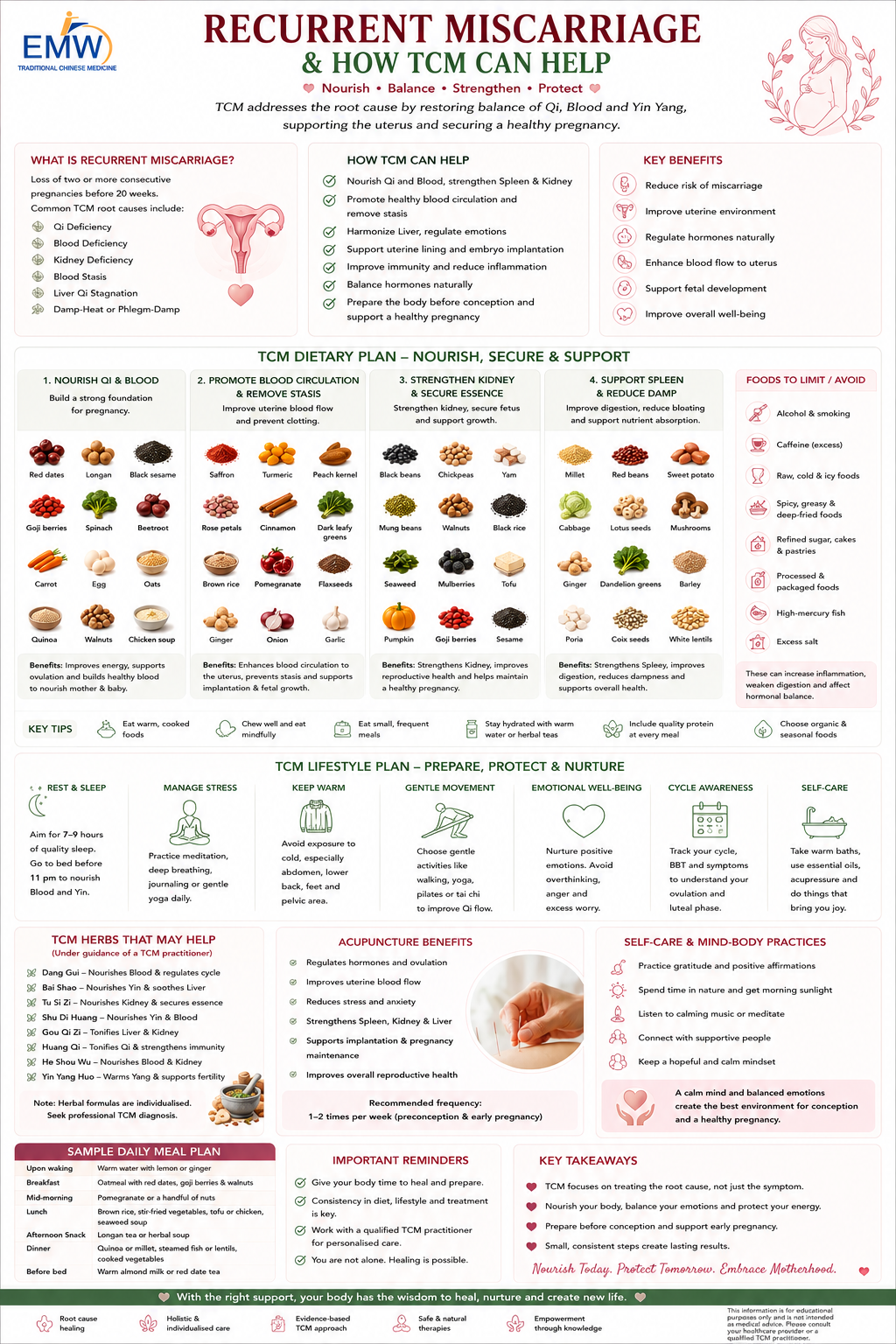
The TCM View: Why Pregnancy May Not Hold
In Traditional Chinese Medicine, pregnancy stability depends on:
- Strong Kidney Essence
- Sufficient Blood
- Warm and nourished uterus
- Smooth Liver Qi
- Stable Chong and Ren meridians
Recurrent loss may arise from patterns such as:
- Kidney deficiency
- Spleen Qi deficiency
- Blood deficiency
- Blood stasis
- Damp-Heat
- Excess internal Heat
- Liver Qi stagnation affecting implantation
Each pattern requires different treatment.
This is why TCM for recurrent miscarriage must be individualised. There is no universal “miscarriage formula.”
Seven Key Reasons For Recurrent Miscarriage
1. Luteal Phase Insufficiency and Progesterone Support
A weak luteal phase may result in:
- Early spotting
- Low progesterone
- Inadequate endometrial support
In TCM, this often corresponds to Kidney Yang deficiency or Spleen Qi weakness.
Treatment strategies may include:
- Warming and stabilising herbs before conception
- Acupuncture to regulate ovulation timing
- Nutritional support for blood sugar stability
TCM for recurrent miscarriage focuses on strengthening progesterone support before pregnancy rather than reacting after implantation.
2. Microcirculation and Blood Stasis
Even when scans appear normal, uterine microcirculation may be suboptimal.
In TCM, Blood stasis can present as:
- Clotting during menses
- Dark menstrual blood
- Sharp menstrual pain
- Previous fibroids or endometriosis
Acupuncture has been shown to influence uterine artery blood flow parameters in some studies.
Reference: Stener-Victorin E et al. Hum Reprod. 1996. DOI: 10.1093/oxfordjournals.humrep.a019187
However, timing is critical.
Blood-moving herbs are never used after ovulation or during early pregnancy. In TCM for recurrent miscarriage, improving circulation occurs pre-conception, not post-implantation.
3. Chronic Low-Grade Inflammation
Inflammation can interfere with implantation and placental development.
Biomedical research suggests inflammatory cytokines may contribute to pregnancy loss in some women.
Reference: Kwak-Kim J et al. Am J Reprod Immunol. 2010. DOI: 10.1111/j.1600-0897.2010.00858.x
In TCM, this often presents as Damp-Heat or internal Heat patterns.
Symptoms may include:
- Acne
- Constipation
- Bitter taste
- Irritability
- Heavy or clotty periods
TCM for recurrent miscarriage includes careful anti-inflammatory strategies while protecting digestive strength.
4. Immune Dysregulation
Some cases of recurrent miscarriage involve immune imbalance.
While complex immunological disorders require specialist management, systemic regulation through:
- Nervous system modulation
- Gut health improvement
- Stress reduction
can support immune resilience.
In TCM, immune instability may relate to Spleen deficiency or underlying Yin deficiency Heat.
At EMW TCM, we emphasise digestion and gut regulation as foundational to immune balance.
5. Thyroid and Metabolic Instability
Even mild thyroid dysfunction increases miscarriage risk.
Insulin resistance also affects placental development.
From a TCM perspective, metabolic instability often involves Spleen deficiency with Damp accumulation.
TCM for recurrent miscarriage integrates:
- Plant-forward, blood sugar stabilising nutrition
- Gentle metabolic acupuncture support
- Herbal regulation prior to conception
We work alongside medical providers. Thyroid medication is not replaced, but physiological support improves overall resilience.
6. Stress and Cortisol Dysregulation
Repeated loss creates profound stress.
Chronic cortisol elevation affects:
- Progesterone signalling
- Immune balance
- Uterine blood flow
In TCM, stress constrains Liver Qi, which disrupts Chong and Ren meridians.
Acupuncture has been shown to reduce stress markers and improve autonomic balance.
TCM for recurrent miscarriage includes nervous system regulation as a core component.
7. Digestive Weakness and Blood Production
In TCM, Blood is produced from transformed food essence.
If digestion is weak:
- Nutrient absorption declines
- Endometrial thickness may suffer
- Energy drops
This is why we emphasise food-first strategies.
Before adding strong tonics, we strengthen Spleen Qi and optimise digestion.
When Should You Consider TCM for Recurrent Miscarriage?
You may benefit from evaluation if you have:
- Two or more pregnancy losses
- Early spotting in pregnancy
- Thin endometrium
- Severe PMS before conception
- Thyroid or insulin instability
- IVF implantation failure
Early preparation before the next conception attempt is crucial.
Our Clinical Approach at EMW TCM
Patients choose EMW because we provide:
Root-Cause Fertility Mapping
We assess cycles, digestion, inflammation, stress physiology, and IVF history.
IVF-Aligned Treatment
Herbal adjustments are carefully timed around stimulation and transfer.
Conservative Pregnancy Management
Once pregnancy occurs, treatment is stabilising and cautious.
Nutrition Integration
Plant-forward, digestion-supportive strategies form the foundation.
We do not promise that TCM for recurrent miscarriage will prevent all losses.
We focus on optimising physiology before conception and stabilising early pregnancy responsibly.
If you would like personalised support, you may WhatsApp +65 8958 5869 to arrange a consultation in Singapore.
You may also explore:
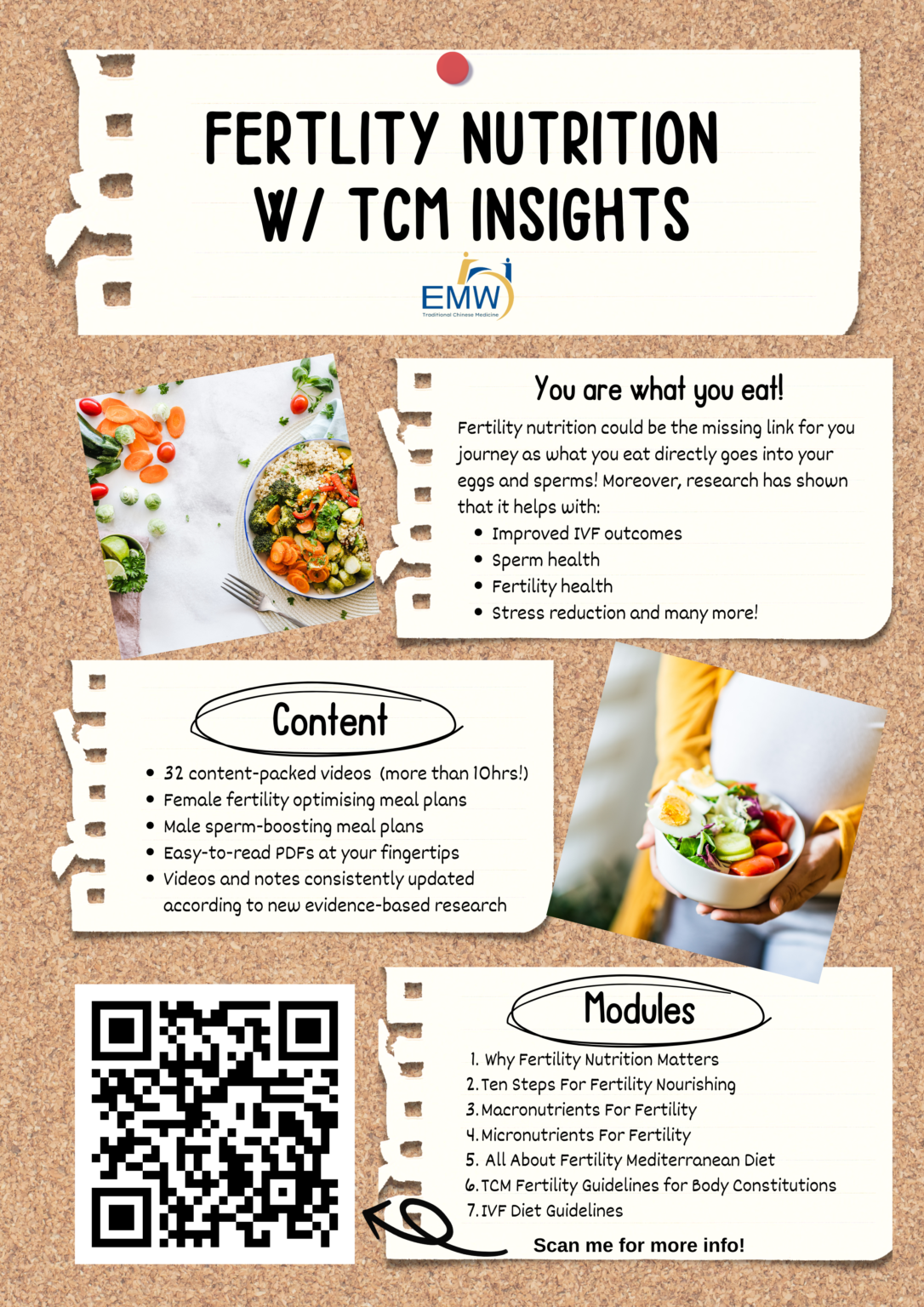
Fertility Nutrition with TCM Insights
https://emwtcm.podia.com/fertility-nutrition-with-tcm-insights
Fertility Support Guide
When Should You Consider TCM Herbs for Fertility?
Recurrent miscarriage is rarely caused by a single factor.
Chromosomal abnormalities may play a role.
So may inflammation, circulation, hormonal instability, immune imbalance, and stress.
TCM for recurrent miscarriage provides a structured, integrative framework to strengthen the internal environment before the next attempt.
Preparation matters.
Timing matters.
Individualisation matters.
With calm, ethical, evidence-informed care, many women regain physiological stability and approach their next pregnancy with greater confidence.
If you are navigating recurrent loss in Singapore, EMW TCM is here to support you thoughtfully and professionally.
You may benefit from a professional assessment if you have:
- Irregular cycles
- Recurrent miscarriage
- Thin endometrium
- Poor egg quality
- Failed IVF cycles
- Severe PMS
- Digestive weakness affecting nutrient absorption
Why Patients Choose EMW TCM
Patients often come to us after trying generic formulas elsewhere.
They choose EMW TCM because we provide:
- Structured fertility diagnostics
- Clear biomedical translation
- IVF phase alignment
- Food-first fertility nutrition strategy
- Individualised prescriptions
- Physician-led oversight
We do not promise pregnancy. We optimise physiology.
If you are preparing for IVF or trying naturally and want a personalised fertility assessment, you may book a consultation or acupuncture session via WhatsApp at +65 8958 5869.
TCM Herbs For Fertility
TCM herbs for fertility can be powerful tools when prescribed precisely.
They are not magic pills.
They are not universal formulas.
They require timing, pattern differentiation, and biomedical awareness.
When integrated thoughtfully with nutrition, lifestyle medicine, and IVF care, Chinese herbal medicine can support the physiology of conception in a structured, ethical way.
If you would like guidance tailored to your fertility journey in Singapore, EMW TCM is here to support you with clarity and evidence-based care.
How EMW TCM Help Your Fertility
From a biomedical perspective, acupuncture for fertility improves ovarian and uterine blood flow, regulates the hypothalamic-pituitary-ovarian axis, lowers cortisol, reduces inflammation, and supports hormonal balance. These effects complement TCM principles and help enhance egg development, implantation, and reproductive function.
1. Comprehensive Assessment
Your first consultation includes:
Cycle assessment
Digestion and hormonal review
Energy and stress evaluation
Sleep and lifestyle factors
Male fertility screening when relevant
2. Evidence-Based TCM Diagnosis
Qi stagnation
Blood deficiency
Spleen Qi weakness
Kidney Yin/Yang imbalance
Liver Qi constraint
Dampness and inflammation
3. Personalised Fertility Treatment Plan
Weekly fertility acupuncture
Customised herbal formulas
Stress reduction strategies
Lifestyle recommendations
TCM Acupuncture for Fertility Treatments
Acupuncture, one of the most researched TCM fertility tools, has been found to influence several physiological pathways related to reproduction.
A review published in Fertility and Sterility (2019) reported that acupuncture may improve blood flow to the uterus and ovaries, modulate stress hormones, and enhance endometrial receptivity. Another meta-analysis in Integrative Medicine Research (2021) concluded that acupuncture used alongside conventional fertility treatment can improve pregnancy outcomes and reduce anxiety levels in women undergoing IVF.
From a clinical standpoint, acupuncture helps regulate the hypothalamic-pituitary-ovarian axis, improving hormone balance and menstrual regularity. It can also reduce cortisol levels, encouraging the parasympathetic or “rest-and-rebuild” state which supports implantation and early pregnancy.
Our Flagship Ebook & Video Course
When to Seek Professional TCM Fertility Help
Fertility is not just a matter of age or hormones. It is a reflection of the body’s internal harmony. Traditional Chinese Medicine provides an integrative and natural way to restore this balance, supporting both physical and emotional readiness for conception.
At EMW TCM Singapore, our team of experienced physicians brings together centuries-old wisdom and modern evidence to guide your fertility journey. Whether you are trying naturally or preparing for IVF, we are here to help you create the best internal environment for new life to begin.
If you have been trying to conceive for more than six to twelve months, experience irregular menses, painful periods, or have been diagnosed with PCOS, endometriosis, or low sperm count, consider a consultation. Professional TCM fertility care aims to correct the underlying imbalance rather than simply forcing ovulation or hormone production.
Check out our links below to book your fertility consultation and begin your holistic journey toward conception.
EMW TCM Clinics
Scotts Medical Centre Branch
9 Scotts Road #10-04, Scotts Medical Centre @ Pacific Plaza,
Singapore 228210
Book Your Appointment With Us Here: +65 89585869
International Building Branch
360 Orchard Road, International Building #02-05/06
Singapore 238869
Book Your Appointment With Us Here: +65 89585869
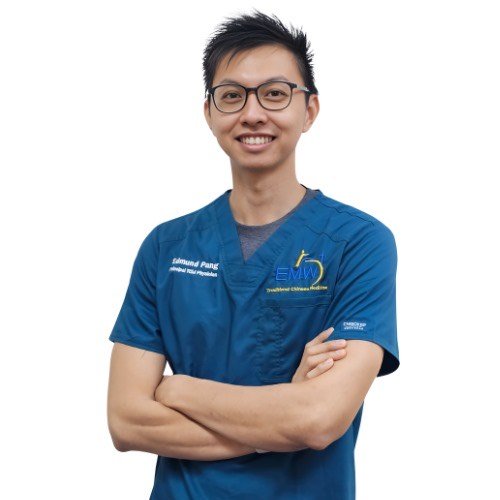
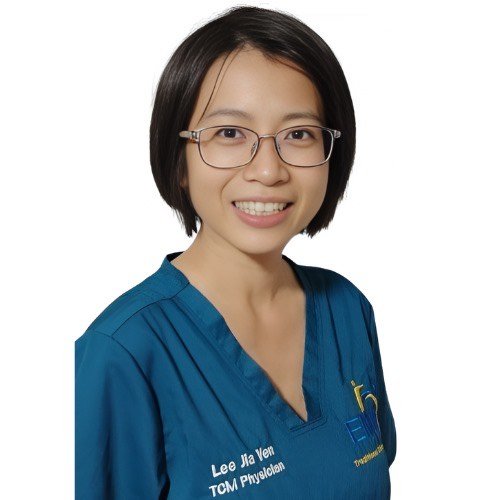
Our Physicians
Principal TCM Physician
- M.Med(TCM Gynaecology)
- B.Sc(Hons) Biomedical Sciences
- Dip. Naturopath
- Ayurvedic Therapist(500hrs)
- Registered TCM Physician (Singapore MOH)
Senior TCM Physician
- M.Med(TCM Acupuncture & Moxibustion)
- B.Sc(Hons) Biomedical Sciences
- Certified Aromatherapist
- Registered TCM Physician (Singapore MOH)
TCM Physician
- M.Med(TCM Gynaecology)
- B.Sc(Hons) Biomedical Sciences
- Registered TCM Physician (Singapore MOH)
TCM Physician
- B.Med(TCM)
- B.Sc(Hons) Biomedical Sciences
- International Board-Certified Lactation Consultant (IBCLC)
- Registered TCM Physician (Singapore MOH)
References
- Stener-Victorin E et al. Reduction of uterine artery blood flow impedance by electro-acupuncture. Hum Reprod. 1996. DOI: 10.1093/oxfordjournals.humrep.a019187
- Kwak-Kim J et al. Immunological modes of pregnancy loss. Am J Reprod Immunol. 2010. DOI: 10.1111/j.1600-0897.2010.00858.x