
AMH vs AFC: 7 Essential Differences Every Fertility Patient Should Understand
You receive your fertility results.
AMH: low.
Then you go for an ultrasound.
The doctor counts more follicles than you expected.
Or perhaps the opposite happens.
Your AMH seems reassuring, but your AFC is lower.
Now you are wondering:
Which result should I believe?
This is where AMH vs AFC becomes confusing.
Both are used to assess ovarian reserve, but they do not measure exactly the same thing in exactly the same way.
More importantly, neither test gives you a direct score for:
- egg quality
- natural fertility
- whether you can conceive this month
- whether an embryo will be chromosomally normal
- whether IVF will work
Their greatest clinical value is in helping fertility specialists estimate how the ovaries may respond to stimulation and approximately how many eggs might be retrieved.
The updated 2025 ESHRE ovarian-stimulation guideline strongly recommends either AMH or AFC for predicting a low or high response to ovarian stimulation.
That is very different from saying:
“Your AMH tells us your chance of having a baby.”
It does not.
Quick answer
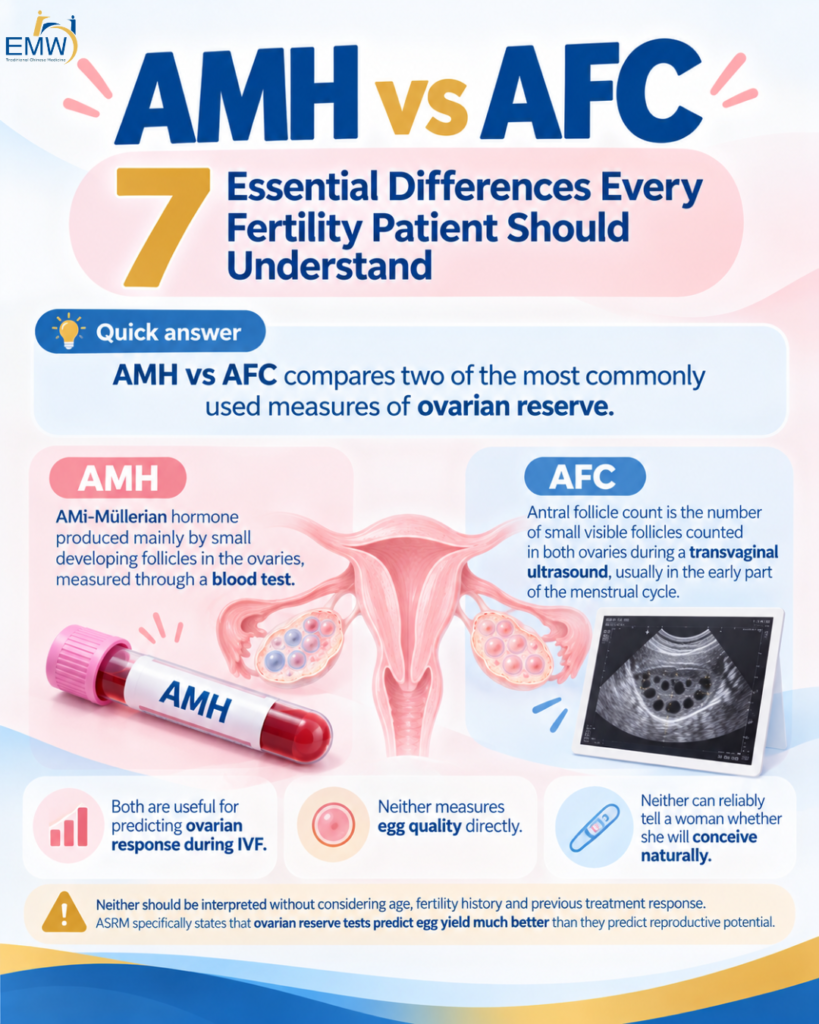
AMH vs AFC compares two of the most commonly used measures of ovarian reserve.
AMH, or anti-Müllerian hormone, is a hormone produced mainly by small developing follicles in the ovaries and is measured through a blood test.
AFC, or antral follicle count, is the number of small visible follicles counted in both ovaries during a transvaginal ultrasound, usually in the early part of the menstrual cycle.
Both are useful for predicting ovarian response during IVF.
Neither measures egg quality directly.
Neither can reliably tell a woman whether she will conceive naturally.
And neither should be interpreted without considering age, fertility history and previous treatment response. ASRM specifically states that ovarian reserve tests predict egg yield much better than they predict reproductive potential.
Here are the seven differences that matter most.
1. AMH is a blood test. AFC is an ultrasound count.
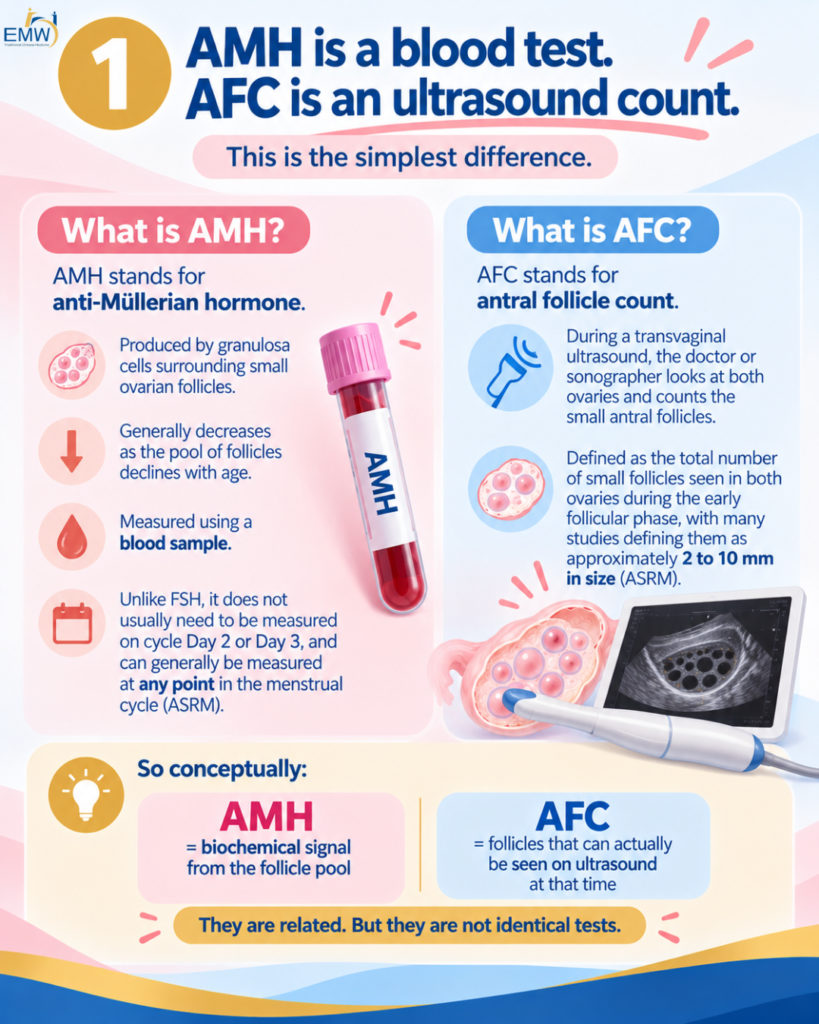
AMH stands for anti-Müllerian hormone.
It is produced by granulosa cells surrounding small ovarian follicles.
As the pool of follicles declines with reproductive ageing, AMH generally decreases as well.
AMH is measured using a blood sample.
Unlike FSH, it does not usually need to be measured specifically on cycle Day 2 or Day 3. ASRM notes that AMH can generally be measured at any point in the menstrual cycle.
AFC stands for antral follicle count.
During a transvaginal ultrasound, the doctor or sonographer looks at both ovaries and counts the small antral follicles.
ASRM describes AFC as the total number of small follicles seen in both ovaries during the early follicular phase, with many studies defining them as approximately 2 to 10 mm in size.
So conceptually:
AMH = biochemical signal from the follicle pool
AFC = follicles that can actually be seen on ultrasound at that time
They are related.
But they are not identical tests.
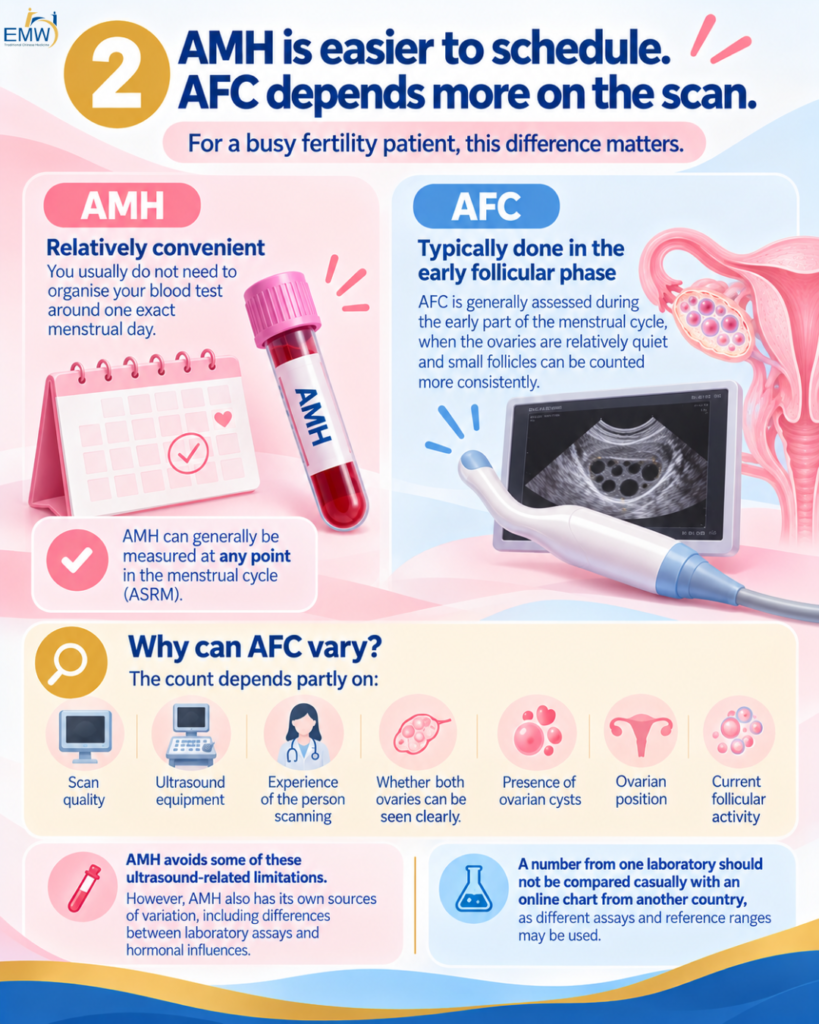
2. AMH is easier to schedule. AFC depends more on the scan.
For a busy fertility patient, this difference matters.
AMH is relatively convenient.
You usually do not need to organise your blood test around one exact menstrual day.
AFC is generally assessed during the early follicular phase, when the ovaries are relatively quiet and small follicles can be counted more consistently.
Why can AFC vary?
The count depends partly on:
- scan quality
- ultrasound equipment
- experience of the person scanning
- whether both ovaries can be seen clearly
- presence of ovarian cysts
- ovarian position
- current follicular activity
An ovary sitting high behind the uterus or bowel may simply be more difficult to visualise.
That does not mean the follicles vanished.
3. Both predict egg numbers better than egg quality
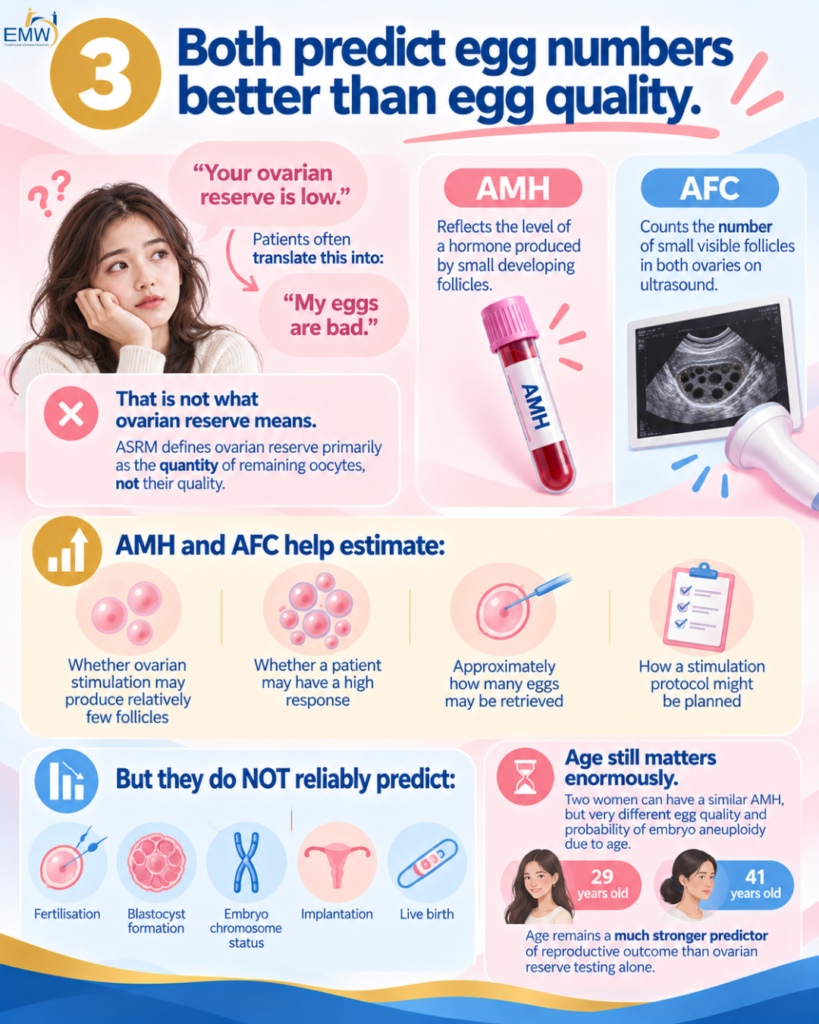
This is probably the most important part of the entire AMH vs AFC discussion.
Patients often hear:
“Your ovarian reserve is low.”
And translate it into:
“My eggs are bad.”
That is not what ovarian reserve means.
ASRM defines ovarian reserve primarily as the quantity of remaining oocytes, not their quality.
AMH and AFC are useful because they help estimate:
- whether ovarian stimulation may produce relatively few follicles
- whether a patient may have a high response
- approximately how many eggs may be retrieved
- how a stimulation protocol might be planned
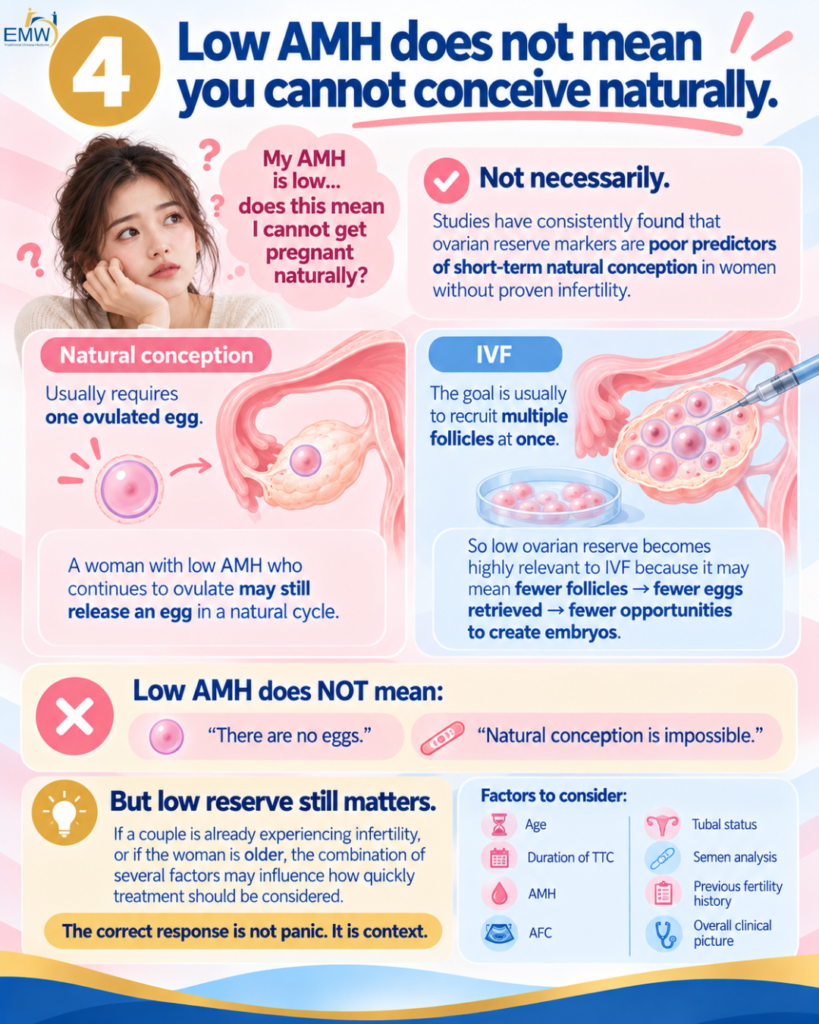
4. Low AMH does not mean you cannot conceive naturally
This misconception creates a huge amount of unnecessary anxiety.
A woman gets an AMH test because she has been trying to conceive.
The result is low.
She immediately thinks:
“Does this mean I cannot get pregnant naturally?”
Not necessarily.
Studies have consistently found that ovarian reserve markers are poor predictors of short-term natural conception in women without proven infertility.
ASRM specifically states that ovarian reserve tests should not be used as general fertility tests, and poor ovarian reserve results do not automatically mean that a woman cannot conceive.
Why?
Because natural conception usually requires one ovulated egg.
IVF is different.
During IVF, the goal is usually to recruit multiple follicles at once.
So low ovarian reserve becomes highly relevant to IVF because it may mean:
fewer follicles → fewer eggs retrieved → fewer opportunities to create embryos
But a woman with low AMH who continues to ovulate may still release an egg in a natural cycle.
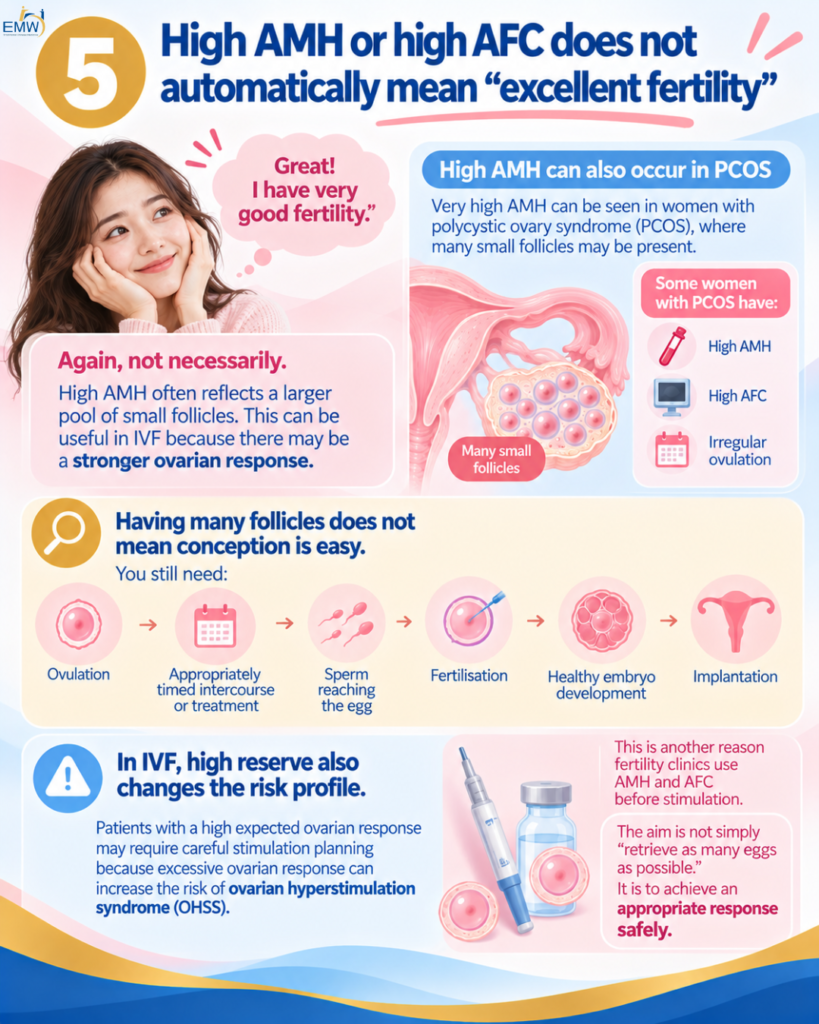
5. High AMH or high AFC does not automatically mean “excellent fertility”
The opposite misunderstanding also happens.
A woman receives a high AMH result and thinks:
“Great. I have very good fertility.”
Again, not necessarily.
High AMH often reflects a larger pool of small follicles.
That can be useful in IVF because there may be a stronger ovarian response.
But very high AMH can also occur in women with polycystic ovary syndrome, PCOS, where many small follicles may be present.
The 2023 international PCOS guideline recognises that AMH may be elevated in adults with polycystic ovarian morphology and that follicle count is also part of ultrasound assessment.
Some women with PCOS have:
high AMH + high AFC + irregular ovulation
So having many follicles does not automatically mean conception is easy.
6. Hormonal contraception can make both numbers look lower
This point is particularly useful for women who recently stopped:
- birth-control pills
- hormonal contraception
- some other forms of ovarian suppression
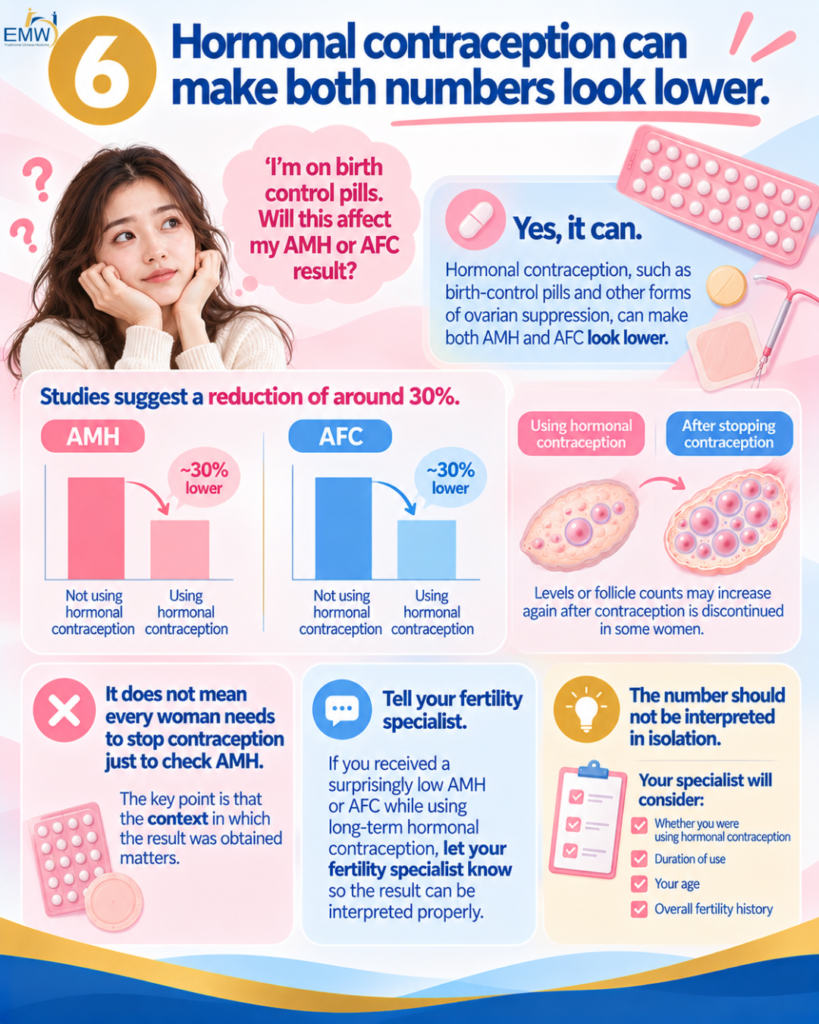
ASRM’s 2024 committee opinion notes that prolonged hormonal contraception may suppress both AMH and AFC.
Some studies have reported reductions of around 30%, with levels or follicle counts increasing again after contraception is discontinued in some women.
ASRM therefore notes that stopping hormonal contraception for approximately two to three months may sometimes allow a more accurate ovarian reserve assessment, especially when an unexpectedly low result has been obtained.
That does not mean every woman needs to stop contraception just to check AMH.
It means:
the context in which the result was obtained matters.
If you received a surprisingly low AMH while using long-term hormonal contraception, tell your fertility specialist.
The number should not be interpreted in isolation.
7. Sometimes AMH and AFC disagree
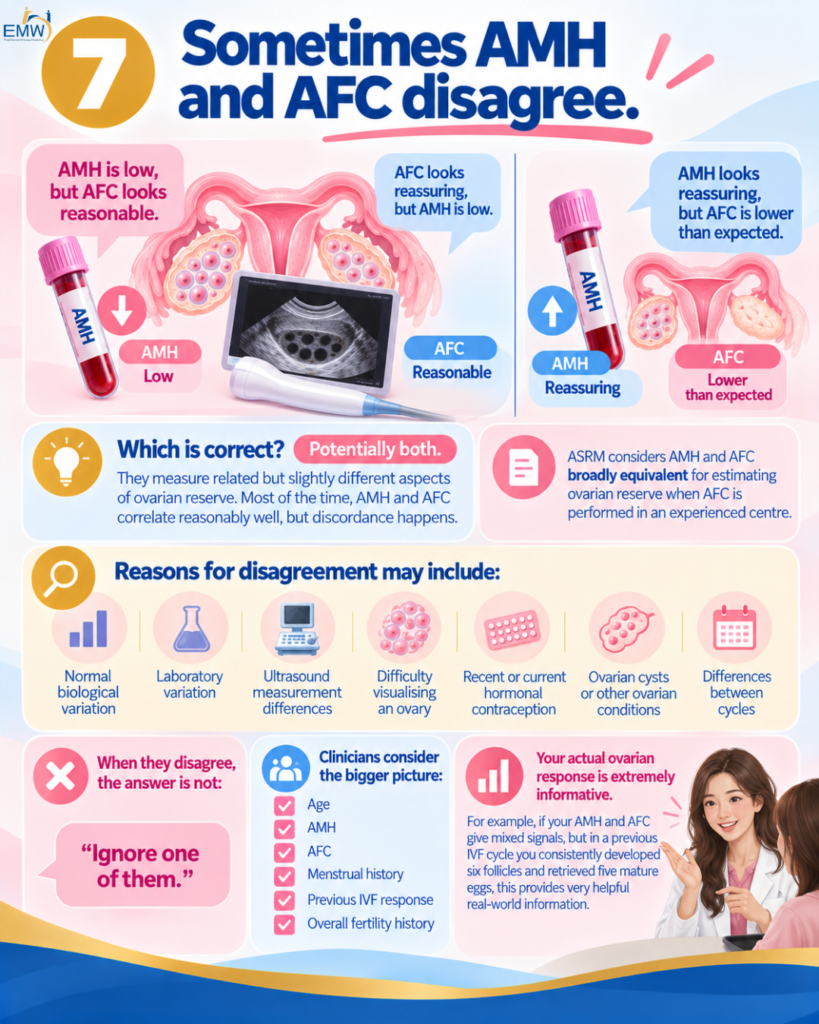
Remember, they measure related but slightly different aspects of ovarian reserve.
ASRM considers AMH and AFC broadly equivalent for estimating ovarian reserve when AFC is performed in an experienced centre.
Most of the time, the two markers correlate reasonably well.
But discordance happens.
Reasons may include:
- normal biological variation
- laboratory variation
- ultrasound measurement differences
- difficulty visualising an ovary
- recent or current hormonal contraception
- ovarian cysts or other ovarian conditions
- differences between cycles
AMH vs AFC: which one is more accurate?
Patients understandably want a winner.
But that is not really the right way to think about it.
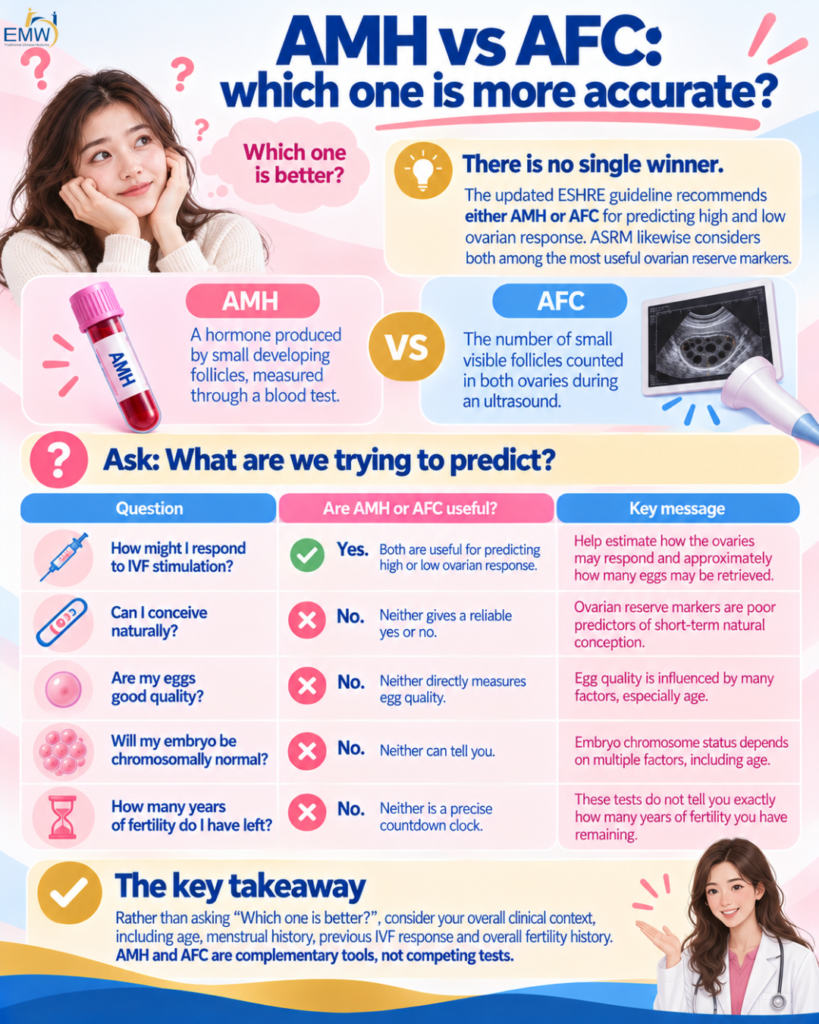
The updated ESHRE guideline recommends either AMH or AFC for predicting high and low ovarian response.
ASRM likewise considers both among the most useful ovarian reserve markers.
So rather than asking:
“Which one is better?”
Ask:
“What are we trying to predict?”
If the question is:
How might I respond to IVF stimulation?
Both are useful.
Does AMH tell you when menopause will happen?
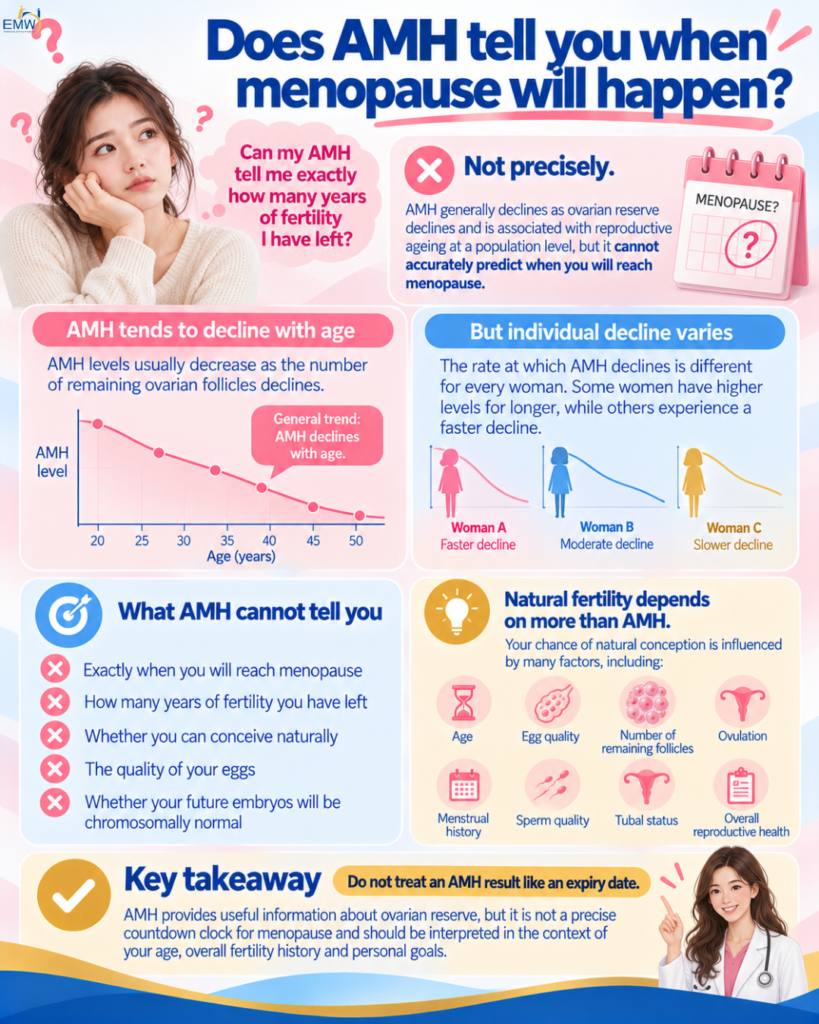
Not precisely enough for individual fertility planning.
AMH generally declines as ovarian reserve declines.
At a population level, it is associated with reproductive ageing.
But that does not mean a doctor can look at your AMH and say:
“You have exactly three fertile years remaining.”
Individual decline varies.
And natural fertility depends heavily on age and egg quality, not simply on how many follicles remain.
Do not treat an AMH result like an expiry date.
What does a low AFC mean?
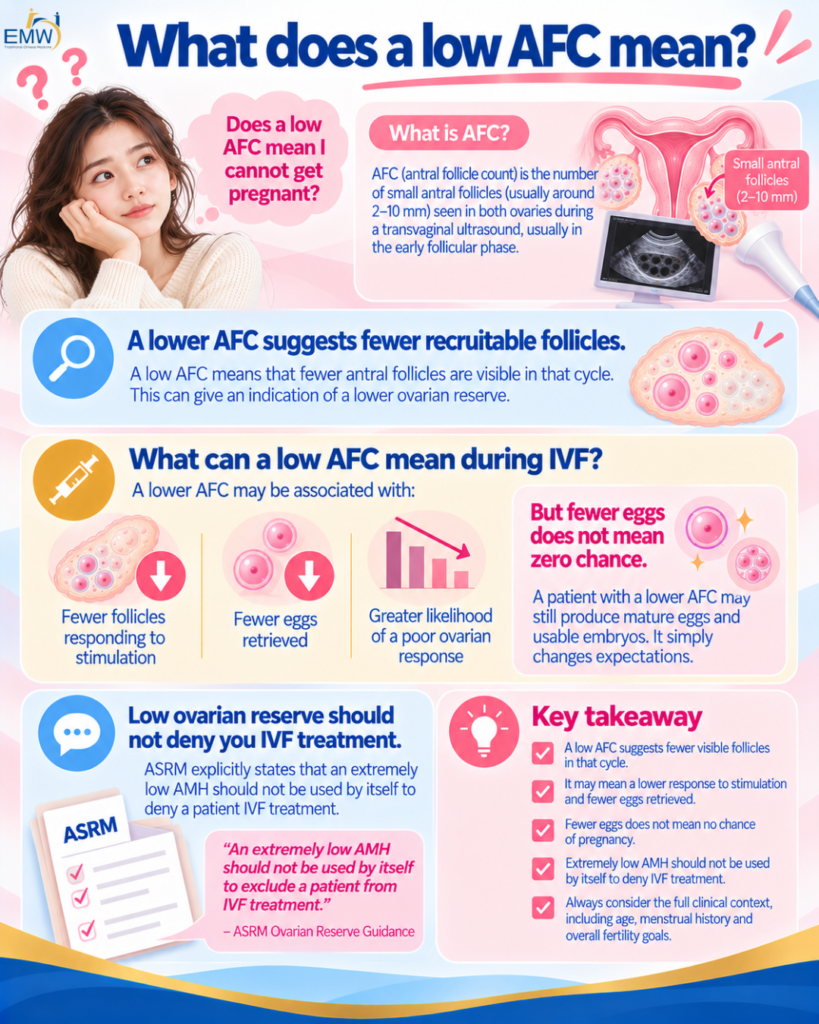
A lower AFC suggests that fewer recruitable antral follicles are visible in that cycle.
During IVF this may mean:
- fewer follicles responding to stimulation
- fewer eggs retrieved
- greater likelihood of poor ovarian response
But again:
fewer eggs does not mean zero chance.
A patient with a lower AFC may still produce mature eggs and usable embryos.
It simply changes expectations.
And extremely low AMH should not be used by itself to deny a patient IVF treatment. ASRM explicitly states this in its ovarian reserve guidance.
What if AMH is normal but AFC is low?
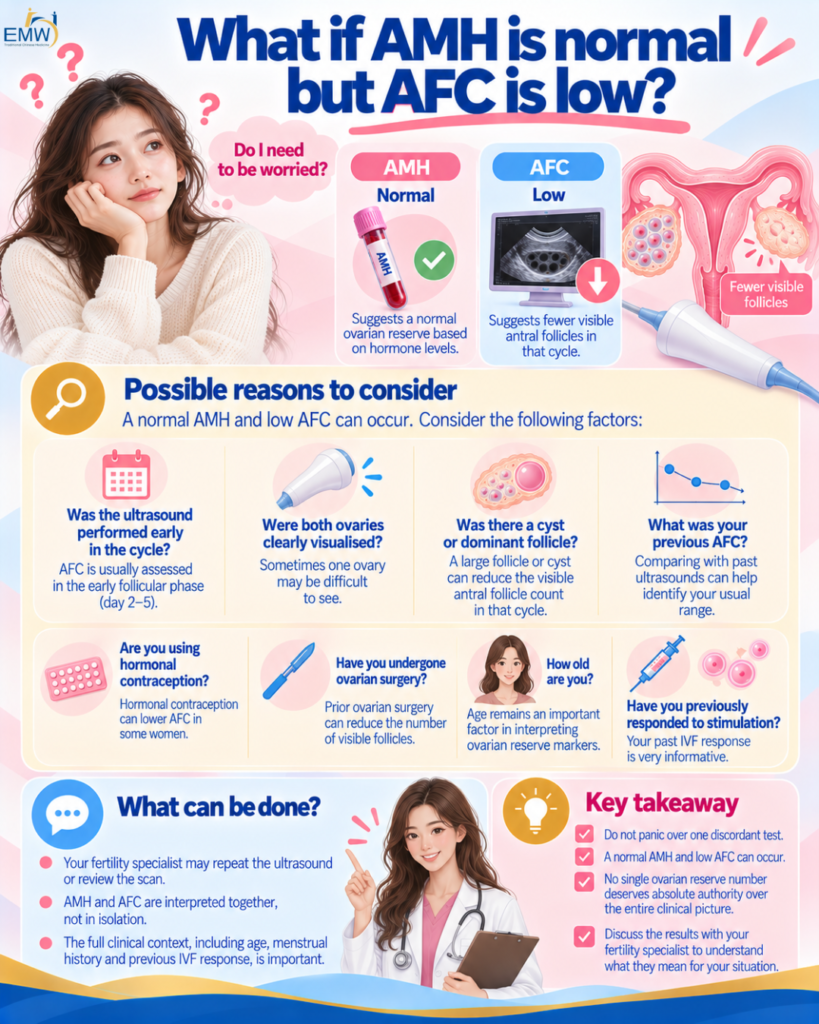
Do not panic over one discordant test.
Ask:
- Was the ultrasound performed early in the cycle?
- Were both ovaries clearly visualised?
- Was there a cyst or dominant follicle?
- What was your previous AFC?
- Are you using hormonal contraception?
- Have you undergone ovarian surgery?
- How old are you?
- Have you previously responded to stimulation?
Your fertility specialist may repeat the ultrasound or interpret the markers together.
No single ovarian reserve number deserves absolute authority over the entire clinical picture.
What if AMH is low but AFC is normal?
This can also happen.
Again, context matters.
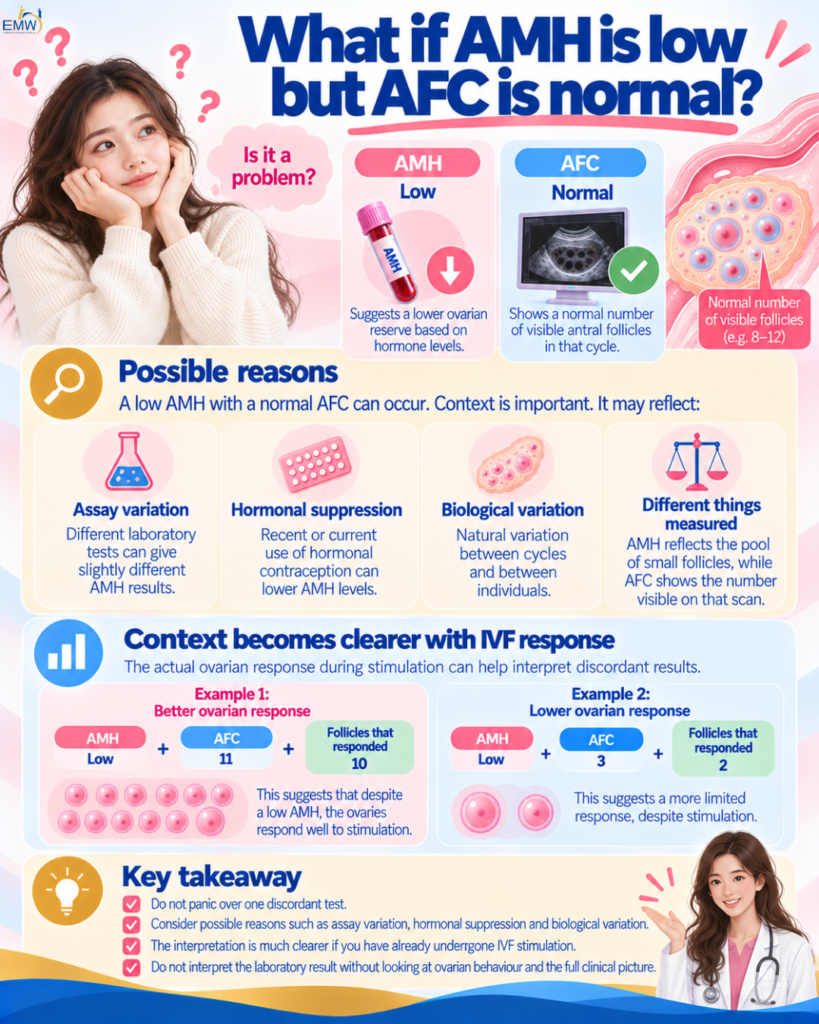
It may reflect:
- assay variation
- hormonal suppression
- biological variation
- differences between what the hormone reflects and what is visible during that scan
The correct interpretation may become much clearer if IVF stimulation has already occurred.
For example:
AMH low + AFC 11 + 10 follicles respond to stimulation
is a different clinical picture from:
AMH low + AFC 3 + 2 follicles respond despite substantial stimulation.
Do not interpret the laboratory result without looking at ovarian behaviour.
How EMW TCM uses AMH and AFC information
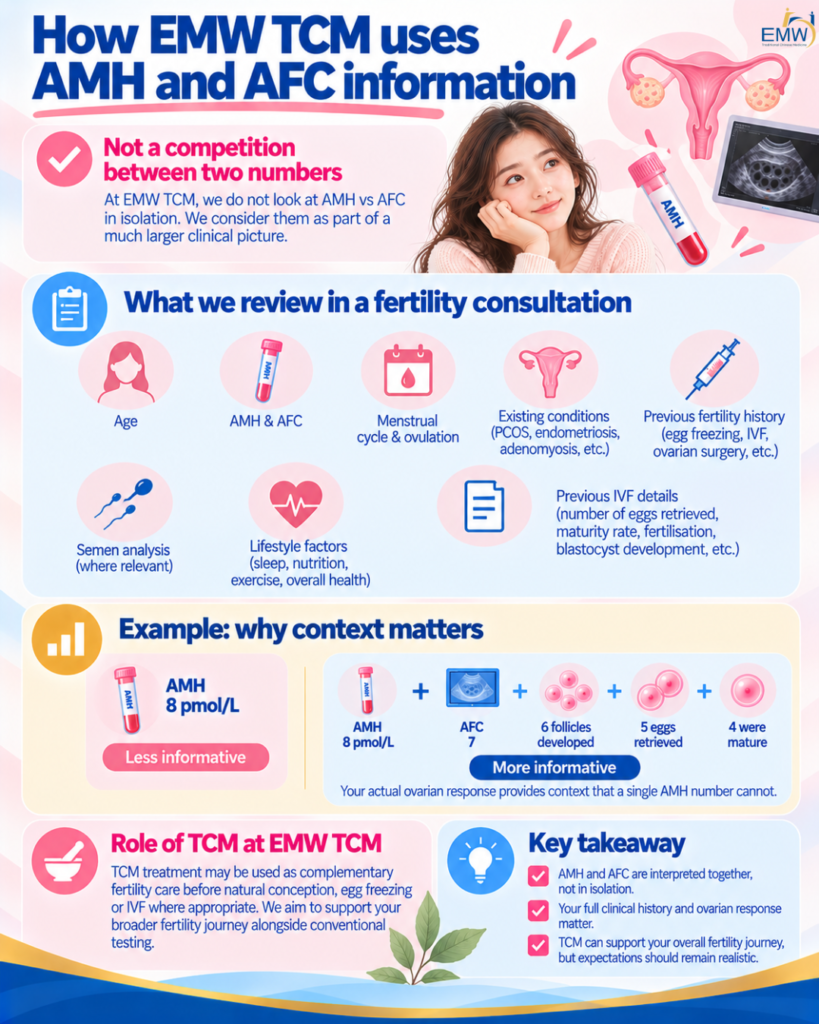
At EMW TCM, we do not use AMH vs AFC as a competition between two numbers.
For fertility patients, we look at them as part of a much larger clinical picture.
A first fertility consultation may review:
- age
- AMH
- AFC
- FSH and estradiol where relevant
- menstrual-cycle length
- ovulation
- previous pregnancy history
- endometriosis
- adenomyosis
- PCOS
- ovarian surgery
- previous egg freezing
- previous IVF stimulation
- number of eggs retrieved
- maturity rate
- fertilisation
- blastocyst development
- semen analysis
- sleep
- nutrition
- exercise
- overall health
If you have already undergone egg retrieval, bring those results.
EMW IVF Master Guide
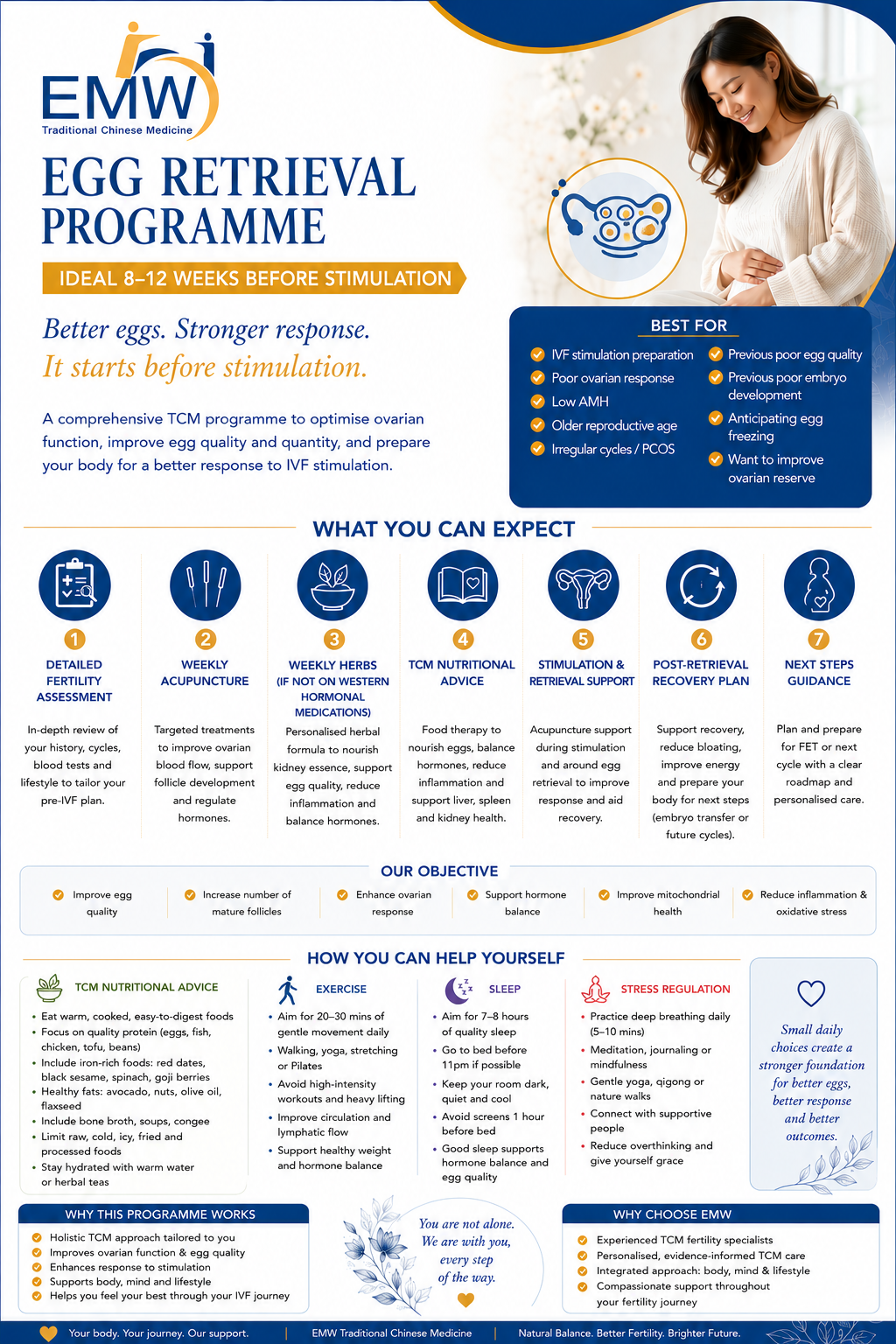
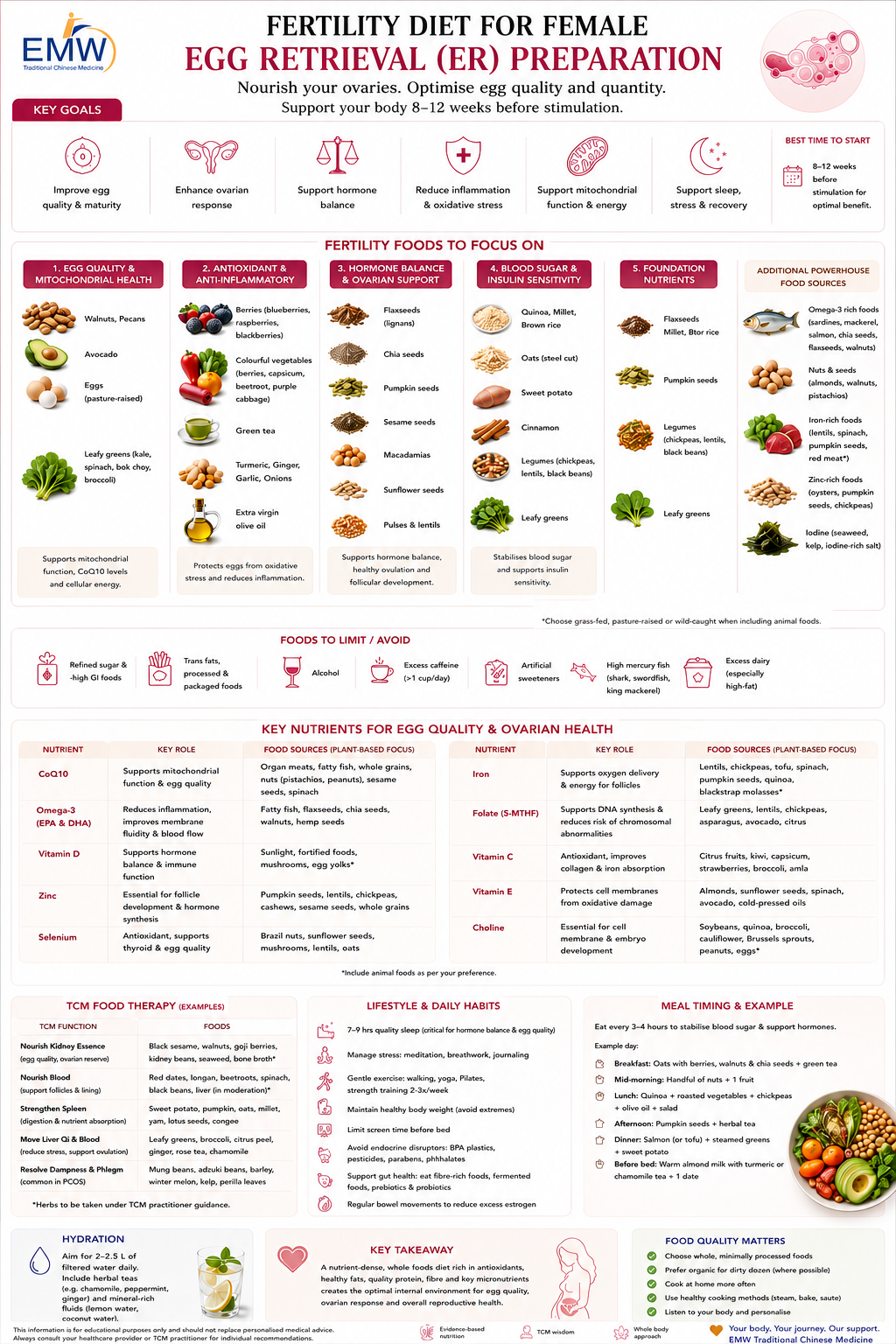
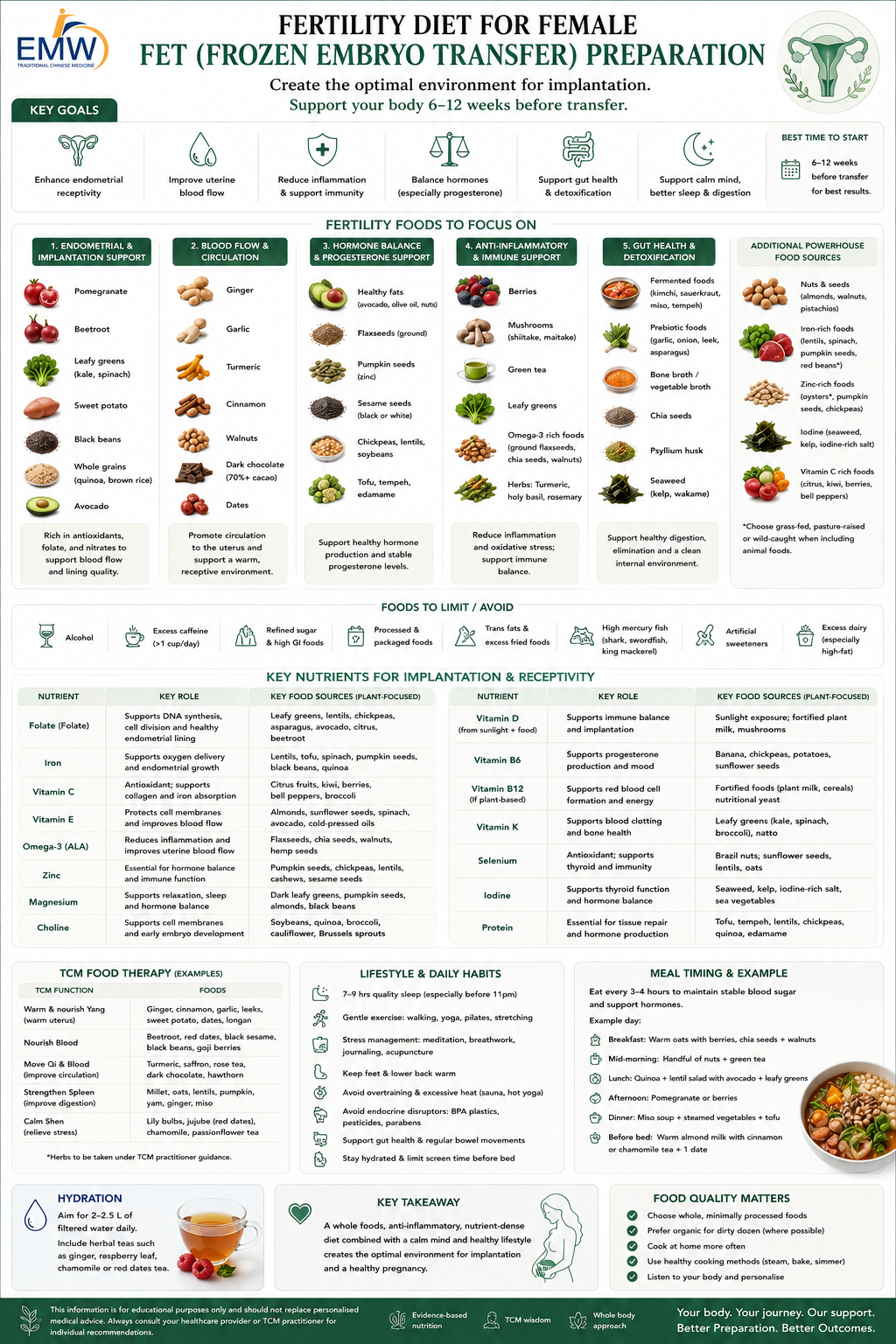
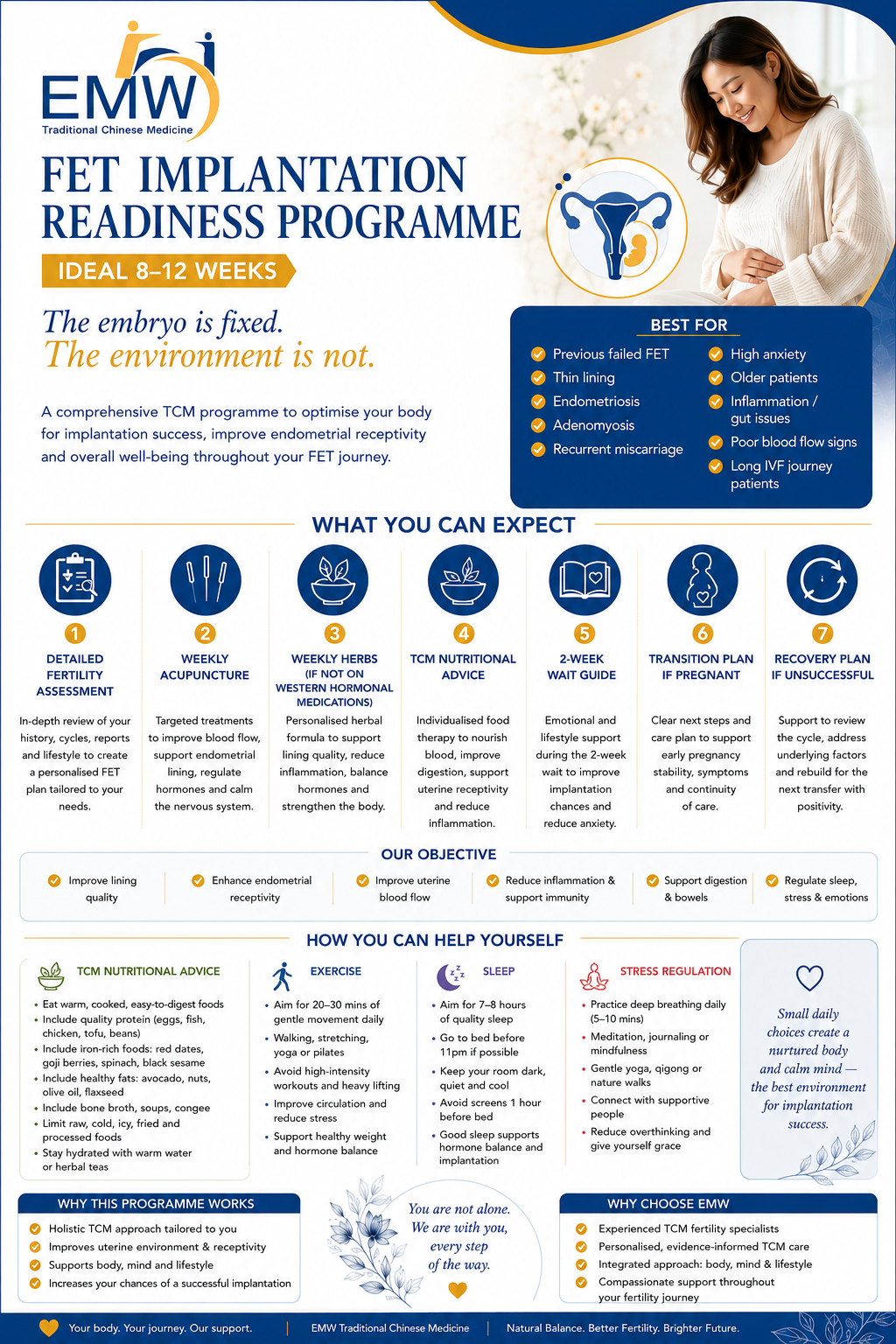
Press the image to zoom in. If you like such infographics, we have a ‘3 ways to superboost your fertility’ PDF guide – Actionable steps that can help to support your reproductive health right away. You can sign up for free here: https://emwtcm.podia.com/3-ways-to-boost-your-fertility
Frequently Asked Questions
Is AMH or AFC more important for IVF?
Both are useful.
Current ESHRE guidance recommends either AMH or AFC for predicting low or high ovarian response during stimulation.
Your fertility specialist may use both alongside age and previous response.
Can AMH tell me my egg quality?
No.
AMH primarily provides information about ovarian reserve and likely egg quantity, not the chromosome quality or reproductive competence of individual eggs.
Does a low AMH mean IVF will fail?
No.
Low AMH may predict fewer eggs from stimulation.
It does not mean that no usable embryo can be created, and ASRM states that even extremely low AMH should not by itself be used to refuse IVF treatment.
Can I get pregnant naturally with low AMH?
Yes, it is possible.
Ovarian reserve tests do not reliably predict natural conception over the short term.
Age, ovulation, tubal health, sperm and other factors must also be considered.
What if my AMH and AFC do not match?
Discordant results occur.
Your doctor will usually interpret both alongside age, menstrual history, medication, scan conditions and any previous ovarian stimulation response.
Can birth-control pills lower AMH?
Yes.
Long-term hormonal contraception can temporarily suppress AMH and AFC in some women.
Tell your doctor if you were taking hormonal contraception when the test was performed.
Does high AMH mean PCOS?
Not by itself.
AMH may be elevated in women with PCOS, but AMH alone should not automatically be used to diagnose PCOS outside an appropriate diagnostic framework.
What AFC number is considered normal?
There is no single universal number that should be interpreted without age and clinical context.
Laboratories and fertility centres may also use somewhat different thresholds.
Rather than chasing a generic internet range, ask what your AFC means for your age and expected ovarian response.
Stop treating ovarian reserve as a fertility score
It is tempting to turn fertility into a number.
AMH 22 feels better than AMH 8.
AFC 16 feels better than AFC 5.
But reproduction is not quite that neat.
A larger follicle pool can provide more opportunities, particularly during IVF.
That matters.
But fertility still depends on:
Age + ovulation + egg competence + sperm + tubes + embryo development + uterus + timing
This is why AMH vs AFC should answer a fairly specific question:
How much ovarian response might we reasonably expect?
They are useful tests.
They are not verdicts.
A low AMH is not a declaration of infertility.
A high AMH is not a guarantee of pregnancy.
And neither tells you whether the next egg released will be capable of becoming a healthy baby.
Use the numbers for what they are good at.
Do not ask them to predict something they were never designed to predict.
Continue reading
We publish practical fertility guides covering IVF, egg retrieval, embryo development, FET, natural conception and male fertility.
👉 Read the latest fertility articles:
If you are preparing for natural conception, egg freezing or fertility treatment and want a structured approach to nutrition and lifestyle preparation, our Fertility Optimisation Bundle brings together practical fertility guidance with TCM perspectives.
👉 Access the Fertility Optimisation Bundle:
https://emwtcm.podia.com/fertility-optimsation-bundle
This article is educational and does not replace individual advice from a fertility specialist. Ovarian reserve results should be interpreted together with age, reproductive history, ultrasound findings and other fertility investigations.
When to Seek Professional TCM Fertility Help
Fertility is not just a matter of age or hormones. It is a reflection of the body’s internal harmony. Traditional Chinese Medicine provides an integrative and natural way to restore this balance, supporting both physical and emotional readiness for conception.
At EMW TCM Singapore, our team of experienced physicians brings together centuries-old wisdom and modern evidence to guide your fertility journey. Whether you are trying naturally or preparing for IVF, we are here to help you create the best internal environment for new life to begin.
If you have been trying to conceive for more than six to twelve months, experience irregular menses, painful periods, or have been diagnosed with PCOS, endometriosis, or low sperm count, consider a consultation. Professional TCM fertility care aims to correct the underlying imbalance rather than simply forcing ovulation or hormone production.
Check out our links below to book your fertility consultation and begin your holistic journey toward conception.
EMW TCM Clinics
International Building Branch
360 Orchard Road, International Building #02-05/06
Singapore 238869
Book Your Appointment With Us Here: +65 89585869
Our Physicians

Principal TCM Physician
- M.Med(TCM Gynaecology)
- B.Sc(Hons) Biomedical Sciences
- Dip. Naturopath
- Ayurvedic Therapist(500hrs)
- Registered TCM Physician (Singapore MOH)

Senior TCM Physician
- M.Med(TCM Acupuncture & Moxibustion)
- B.Sc(Hons) Biomedical Sciences
- Certified Aromatherapist
- Registered TCM Physician (Singapore MOH)

TCM Physician
- M.Med(TCM Gynaecology)
- B.Sc(Hons) Biomedical Sciences
- Registered TCM Physician (Singapore MOH)

TCM Physician
- M.Med(TCM Acupuncture & Moxibustion)
- B.Sc(Hons) Biomedical Sciences
- Registered TCM Physician (Singapore MOH)

TCM Physician
- B.Med(TCM)
- B.Sc(Hons) Biomedical Sciences
- International Board-Certified Lactation Consultant (IBCLC)
- Registered TCM Physician (Singapore MOH)
References
- European Society of Human Reproduction and Embryology. Guideline on Ovarian Stimulation for IVF/ICSI. Updated 2025.
- American Society for Reproductive Medicine. Testing and Interpreting Measures of Ovarian Reserve: A Committee Opinion.
- American Society for Reproductive Medicine. Fertility Evaluation of Infertile Women: A Committee Opinion.
- American Society for Reproductive Medicine. The Use of Hormonal Contraceptives in Fertility Treatments: A Committee Opinion. 2024.
- International Evidence-Based Guideline for the Assessment and Management of Polycystic Ovary Syndrome. 2023.
- National University Hospital Singapore. Infertility. Updated July 2026.
- National University Hospital Singapore. Reproductive Endocrinology and Infertility.
- KK Women’s and Children’s Hospital. Clinical Chemistry Laboratory: Ovarian Reserve Testing.