
Low Fertilisation Rate IVF: 7 Critical Reasons Fewer Eggs May Fertilise
Egg retrieval went reasonably well.
You had 10 eggs collected.
So when the embryologist calls the next morning, you are hoping to hear:
“Most of them fertilised.”
Instead:
Four were mature.
Two fertilised normally.
Suddenly the number of possible embryos is much smaller than expected.
And naturally, the questions start:
Was it the eggs?
Was it the sperm?
Should we have done ICSI?
A low fertilisation rate IVF result can happen for several different reasons, and the first thing to establish is what denominator you are actually using.
Ten eggs retrieved does not necessarily mean ten eggs were capable of fertilising.
Where the biggest drop occurs helps determine what should be reviewed before another cycle.
Quick answer
A low fertilisation rate IVF cycle means fewer mature eggs than expected achieve normal fertilisation.
Normal fertilisation is usually confirmed when the embryologist sees two pronuclei, or 2PN, representing the maternal and paternal genetic material after fertilisation.
Possible explanations include:
- too few mature eggs
- poor sperm concentration, motility or function
- difficulty with sperm binding to or entering the egg during conventional IVF
- egg-related factors
- failure of the egg to activate after sperm entry
- rare sperm or oocyte genetic factors
- normal biological variation, particularly when only a few mature eggs are available
The fertilisation method also matters.
ICSI can reduce the risk of another episode of poor or absent fertilisation after a previous conventional IVF cycle with unexpectedly low fertilisation. However, the latest 2026 ASRM guidance does not recommend routinely using ICSI for every IVF patient without male-factor infertility or a previous fertilisation problem because improved fertilisation does not necessarily translate into improved live birth.
Here are seven areas worth understanding.
1. Not every egg retrieved is mature enough to fertilise
This is the first number to check.
Imagine:
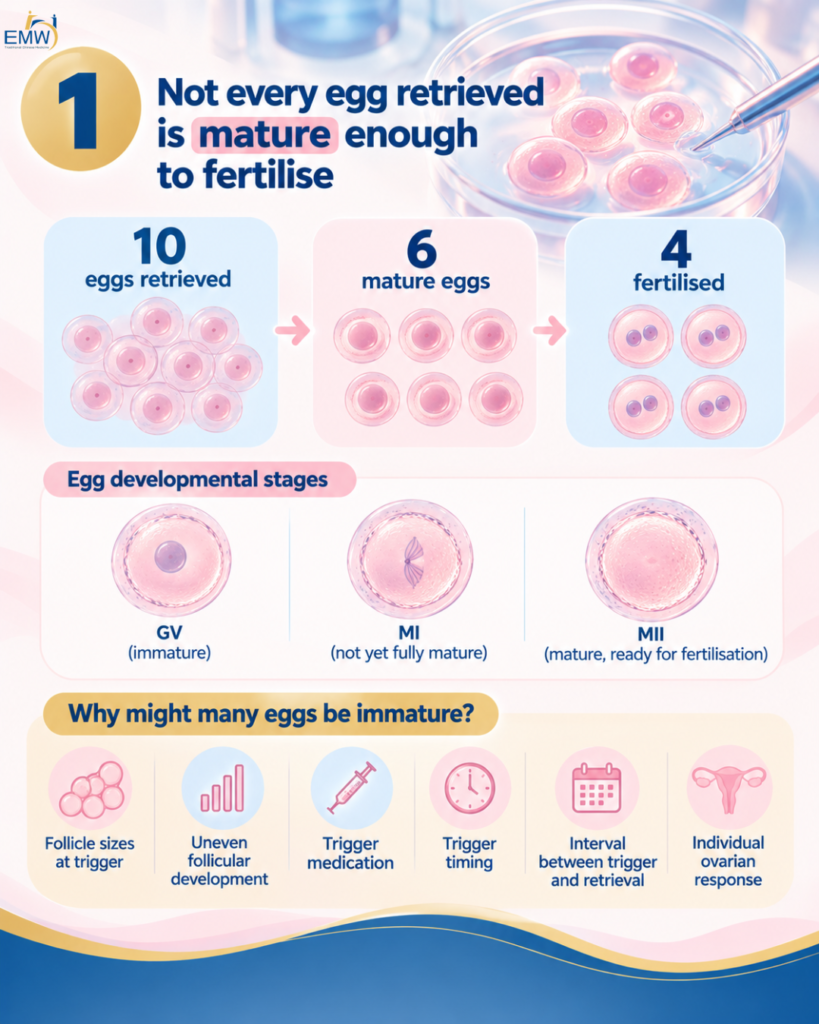
10 eggs retrieved
It sounds like ten opportunities for fertilisation.
But then the laboratory reports:
6 mature eggs
Your true starting point is now six.
NUH explains that retrieved eggs can be at several developmental stages:
- GV, germinal vesicle: immature
- MI, metaphase I: not yet fully mature
- MII, metaphase II: mature and ready for fertilisation
Only mature MII eggs are normally ready for fertilisation.
So:
10 retrieved → 6 mature → 4 fertilised
is not a 40% fertilisation rate when assessing mature eggs.
It is approximately:
4 out of 6 mature eggs
That tells a very different story.
Why might many eggs be immature?
Possible factors include:
- follicle sizes at trigger
- uneven follicular development
- trigger medication
- trigger timing
- interval between trigger and retrieval
- individual ovarian response
Sometimes an apparently disappointing fertilisation result actually begins one step earlier with egg maturity.
This is why your IVF review should always include:
How many eggs were retrieved?
and separately:
How many were mature?
2. Sperm quantity and movement still matter
With conventional IVF, sperm still need to perform several biological tasks.
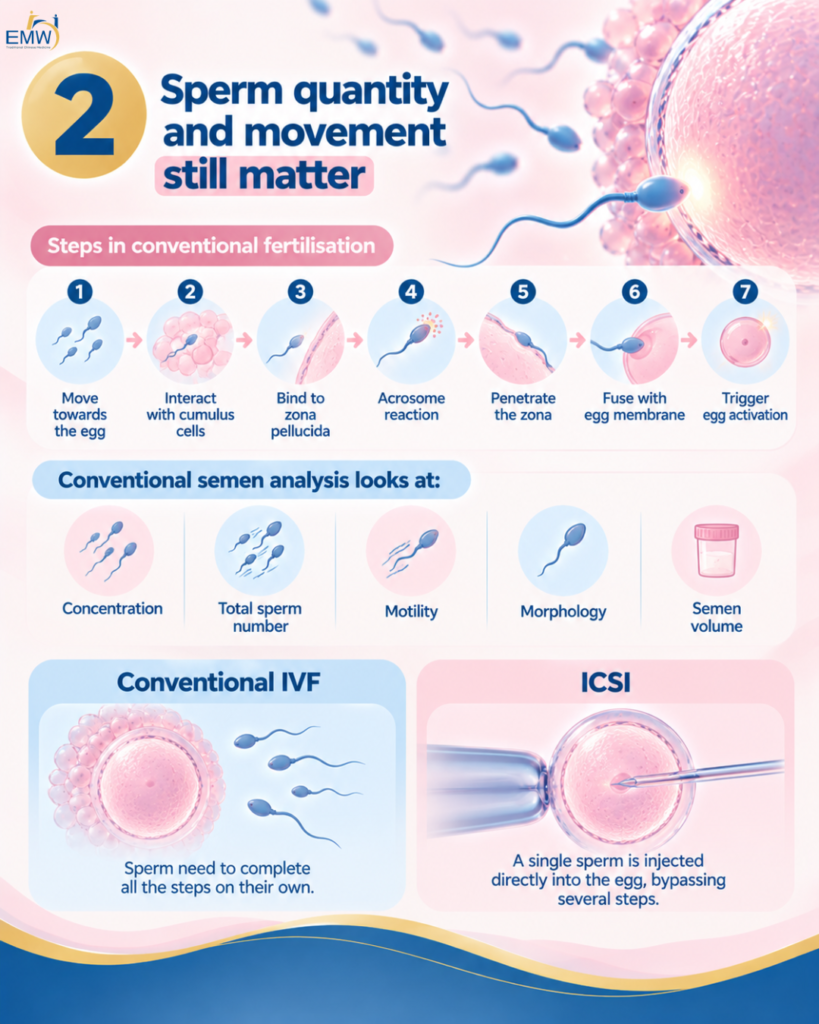
They need to:
- move towards the egg
- interact with the surrounding cumulus cells
- bind to the zona pellucida
- undergo the acrosome reaction
- penetrate the zona
- fuse with the egg membrane
- trigger egg activation
A conventional semen analysis assesses parameters such as:
- concentration
- total sperm number
- motility
- morphology
- semen volume
Significant abnormalities may make conventional fertilisation less likely.
This is one of the main reasons ICSI was developed.
With ICSI, an embryologist selects a sperm and injects it directly into the cytoplasm of a mature egg, bypassing several of the steps sperm normally need to complete independently.
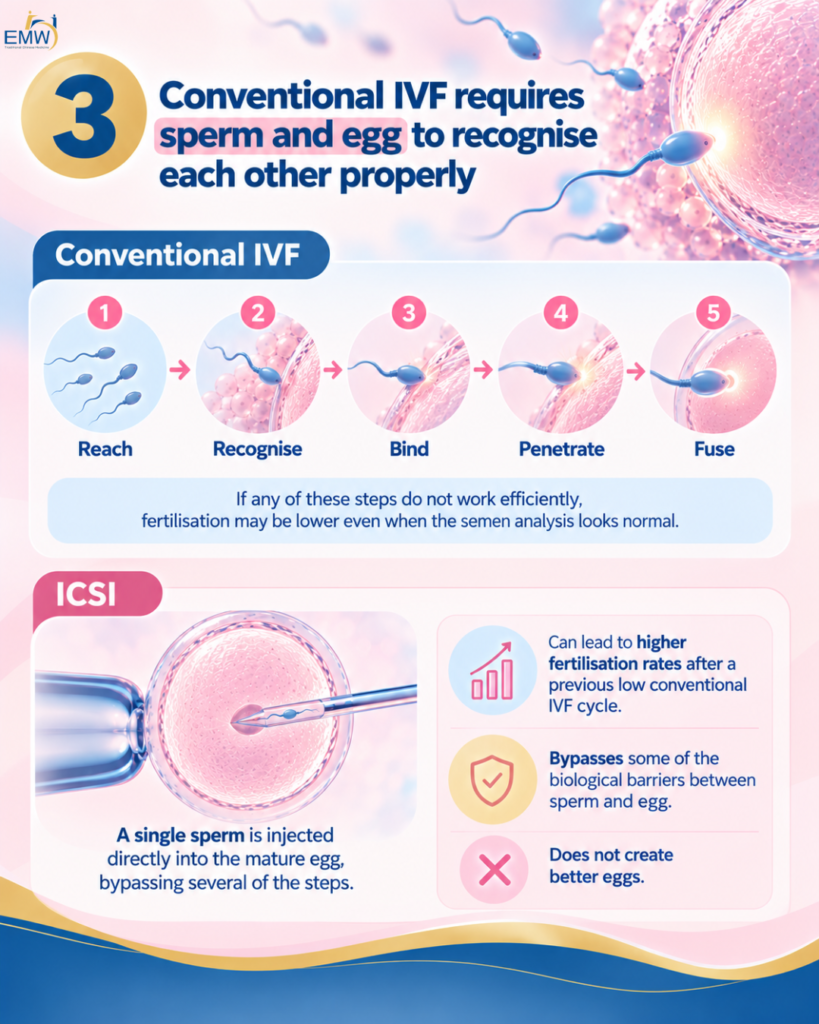
3. Conventional IVF requires sperm and egg to recognise each other properly
This is a particularly important distinction between conventional IVF and ICSI.
In conventional IVF, eggs and prepared sperm are placed together and fertilisation occurs through a process much closer to natural sperm-egg interaction.
The sperm still has to:
reach – recognise – bind – penetrate – fuse with the egg.
If one of these processes does not work efficiently, fertilisation may be unexpectedly low even when the semen analysis did not look severely abnormal.
By contrast, ICSI bypasses much of this process by physically injecting one sperm into a mature egg.
This helps explain why someone can have:
normal-looking semen analysis + unexpectedly low conventional IVF fertilisation
and then achieve better fertilisation with ICSI in a subsequent cycle.
4. Egg competence matters too
When fertilisation is unexpectedly low, conversations often move rapidly towards the male partner.
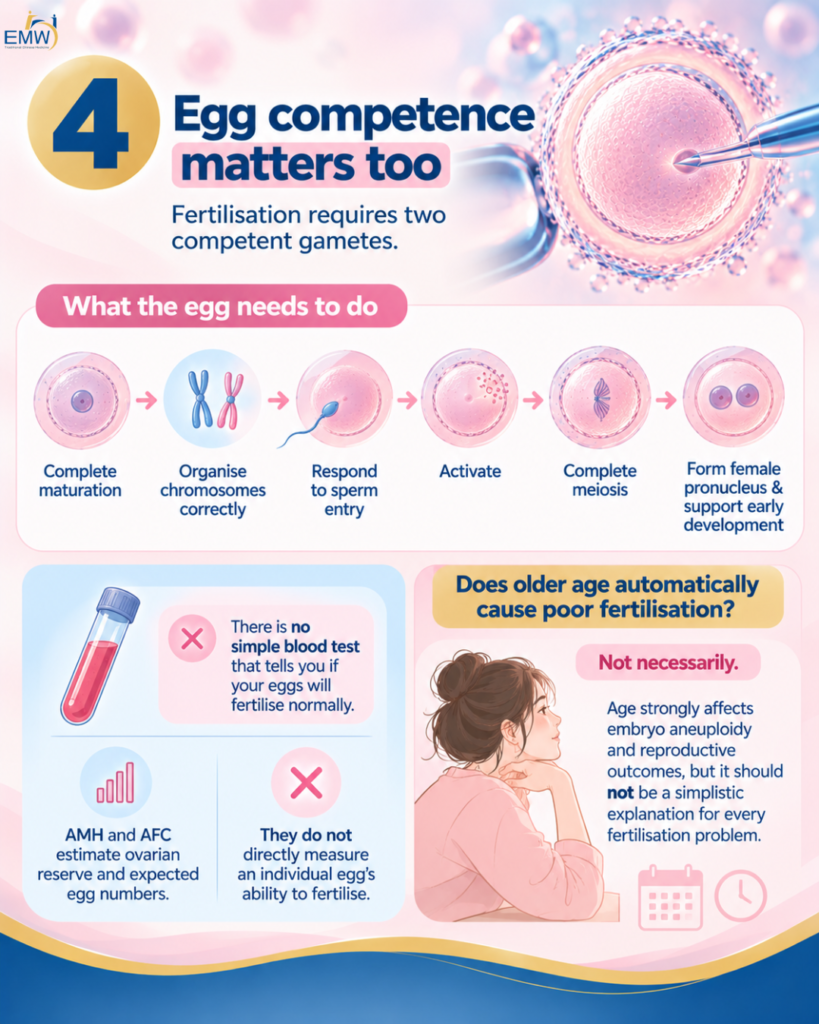
But fertilisation requires two competent gametes.
The egg needs to:
- complete appropriate maturation
- organise its chromosomes correctly
- respond to sperm entry
- activate
- complete meiosis
- form the female pronucleus
- support the first stages of embryonic development
An egg can be classified as mature and still not necessarily have ideal developmental competence.
Importantly, there is no simple blood test before IVF that tells you:
“These eggs will fertilise normally.”
AMH and AFC mainly estimate ovarian reserve and expected egg numbers.
They do not directly measure an individual egg’s ability to fertilise.
5. Sometimes the sperm enters, but the egg does not activate properly
This is where fertilisation gets more biologically interesting.
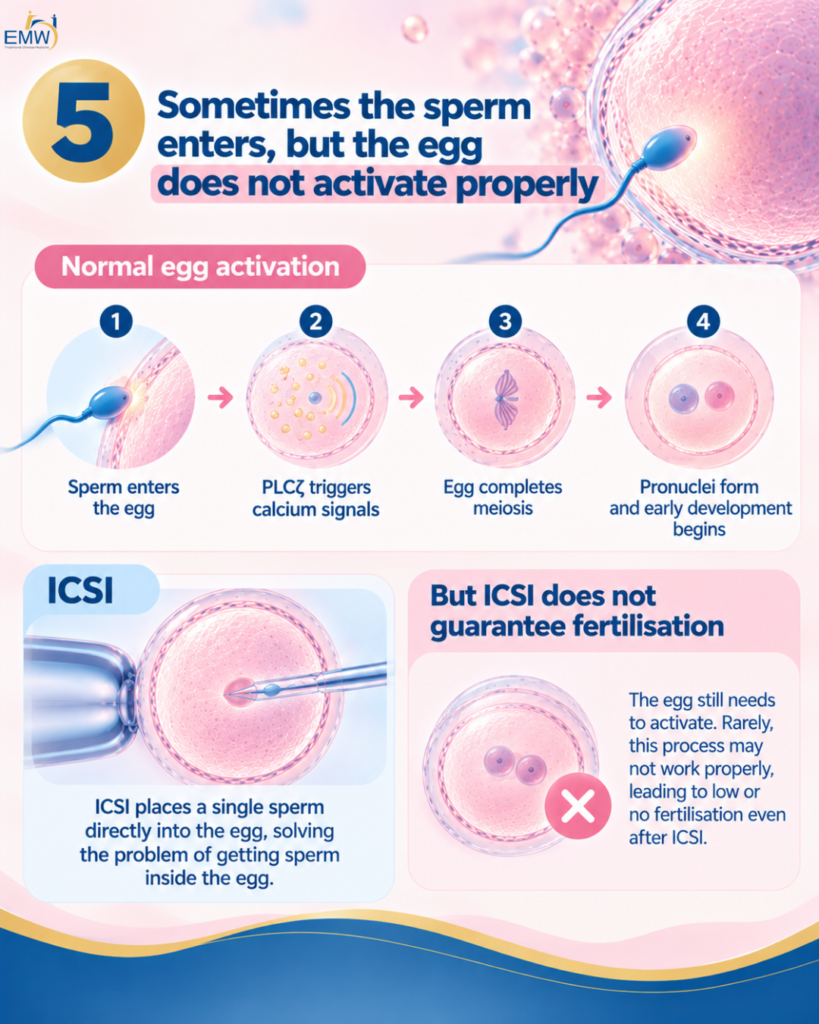
Getting sperm inside the egg is not the end of fertilisation.
The egg must also activate.
Normally, sperm introduces a factor called phospholipase C zeta, or PLCζ, which triggers calcium oscillations inside the egg.
These calcium signals tell the egg, in effect:
Fertilisation has happened. Start the next programme.
They help the egg:
- complete meiosis
- form pronuclei
- begin early embryonic development
Deficiency or abnormal function of PLCζ has been associated with some cases of low or total fertilisation failure, including after ICSI.
This explains an important point:
6. Rare egg-related genetic factors can cause recurrent fertilisation failure
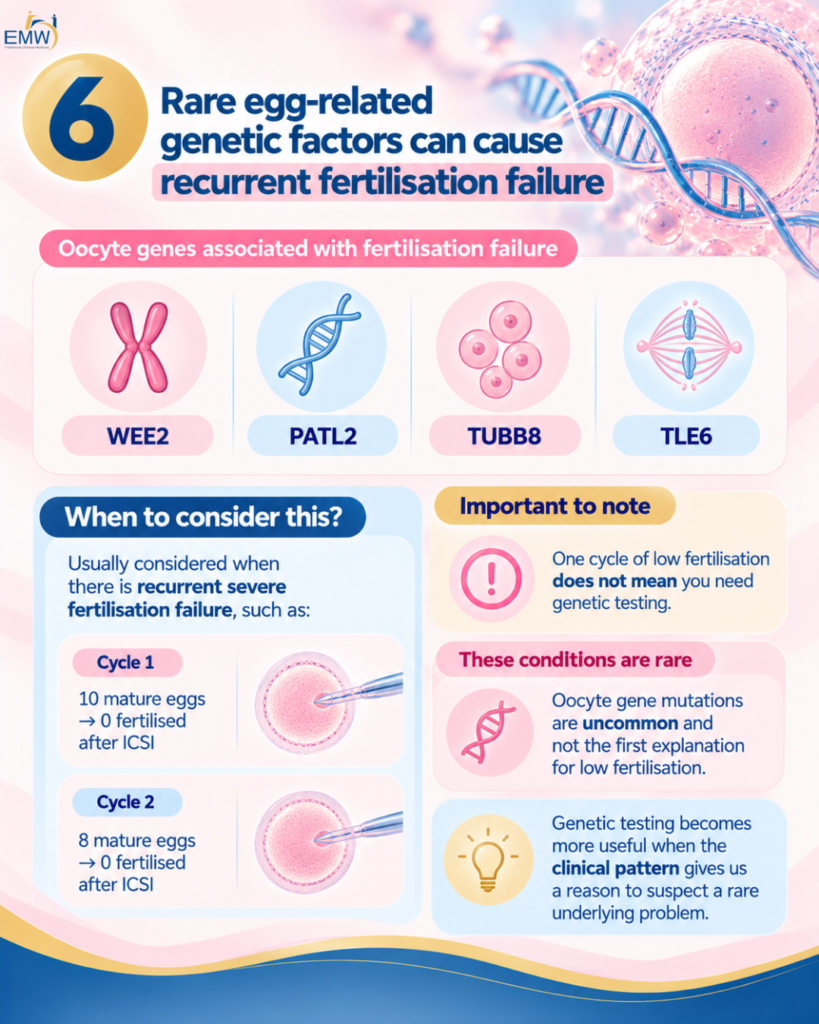
One cycle of unexpectedly poor fertilisation does not mean you need genetic testing.
That needs to be very clear.
But when the pattern is unusually severe and keeps repeating, there are rarer causes worth knowing about.
Research has identified variants in several oocyte-related genes associated with fertilisation or activation failure, including:
- WEE2
- PATL2
- TUBB8
- TLE6
A recent systematic review found that certain oocyte gene mutations are associated with markedly higher rates of total fertilisation failure.
These conditions are uncommon.
They are not the first explanation for:
“I had five mature eggs and only two fertilised.”
Rare testing becomes more useful when the clinical pattern gives us a reason to suspect a rare problem.
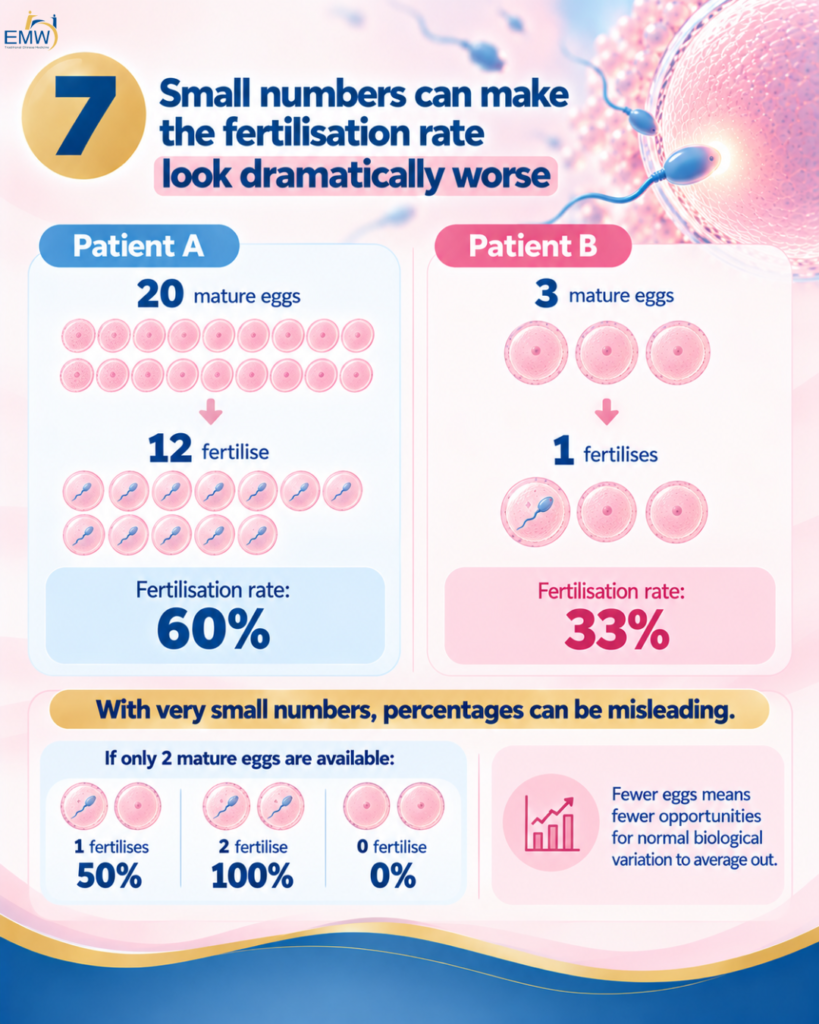
7. Small numbers can make the fertilisation rate look dramatically worse
The 2026 ASRM guidance notes that total fertilisation failure is related partly to the number of follicles, eggs retrieved and mature eggs available.
This matters particularly for women with:
- diminished ovarian reserve
- poor ovarian response
- very low egg yield
Fewer eggs means fewer opportunities for normal biological variation to average out.
A low fertilisation rate IVF result based on two mature eggs should therefore be interpreted differently from the same percentage after 15 mature eggs.
What is considered a “normal” IVF fertilisation rate?
Patients naturally want a benchmark.
There is no single fertilisation percentage that every clinic or every patient must achieve.
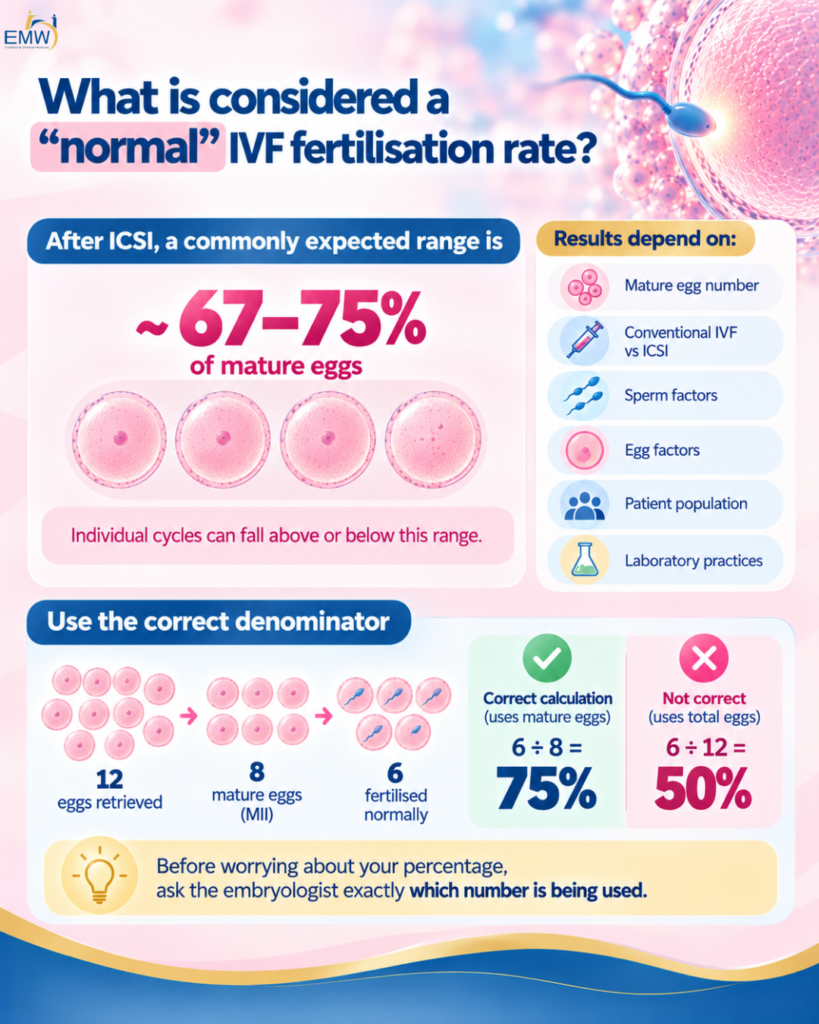
Results depend on:
- mature egg number
- conventional IVF versus ICSI
- sperm factors
- egg factors
- patient population
- laboratory practices
A commonly expected range after ICSI is roughly around two-thirds to three-quarters of mature eggs, although individual cycles can fall above or below that.
What does “normally fertilised” mean?
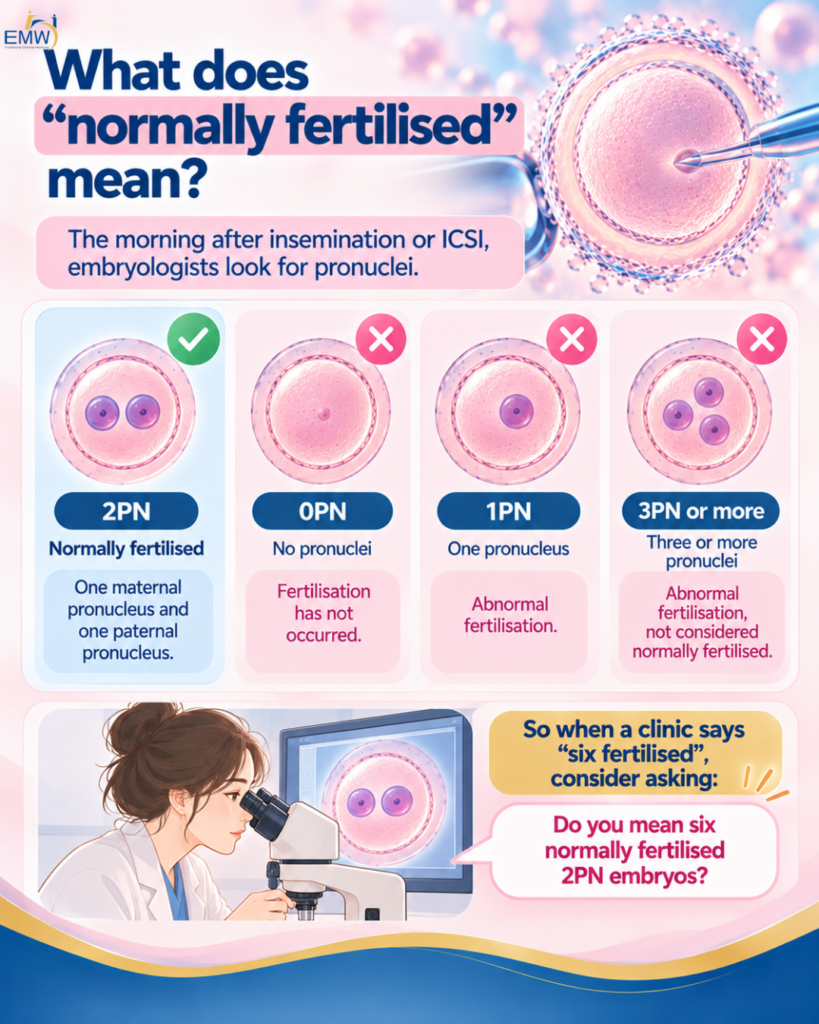
The morning after insemination or ICSI, embryologists typically look for pronuclei.
A normally fertilised egg generally shows:
2PN
meaning two pronuclei.
One contains maternal genetic material.
One contains paternal genetic material.
Abnormal findings can include:
- 0PN
- 1PN
- 3PN or more
A 3PN embryo may result from abnormal fertilisation and would generally not be considered normally fertilised.
Is fertilisation rate the same as blastocyst rate?
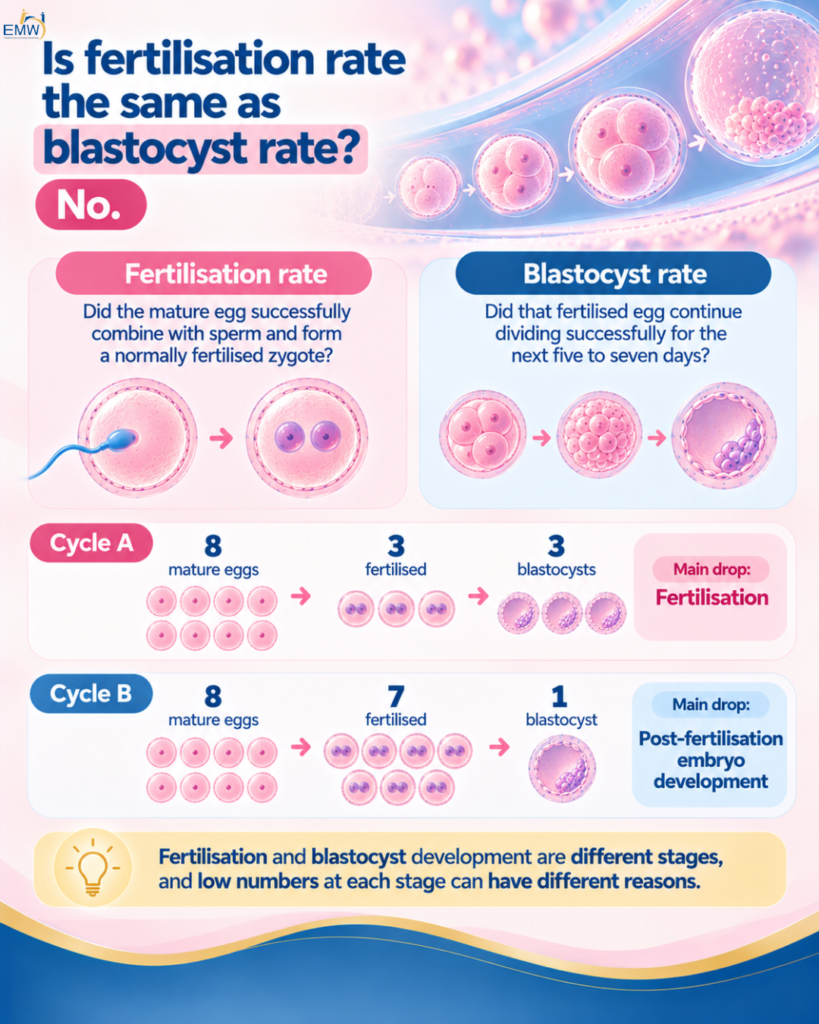
No.
For example:
Cycle A
8 mature
3 fertilised
3 blastocysts
Main drop:
fertilisation
Cycle B
8 mature
7 fertilised
1 blastocyst
Main drop:
post-fertilisation embryo development
The investigations and clinical discussion may therefore be very different.
Do not label both situations simply as:
“Poor embryo quality.”
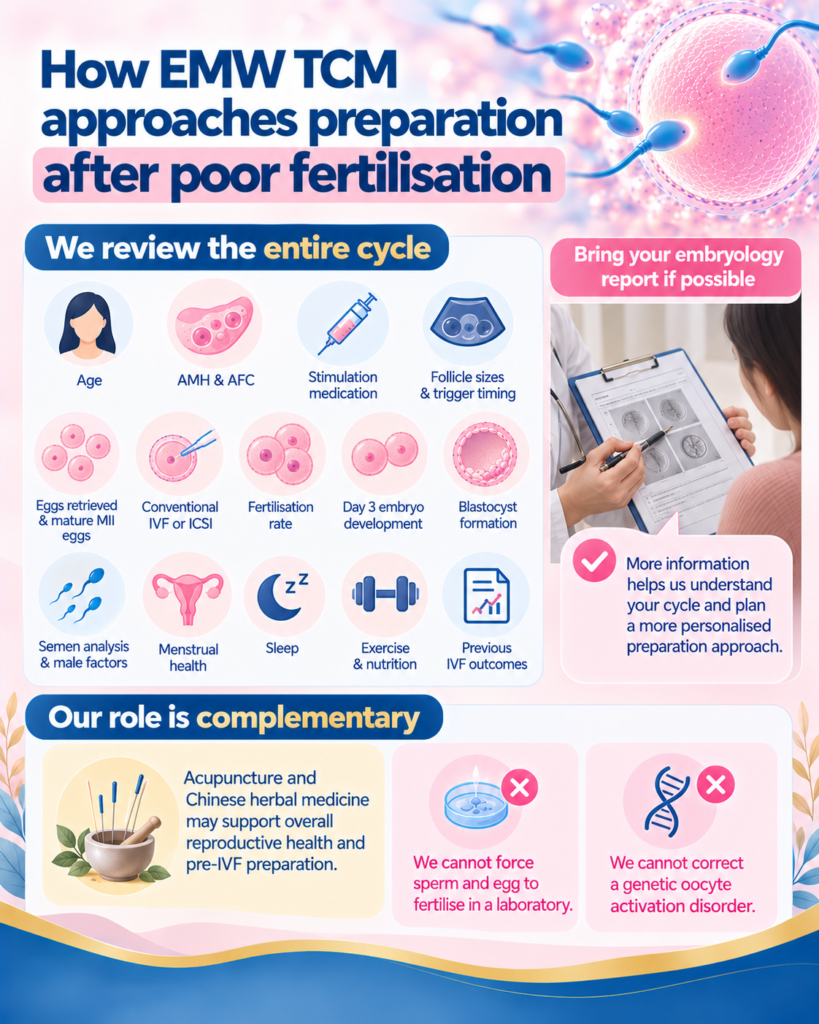
How EMW TCM approaches preparation after poor fertilisation
At EMW TCM, we do not look at low fertilisation rate IVF results and automatically conclude:
“Egg quality is poor.”
We review the entire cycle.
This may include:
- age
- AMH and AFC
- stimulation medication
- follicle sizes
- trigger timing
- eggs retrieved
- mature MII eggs
- conventional IVF or ICSI
- fertilisation rate
- Day 3 embryo development
- blastocyst formation
- semen analysis
- male lifestyle and medical factors
- menstrual health
- sleep
- exercise
- nutrition
- previous IVF outcomes
If possible, bring your embryology report rather than only the final number.
Our role remains complementary.
Acupuncture or Chinese herbal medicine cannot force sperm and egg to fertilise in a laboratory.
They also cannot correct a genetic oocyte activation disorder.
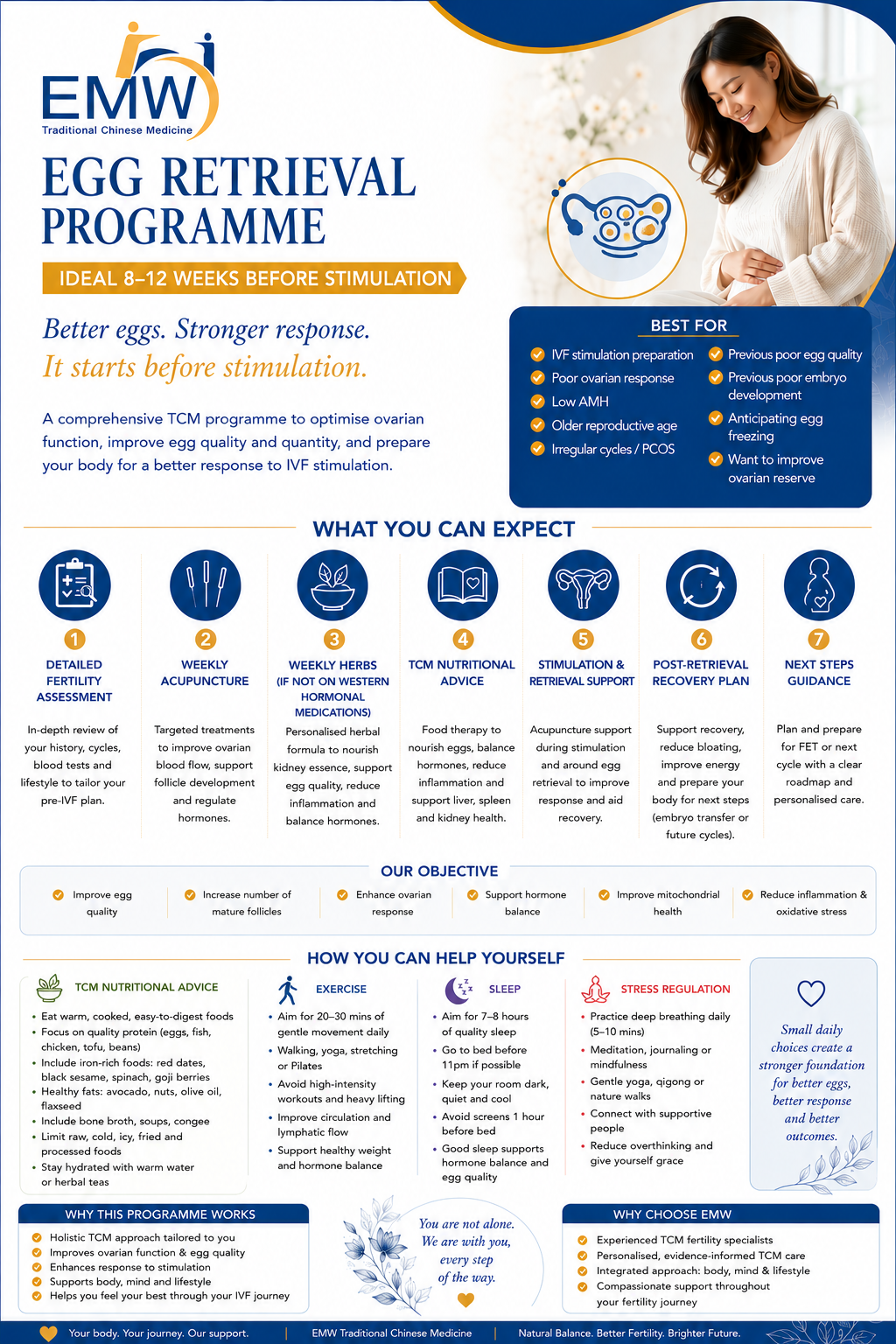
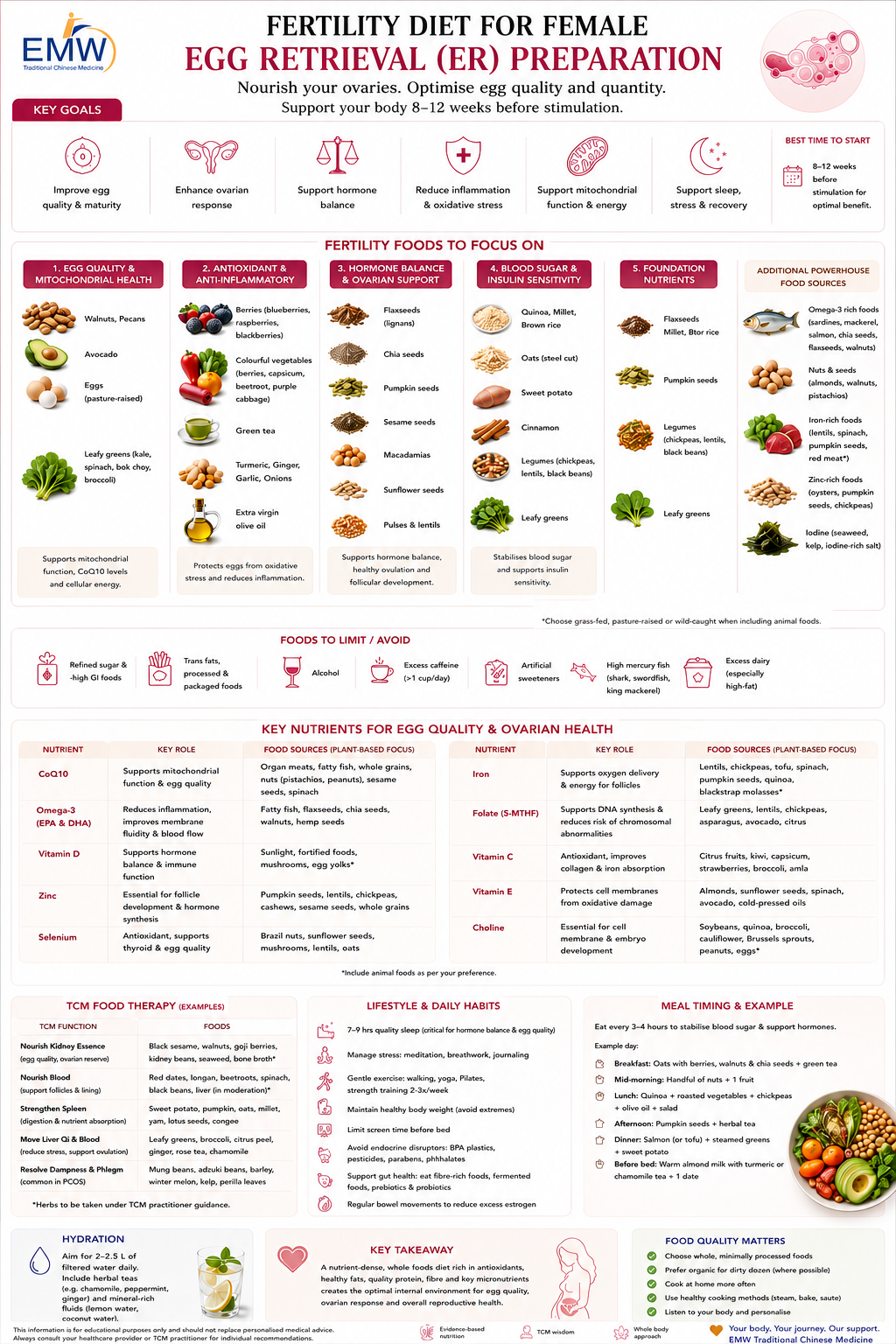
Where patients have time before another egg retrieval, TCM may instead form part of a broader pre-IVF preparation period while the fertility specialist reviews the previous stimulation, sperm factors and fertilisation method.
EMW IVF Master Guide
Press the image to zoom in. If you like such infographics, we have a ‘3 ways to superboost your fertility’ PDF guide – Actionable steps that can help to support your reproductive health right away. You can sign up for free here: https://emwtcm.podia.com/3-ways-to-boost-your-fertility
Frequently Asked Questions
Is 50% IVF fertilisation bad?
It depends on the denominator and circumstances.
If 10 eggs were retrieved but only six were mature and three fertilised, the mature-oocyte fertilisation rate is 50%.
If only two mature eggs were available and one fertilised, the same percentage is much less informative because the starting number is tiny.
Your clinic should interpret the result in context.
Why did only some of my mature eggs fertilise?
Even mature eggs and apparently normal sperm do not fertilise 100% of the time.
Possible factors include sperm-oocyte interaction, egg competence, sperm function and normal biological variation.
Does poor fertilisation mean poor egg quality?
Not necessarily.
Egg factors can contribute, but sperm factors and the fertilisation process itself may also be relevant.
You cannot identify the cause simply from the fertilisation percentage.
Will ICSI fix low fertilisation?
ICSI may substantially reduce the risk of repeat poor fertilisation after a previous conventional IVF cycle with unexpectedly low or failed fertilisation.
It cannot guarantee fertilisation because the egg still needs to activate normally after injection.
Why can fertilisation fail even with ICSI?
ICSI places sperm directly inside the egg, but successful fertilisation still requires activation of the oocyte and formation of normal pronuclei.
Rare sperm or egg activation defects may prevent this.
Should everyone use ICSI to avoid fertilisation failure?
No.
The latest ASRM guidance does not recommend routine ICSI for all IVF patients without male factor or previous fertilisation failure, because routine ICSI has not demonstrated improved live birth.
Does low AMH cause poor fertilisation?
Not directly.
Low AMH mainly predicts a lower ovarian response and potentially fewer eggs.
ASRM’s 2026 review specifically notes that using ICSI solely because of diminished ovarian reserve has not improved fertilisation or live birth outcomes.
Can fertilisation be different in another IVF cycle?
Yes.
A subsequent cycle may involve a different number and cohort of eggs, a different sperm sample or a different fertilisation strategy.
However, repeated similar fertilisation failure deserves increasingly detailed review.
The fertilisation percentage is only useful when you know what happened before it
Hearing:
“Only 30% fertilised”
can sound devastating.
But before drawing conclusions, reconstruct the cycle.
How many eggs were retrieved?
Then:
How many were mature?
Then:
How many were normally fertilised?
Then:
What happened to the resulting embryos?
For couples experiencing low fertilisation rate IVF, those four numbers tell a much more useful story than the final percentage alone.
Sometimes the problem began with egg maturity.
Sometimes sperm and egg did not interact effectively during conventional IVF.
Sometimes ICSI may be reasonable in the next cycle.
Sometimes fertilisation remains poor even after ICSI and a more specialised review is appropriate.
And sometimes the starting number was simply so small that one egg dramatically changed the percentage.
Do not immediately add every fertility test available.
Start by identifying exactly where the bottleneck occurred.
That is what should guide the next step.
Preparing for another egg retrieval?
We publish evidence-informed guides on egg retrieval, embryo development, fertilisation, male fertility, FET and IVF preparation.
👉 Read more on the EMW TCM Blog:
If you have time before your next IVF cycle, our Fertility Optimisation Bundle provides structured fertility nutrition, lifestyle guidance and TCM perspectives for both partners.
👉 Access the Fertility Optimisation Bundle:
https://emwtcm.podia.com/fertility-optimsation-bundle
This article is educational and does not replace advice from your fertility specialist or embryologist. Always follow your IVF clinic’s recommendations regarding stimulation, trigger timing, fertilisation method, ICSI and embryo culture.
When to Seek Professional TCM Fertility Help
Fertility is not just a matter of age or hormones. It is a reflection of the body’s internal harmony. Traditional Chinese Medicine provides an integrative and natural way to restore this balance, supporting both physical and emotional readiness for conception.
At EMW TCM Singapore, our team of experienced physicians brings together centuries-old wisdom and modern evidence to guide your fertility journey. Whether you are trying naturally or preparing for IVF, we are here to help you create the best internal environment for new life to begin.
If you have been trying to conceive for more than six to twelve months, experience irregular menses, painful periods, or have been diagnosed with PCOS, endometriosis, or low sperm count, consider a consultation. Professional TCM fertility care aims to correct the underlying imbalance rather than simply forcing ovulation or hormone production.
Check out our links below to book your fertility consultation and begin your holistic journey toward conception.
EMW TCM Clinics
International Building Branch
360 Orchard Road, International Building #02-05/06
Singapore 238869
Book Your Appointment With Us Here: +65 89585869
Our Physicians

Principal TCM Physician
- M.Med(TCM Gynaecology)
- B.Sc(Hons) Biomedical Sciences
- Dip. Naturopath
- Ayurvedic Therapist(500hrs)
- Registered TCM Physician (Singapore MOH)

Senior TCM Physician
- M.Med(TCM Acupuncture & Moxibustion)
- B.Sc(Hons) Biomedical Sciences
- Certified Aromatherapist
- Registered TCM Physician (Singapore MOH)

TCM Physician
- M.Med(TCM Gynaecology)
- B.Sc(Hons) Biomedical Sciences
- Registered TCM Physician (Singapore MOH)

TCM Physician
- M.Med(TCM Acupuncture & Moxibustion)
- B.Sc(Hons) Biomedical Sciences
- Registered TCM Physician (Singapore MOH)

TCM Physician
- B.Med(TCM)
- B.Sc(Hons) Biomedical Sciences
- International Board-Certified Lactation Consultant (IBCLC)
- Registered TCM Physician (Singapore MOH)
References
- American Society for Reproductive Medicine. Intracytoplasmic Sperm Injection for Nonmale Factor Indications: A Committee Opinion. 2026.
- National University Hospital Singapore. Infertility: IVF, Egg Maturity and Embryo Development.
- KK Women’s and Children’s Hospital. In-Vitro Fertilisation and Intra-Cytoplasmic Sperm Injection.
- KK Women’s and Children’s Hospital. IVF/ICSI Patient Information: Poor or No Fertilisation.
- Cardona Barberán A, et al. Total fertilization failure after ICSI: insights into pathophysiology, diagnosis, and management through artificial oocyte activation. 2023.
- Kashir J, et al. Phospholipase C Zeta in Human Spermatozoa: A Systematic Review on Current Development and Clinical Application. 2024.
- Oocyte gene mutations increase rates of total fertilization failure: a systematic review and meta-analysis. 2026.
- Clinical Applications of Assisted Oocyte Activation in Couples with Various Reproductive Problems: A Systematic Review. 2024.
- Cochrane Collaboration. Oocyte activation for women following intracytoplasmic sperm injection. 2024.