
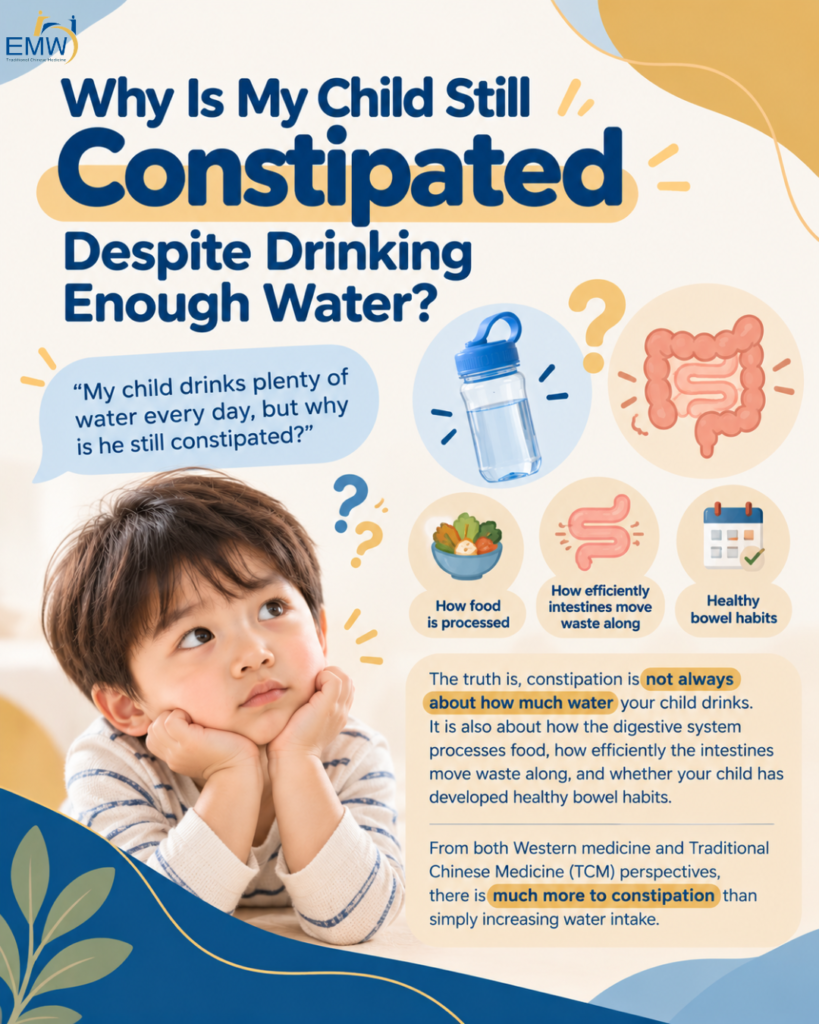
Why Is My Child Still Constipated Despite Drinking Enough Water?
“My child drinks plenty of water every day, but why is he still constipated?”
This is something I hear quite often from parents at EMW TCM.
Many parents associate constipation with not drinking enough water. Naturally, when their child struggles to pass motion, their first instinct is to encourage more water intake.
But what if your child is already drinking enough water and still struggles to pass stools? What if bowel movements happen every day, but the stools are hard, painful or difficult to pass?
The truth is, constipation is not always about how much water your child drinks. It is also about how the digestive system processes food, how efficiently the intestines move waste along, and whether your child has developed healthy bowel habits.
From both Western medicine and Traditional Chinese Medicine (TCM) perspectives, there is much more to constipation than simply increasing water intake.

1. What Is Constipation in Children?
Constipation is commonly understood as having infrequent bowel movements. However, the frequency of passing stools is only one part of the picture.
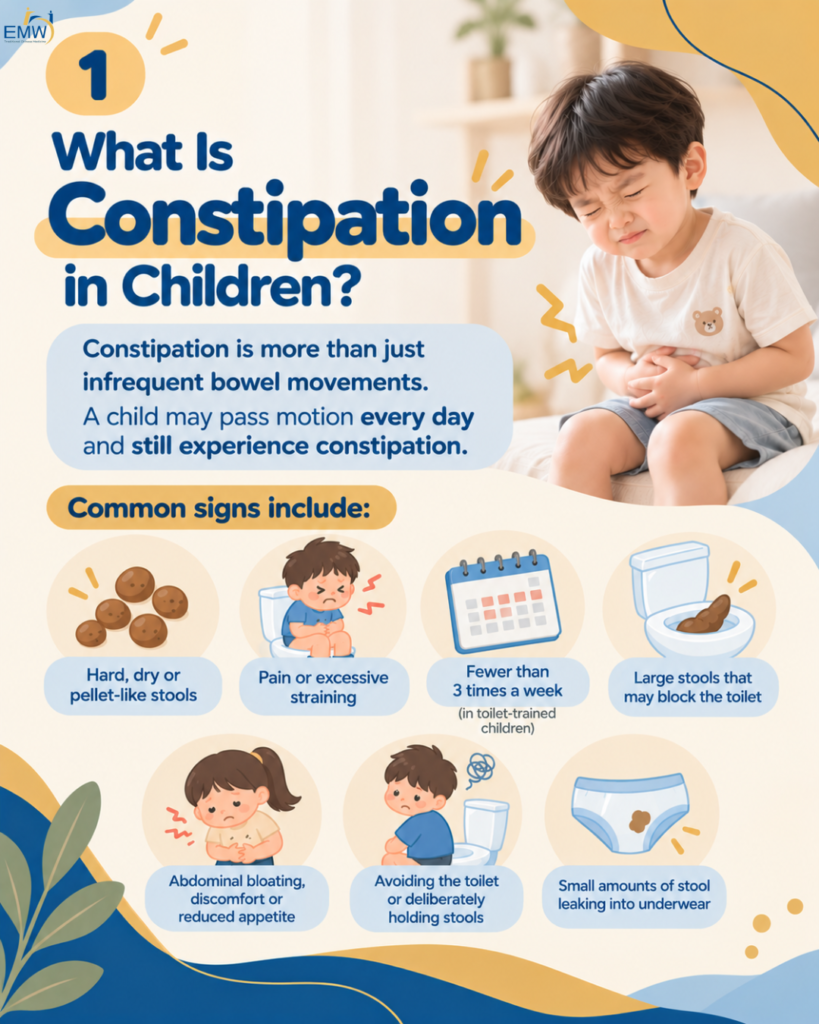
A child may pass motion every day and still experience constipation.
Some common signs include:
- Hard, dry or pellet-like stools
- Pain or excessive straining during bowel movements
- Passing stools fewer than three times a week, particularly in toilet-trained children
- Large stools that may occasionally block the toilet
- Abdominal bloating, discomfort or reduced appetite
- Avoiding the toilet or deliberately holding stools
- Small amounts of stool leaking into underwear due to stool accumulation
In older children, the Bristol Stool Chart is a useful reference for understanding stool consistency.
Types 1–2 suggest constipation. Types 3–4 are generally considered healthy stool consistency, while types 5–7 indicate progressively looser stools. This chart is more suitable for toilet-trained children than infants.
For most toilet-trained children, we generally want stools that are soft, formed and easy to pass without discomfort.
For infants, bowel movement patterns can vary considerably depending on their age and whether they are breastfed or formula-fed. Infrequent soft stools alone do not necessarily mean constipation.
2. Biologically, How Does a Healthy Bowel Movement Happen?
To understand constipation, we first need to understand how our digestive system works.
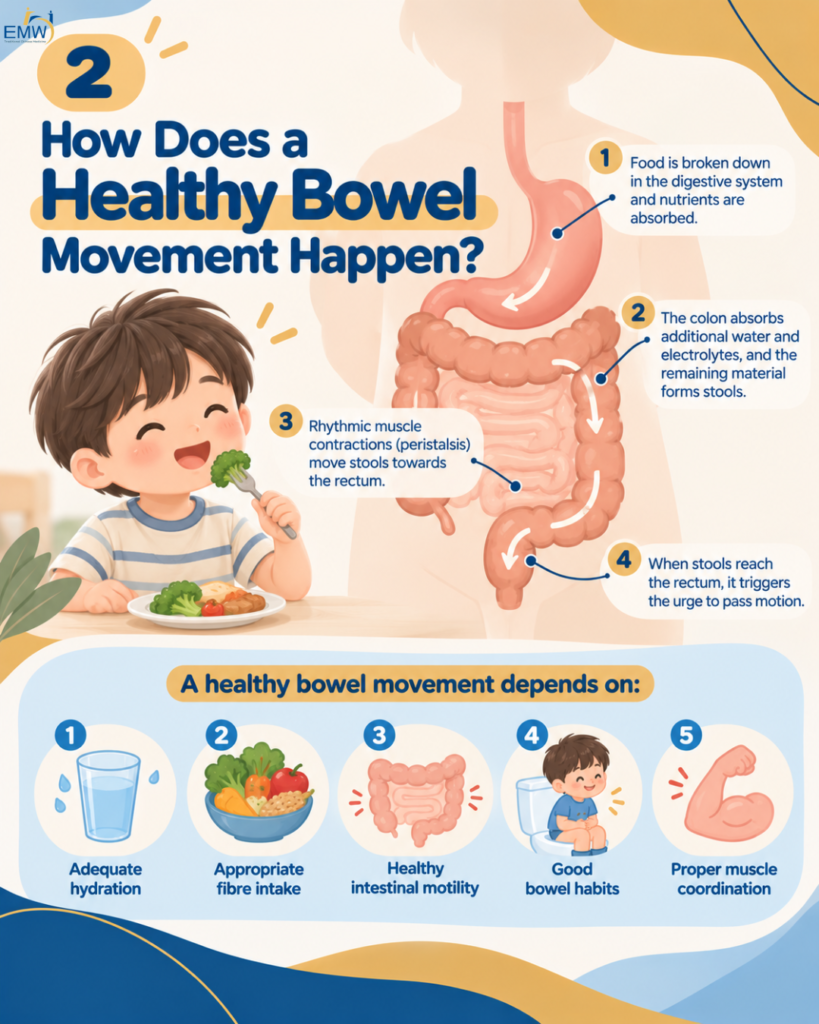
When your child eats, food travels through the digestive system, where nutrients are broken down and absorbed.
By the time the remaining waste reaches the large intestine, most nutrients have already been absorbed. The colon then absorbs additional water and electrolytes, while the remaining material gradually forms stools.
The intestines also perform rhythmic muscular contractions, known as peristalsis, to move stools towards the rectum.
When stools reach the rectum, stretching of the rectal wall triggers the sensation of needing to pass motion. The pelvic floor and anal sphincter muscles then need to relax appropriately for stools to pass comfortably.
A healthy bowel movement therefore depends on several factors working together:
- Adequate hydration: Helps maintain normal stool moisture.
- Appropriate fibre intake: Supports stool bulk and consistency.
- Healthy intestinal motility: Moves stools through the digestive tract.
- Good bowel habits: Allows the body to respond naturally to the urge to defecate.
- Proper muscle coordination: Helps stools pass without excessive straining.
This explains why drinking enough water alone may not resolve constipation.
What happens when your child holds back stools?
Imagine your child is busy playing and suddenly feels the urge to pass motion.
Instead of going to the toilet, your child ignores the sensation because they do not want to stop playing.
The stools remain in the rectum and colon for longer, allowing more water to be absorbed. As a result, the stools become progressively harder and more difficult to pass.
Eventually, passing motion becomes uncomfortable or painful.
Your child may then deliberately avoid going to the toilet because they associate bowel movements with pain.
The constipation cycle
Child ignores the urge to pass motion
Stools stay longer in the colon and rectum
Stools become harder and drier
Painful bowel movements lead to further withholding
The cycle continues unless the stools are softened and withholding is addressed.
Over time, persistent stool retention can stretch the rectum and reduce the child’s awareness of the urge to pass motion.
This is why I often remind parents that responding to nature’s call is just as important as drinking water.
3. Why Is My Child Still Constipated Despite Drinking Enough Water?
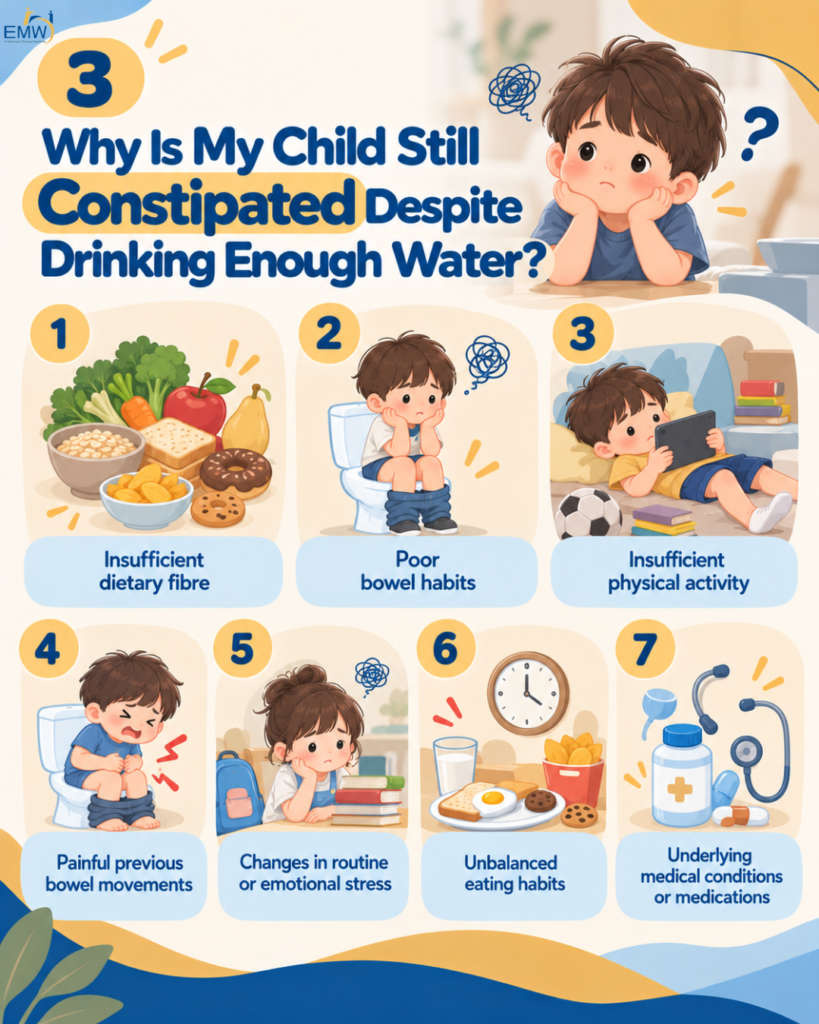
There are several possible reasons.
Insufficient dietary fibre
Water helps with hydration, but fibre contributes to stool bulk and consistency. Children who consume mainly refined carbohydrates, processed snacks and limited vegetables or fruits may not be getting enough fibre.
Poor bowel habits
Children may avoid using school toilets, delay bowel movements while playing or feel uncomfortable using unfamiliar bathrooms. Repeated withholding can contribute to constipation.
Insufficient physical activity
Physical movement supports normal intestinal activity. Children who spend prolonged periods sitting or engaging in screen-based activities may have fewer opportunities for active movement.
Painful previous bowel movements
A child who previously experienced painful defecation may intentionally withhold stools, even when their diet and hydration are adequate.
Changes in routine or emotional stress
Starting school, travelling, toilet training or experiencing changes in family routines can influence bowel habits.
Unbalanced Eating Habits
Beyond fibre intake, irregular mealtimes, frequent snacking and skipping meals may affect bowel routines. Eating stimulates the gastrocolic reflex, which encourages movement in the colon. Children who regularly skip breakfast or eat at inconsistent times may miss opportunities to establish regular toilet habits.
Underlying Medical Conditions or Medications
Occasionally, constipation may be associated with certain medications, iron supplements or underlying medical conditions such as hypothyroidism or coeliac disease. Children with persistent constipation despite appropriate dietary and lifestyle changes should be assessed by a doctor to identify possible contributing factors.
4. Understanding Children’s Constipation From a TCM Perspective
In TCM, constipation is known as 便秘 (Bian Mi).
TCM views bowel movements as a process involving the transportation and transformation of food, movement of Qi, and appropriate moistening of the intestines.
The Spleen and Stomach are traditionally associated with digestion and nutrient transformation, while the Large Intestine is responsible for transporting and eliminating waste.
The Liver’s role in maintaining the smooth movement of Qi may also be considered, particularly when emotional changes and stress affect digestive patterns.
Rather than treating all constipation as the same condition, TCM practitioners differentiate patterns based on the child’s stool consistency, abdominal symptoms, appetite, tongue and overall constitution.
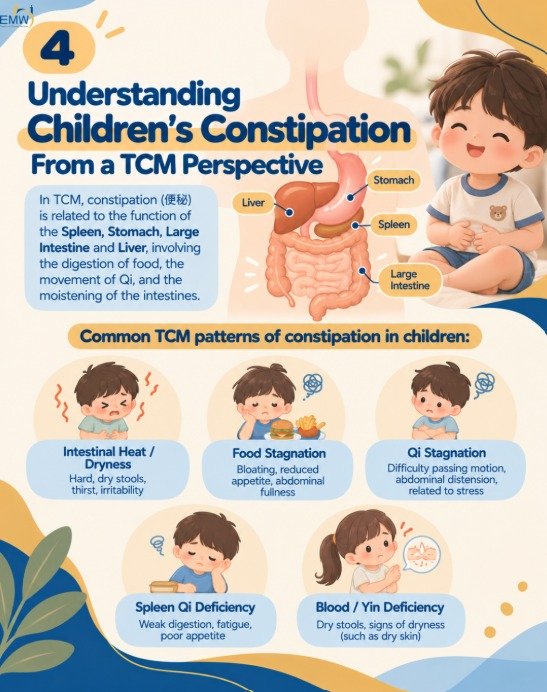
Common TCM patterns of constipation in children
| TCM pattern | Common presentation |
|---|---|
| Intestinal Heat / Dryness (肠胃积热) | Hard, dry stools, thirst, possible bad breath, irritability and abdominal fullness |
| Food Stagnation (食积内停) | Bloating, reduced appetite, abdominal fullness, foul-smelling stools or breath |
| Qi Stagnation (气机郁滞) | Difficulty passing motion, abdominal distension, symptoms that may fluctuate with stress or routine changes |
| Spleen Qi Deficiency (脾气虚弱) | Weak digestive function, fatigue, poor appetite, difficulty passing stools despite stools not always being very hard |
| Blood / Yin Deficiency (血虚或阴虚肠燥) | Dry stools with insufficient intestinal moistening, sometimes accompanied by dry skin or other signs of dryness |
These are traditional pattern descriptions rather than medically established causes of constipation. A child may present with overlapping patterns, and a TCM assessment should complement, not replace, appropriate medical evaluation.
For example, two children may both experience hard stools, but one may have significant bloating and poor appetite, while another may be withholding stools because of previous painful experiences.
Their management should not necessarily be identical.
At EMW TCM, we believe that understanding the child’s digestive pattern and daily habits is important when developing a personalised treatment approach.
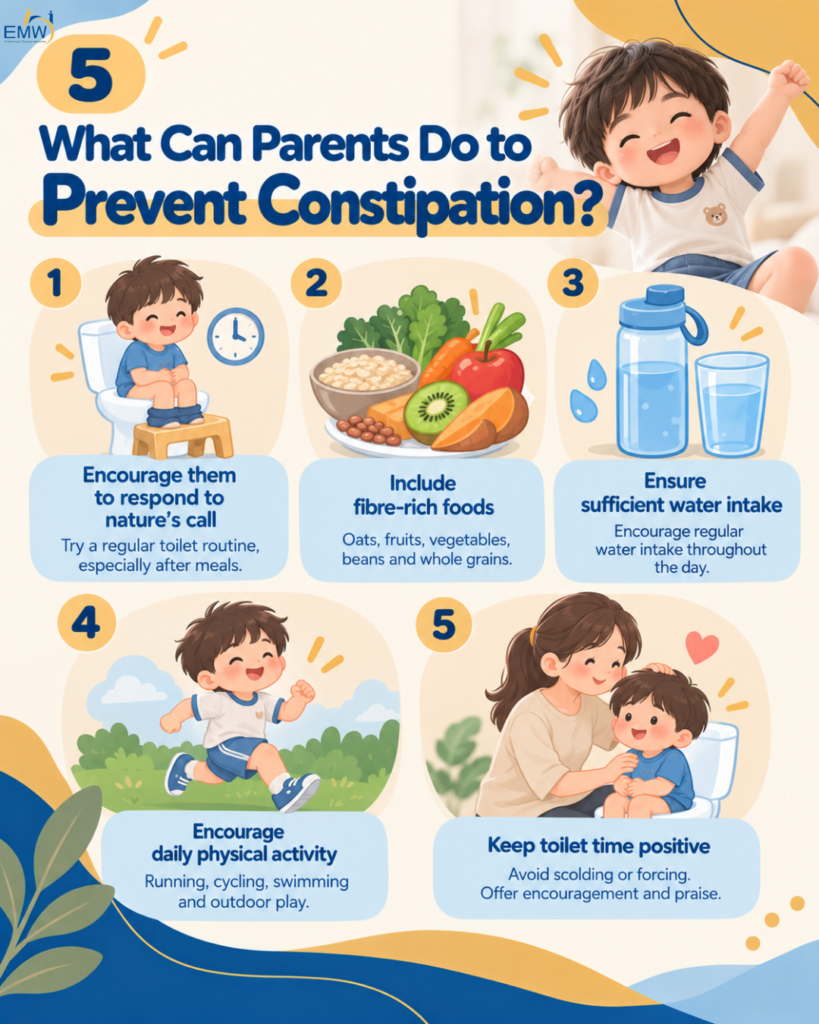
Encourage daily physical activity
Running, walking, cycling, swimming and outdoor play all provide opportunities for children to stay active.
Physical activity supports general health and may help encourage normal bowel function.
It also provides a useful break from prolonged sitting and screen time.
Avoid turning toilet time into a stressful experience
For children who are already afraid of passing motion, reassurance and patience are particularly important.
Avoid scolding, rushing or forcing them to sit on the toilet for prolonged periods.
Instead, praise them for trying, even when they do not successfully pass stools.
If stools are already hard and painful, dietary changes alone may not be enough. A doctor may recommend a stool-softening treatment to break the withholding cycle.
5. What Can Parents Do to Prevent Constipation?
In many cases, simple and consistent daily habits can make a meaningful difference.
Encourage children to respond to nature’s call
Children should be encouraged to use the toilet when they feel the urge, rather than delaying bowel movements.
A practical tip is to establish a regular toilet routine, especially after meals.
The gastrocolic reflex is a natural response in which eating stimulates movement in the colon. This makes the period after breakfast or dinner a useful time to encourage bowel movements.
Try allowing your child to sit comfortably on the toilet for approximately five minutes after meals, without forcing or pressuring them to pass motion.
For smaller children, use a footstool so their feet are supported and their knees are slightly higher than their hips.
Include fibre-rich foods in everyday meals
Fibre helps support regular bowel movements by contributing to stool bulk and influencing stool consistency.
Some family-friendly choices include oats, sweet potatoes, pears, kiwi, papaya, prunes, cooked vegetables, beans and whole grains.
Increase fibre gradually, especially for children who experience significant bloating. A sudden increase may cause gas and abdominal discomfort.
For younger children, prepare foods in age-appropriate textures to reduce choking risks.
Ensure sufficient water intake
Water remains essential, even though it is not the only factor affecting constipation.
Encourage children to drink regularly throughout the day, particularly during hot weather and after physical activities.
Water requirements vary according to age, body size, activity level and dietary intake. Milk, soups, fruits and other foods also contribute to total fluid intake.
However, forcing excessive amounts of water is unlikely to resolve constipation if your child is already adequately hydrated.
6. How Does EMW TCM Support Children’s Constipation?
At EMW TCM, our approach to children’s gut health focuses on understanding their digestive constitution, bowel habits, diet and overall wellbeing.
We combine traditional paediatric TCM techniques with practical lifestyle guidance to support children experiencing digestive discomfort.
Our signature paediatric gut health approach may incorporate paediatric Tuina, gentle essential oil massage and personalised herbal stickers, depending on the child’s age, symptoms and suitability.
Paediatric Tuina (小儿推拿)
Paediatric Tuina is a specialised form of TCM massage that uses gentle, rhythmic movements over selected areas of the body.
For constipation, we may incorporate techniques such as:
- 摩腹 (Mo Fu): Gentle abdominal massage traditionally used to regulate digestive function.
- 分推腹阴阳 (Fen Tui Fu Yin Yang): A paediatric Tuina technique traditionally used to regulate abdominal Qi and digestive function.
- 推下七节骨 (Tui Xia Qi Jie Gu): A traditional paediatric technique commonly selected for constipation patterns.
The techniques and duration are adjusted according to the child’s age, comfort level and TCM presentation.
Gentle abdominal massage may provide comfort and relaxation, although research on paediatric Tuina for constipation remains limited. It should not be regarded as a replacement for established constipation treatment.
Gentle massage with essential oils
At EMW TCM, we may incorporate appropriately diluted essential oils into gentle massage as part of our paediatric gut health sessions.
From a TCM perspective, massage is traditionally intended to promote the smooth movement of Qi and support digestive comfort.
The soothing nature of touch may also help children relax, particularly those who experience tension or discomfort around bowel movements.
Essential oils themselves have not been proven to treat paediatric constipation. They must be selected carefully for the child’s age and health status, used at suitable dilutions and avoided when there are allergies or skin sensitivities. They should never be ingested.
Supporting long-term digestive health
Beyond treatment sessions, we place emphasis on educating parents about their child’s bowel habits, food choices, physical activity and daily routines.
Our goal is not simply to focus on one bowel movement, but to help families develop healthier, more comfortable digestive habits over time.
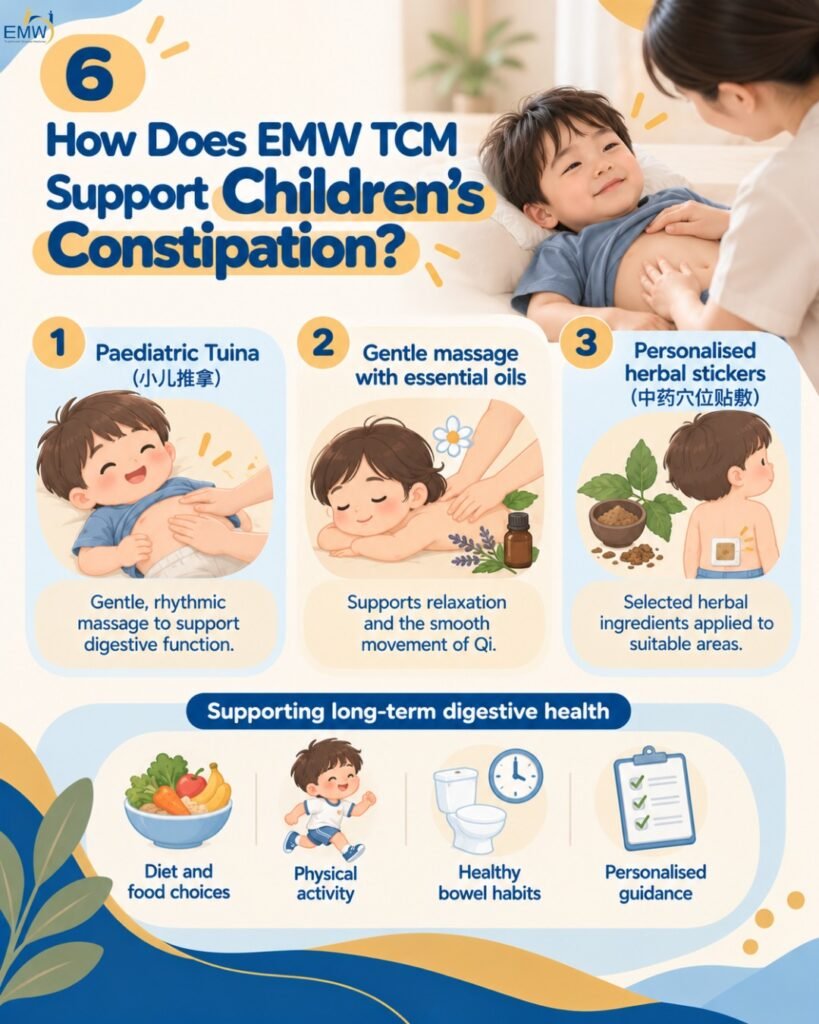
Personalised herbal stickers (中药穴位贴敷)

Our personalised herbal stickers are another component of our paediatric gut health approach.
These stickers are prepared using selected herbal powders and are applied externally to suitable areas, such as around the navel or mid-back, depending on the physician’s assessment.
In traditional TCM practice, herbal applications are used with the intention of supporting digestive balance and regulating the movement of Qi.
At EMW TCM, the herbal ingredients are selected according to the child’s constitution and digestive presentation rather than using one standard formula for every child.
It is important to recognise that clinical evidence for herbal stickers in treating childhood constipation is currently insufficient. They are offered as a complementary modality, not as a proven method of restoring bowel motility or replacing medical treatment.
As children’s skin can be sensitive, suitability, ingredient safety, application duration and the risk of irritation must be considered. Herbal stickers should not be applied to broken or inflamed skin.
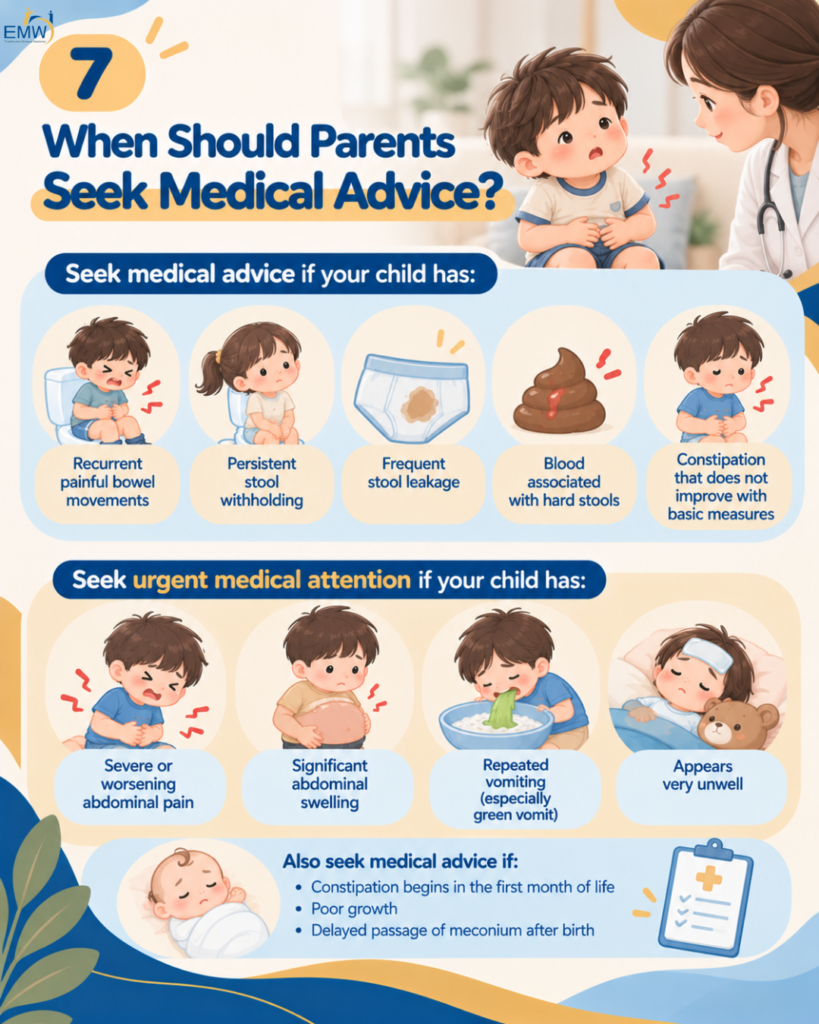
7. When Should Parents Seek Medical Advice?
While constipation is common in children, persistent or severe symptoms should not be ignored.
Arrange a medical review if your child has recurrent painful bowel movements, persistent stool withholding, frequent stool leakage, blood associated with hard stools or constipation that does not improve with basic measures.
Seek urgent medical attention for severe or worsening abdominal pain, significant abdominal swelling, repeated vomiting (especially green vomit), or a child who appears very unwell.
Constipation beginning in the first month of life, poor growth or delayed passage of meconium after birth also warrants medical assessment.
For children with established faecal impaction or significant stool retention, appropriate medical treatment is important. Massage and dietary changes alone may not be sufficient.
Final Thoughts: Sometimes Water Is Not the Missing Piece
As a TCM physician, I often encourage parents to look beyond the amount of water their child drinks.
A healthy bowel movement depends on how the digestive system functions as a whole, including intestinal movement, stool consistency, dietary fibre and regular toilet habits.
Sometimes, the most helpful change is not another glass of water, but encouraging your child to respond to nature’s call, creating a comfortable toilet routine or addressing the fear associated with painful bowel movements.
At EMW TCM, we take a personalised approach to children’s digestive health by combining paediatric TCM care with practical guidance for parents.
Because supporting good gut health starts with understanding your child’s everyday habits.
Physician Jasmine Xie
References
- Health Promotion Board, Singapore. Constipation in Children, HealthHub.
- Gordon M, et al. (2026). European Society for Paediatric Gastroenterology, Hepatology and Nutrition/North American Society for Pediatric Gastroenterology, Hepatology and Nutrition Guidelines for Treatment of Functional Constipation in Children Aged 0–18 Years. Journal of Pediatric Gastroenterology and Nutrition. Read guideline.
- National Institute for Health and Care Excellence. Constipation in Children and Young People: Diagnosis and Management, CG99.
- EMW TCM. Paediatric TCM Singapore: Complete Children’s Health Guide.
- EMW TCM. How Can TCM Paediatric Tuina Help With Your Child’s Health?.
Our TCM Physicians

Principal TCM Physician
- M.Med(TCM Gynaecology)
- B.Sc(Hons) Biomedical Sciences
- Dip. Naturopath
- Ayurvedic Therapist(500hrs)
- Registered TCM Physician (Singapore MOH)

Senior TCM Physician
- M.Med(TCM Acupuncture & Moxibustion)
- B.Sc(Hons) Biomedical Sciences
- Certified Aromatherapist
- Registered TCM Physician (Singapore MOH)

TCM Physician
- M.Med(TCM Gynaecology)
- B.Sc(Hons) Biomedical Sciences
- Registered TCM Physician (Singapore MOH)

TCM Physician
- M.Med(TCM Acupuncture & Moxibustion)
- B.Sc(Hons) Biomedical Sciences
- Registered TCM Physician (Singapore MOH)

TCM Physician
- B.Med(TCM)
- B.Sc(Hons) Biomedical Sciences
- International Board-Certified Lactation Consultant (IBCLC)
- Registered TCM Physician (Singapore MOH)