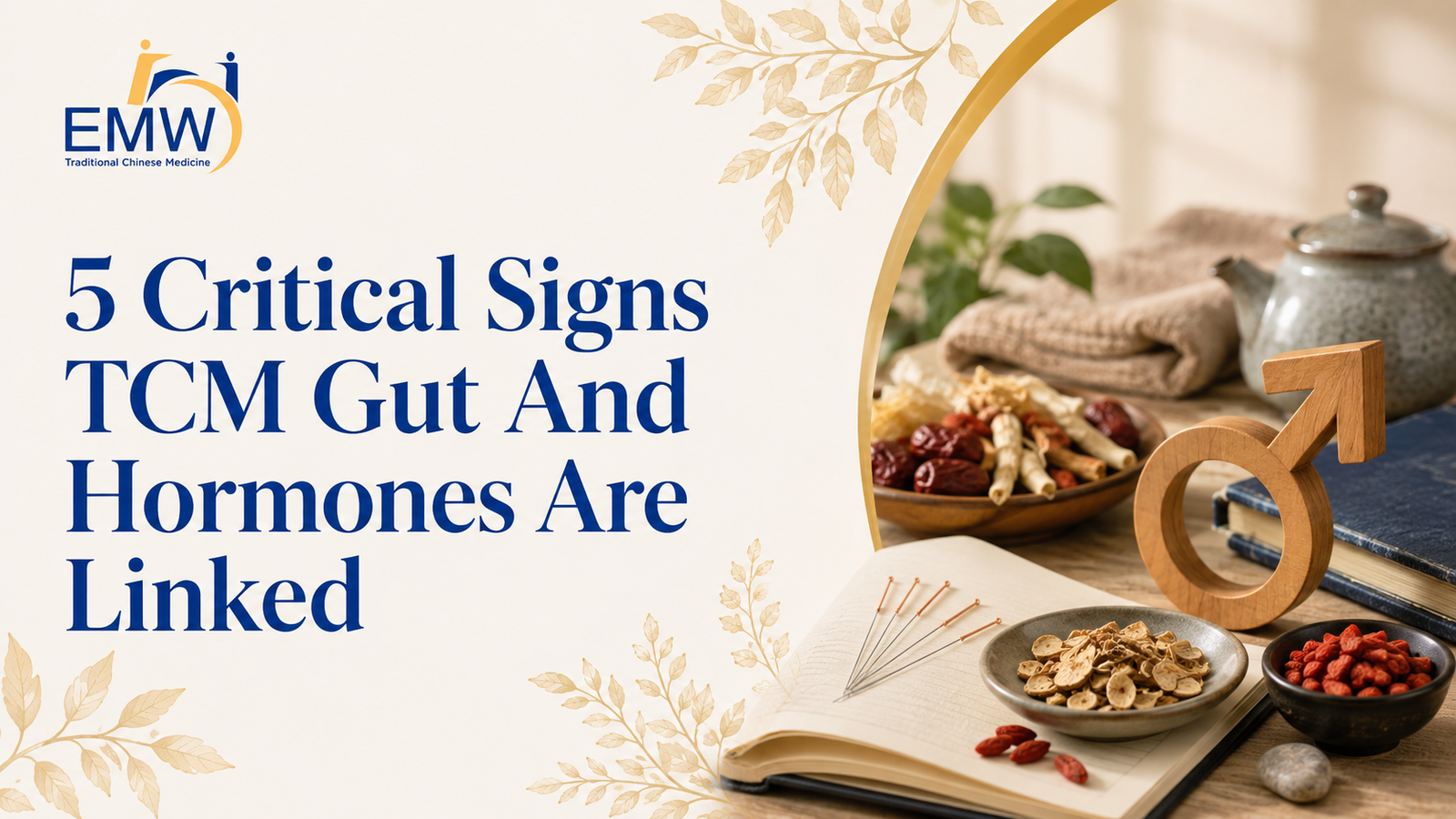
5 Critical Signs Your Gut Is Sabotaging Your Hormones: A TCM Pattern-Based Guide for Singapore Women
Bloating after meals. Constipation one week, loose stools the next. Skin that breaks out before your period. PMS that leaves you unable to function.
Many women in Singapore live with these symptoms for years without connecting them to a single root cause.
In both Traditional Chinese Medicine and modern biomedical science, the gut and hormones are inseparable.
When digestion is impaired, oestrogen clearance suffers, insulin signalling becomes erratic, thyroid conversion declines, and cortisol climbs.
The result is a hormonal environment that produces the exact symptoms you are experiencing.
At EMW TCM, we assess gut function as a core part of every hormonal and fertility consultation.
If your digestion is not right, your hormones will not be right either.
This article identifies five critical warning signs that your gut may be actively sabotaging your hormonal health, and what TCM can do about it.
The TCM Framework: The Spleen Is the Root of Hormonal Harmony
In TCM, the Spleen system governs digestive transformation, Blood production, and Dampness metabolism.
When Spleen Qi is weak, several downstream effects compound over time:
- Blood production declines, causing hormonal insufficiency
- Phlegm and Damp accumulate, disrupting metabolic signalling
- Liver Qi stagnates, worsening PMS and emotional volatility
- Endometrial nutrition becomes inadequate for implantation
The Spleen is the foundation. Hormonal therapies layered on top of weak digestion rarely produce sustainable results.
5 Critical Signs Your Gut Is Sabotaging Your Hormones
Sign 1: Persistent Bloating, Especially After Meals
Bloating is not normal.
It is one of the most common and most overlooked signals that gut function is impaired.
Biomedically, post-meal bloating may indicate impaired gastric motility, dysbiosis, SIBO (small intestinal bacterial overgrowth), or low digestive enzyme production.
Each of these conditions is associated with reduced nutrient absorption and increased intestinal inflammation.
Reduced absorption directly impairs the production of steroid hormones, which are synthesised from cholesterol and micronutrient co-factors.
In TCM, bloating after meals is a hallmark of Spleen Qi deficiency with Food Stagnation.
Treatment addresses digestive motility, enzyme support, and Spleen Qi restoration before any hormonal intervention.
Reference: Quigley EMM. Gut microbiome, hormones, and the gut-brain axis. Gastroenterol Clin North Am. 2012. DOI: 10.1016/j.gtc.2012.09.006
Sign 2: Constipation or Irregular Bowel Habits
Bowel regularity is not a cosmetic issue.
It is a hormonal issue.
The gut microbiome contains a community of bacteria known as the estrobolome, which regulates oestrogen excretion through enzymatic activity.
When constipation is present, oestrogen that should be eliminated via stool is deconjugated and reabsorbed.
This recirculation of oestrogen contributes to:
- PMS and premenstrual breast tenderness
- Heavy or clotted periods
- Fibroid and endometriosis risk
- Difficulty conceiving due to oestrogen dominance
The clinical target is one complete bowel movement daily.
In TCM, chronic constipation may reflect Spleen Qi deficiency, Blood deficiency, Qi stagnation, or Damp obstruction, each requiring a different treatment strategy.
Reference: Plottel CS & Blaser MJ. The estrobolome and oestrogen metabolism. J Clin Endocrinol Metab. 2011. DOI: 10.1210/jc.2011-0373
Sign 3: Skin Breakouts Linked to Your Cycle
Hormonal acne, particularly along the jawline and chin, often has a gut origin.
When the gut barrier is compromised, lipopolysaccharides (LPS) from gram-negative bacteria can cross into systemic circulation.
This triggers low-grade systemic inflammation, raises androgens, and worsens insulin resistance.
Elevated androgens produce sebum excess, follicular blockage, and the cyclical breakouts that many Singapore women accept as an inevitable part of their cycle.
They are not inevitable.
In TCM, skin breakouts related to the cycle are often mapped to Liver Qi Stagnation with Damp-Heat.
Treatment cools the inflammatory response, restores gut barrier integrity, and reduces Liver constraint.
Reference: Salem I et al. The gut microbiome and acne vulgaris. Front Microbiol. 2018. DOI: 10.3389/fmicb.2018.01459
Sign 4: PMS That Worsens During Stressful Months
Stress impairs gut barrier integrity through cortisol-mediated signalling.
A leaky gut increases systemic inflammation, which elevates cortisol further.
Elevated cortisol directly suppresses progesterone production in the luteal phase.
Lower progesterone creates a relative oestrogen dominance environment, worsening PMS symptoms including:
- Mood swings and irritability
- Bloating and water retention
- Breast tenderness
- Fatigue and brain fog
The gut-brain-hormone connection explains why PMS reliably worsens in months when stress is highest.
In TCM, this pattern corresponds to Liver overacting on Spleen with underlying Blood deficiency.
Treatment calms the Liver, strengthens the Spleen, and nourishes Blood to reduce PMS severity over multiple cycles.
Reference: Bested AC et al. Intestinal microbiota, probiotics, and mental health. Gut Pathog. 2013. DOI: 10.1186/1757-4749-5-5
Sign 5: Chronic Fatigue and Brain Fog in the Week Before Your Period
Premenstrual fatigue and cognitive slowing are often attributed to hormones alone.
But in clinical practice, we consistently find that women with the most severe premenstrual fatigue also have the poorest gut function.
The mechanism is multifactorial:
- Impaired B-vitamin absorption (critical for energy metabolism and neurotransmitter synthesis)
- Reduced short-chain fatty acid production impairing brain energy
- Elevated inflammatory cytokines crossing the blood-brain barrier
- Suboptimal magnesium absorption worsening premenstrual tension
In TCM, premenstrual fatigue most often maps to Spleen Qi deficiency with Blood deficiency.
Without adequate Blood nourishment in the luteal phase, the Shen (mind) becomes unsettled and energy drops.
Food-first restoration of gut function is the foundation of every treatment plan we build at EMW TCM.
Why Symptom Management Without Gut Assessment Fails
Many women in Singapore are prescribed supplements, hormone support, or even herbal formulas without a full assessment of their digestive function.
Without gut integrity, supplementation is limited by the absorption problem.
At EMW TCM, we assess:
- Stool frequency and consistency
- Bloating patterns and timing
- Food sensitivities and inflammatory triggers
- TCM tongue and pulse patterns
- Menstrual cycle changes correlated with gut symptoms
This structured approach reveals the connection between gut and hormonal symptoms that generic treatment misses.
Practical First Steps to Restore Gut-Hormone Balance
Before any herbal intervention, these foundations matter:
- Aim for daily bowel movements through dietary fibre diversity
- Eat warm, cooked foods to support Spleen Qi in TCM’s view
- Include prebiotic foods: leeks, garlic, asparagus, legumes
- Reduce ultra-processed foods and refined sugar
- Stabilise meal timing to regulate insulin and cortisol rhythms
These steps reduce the inflammatory and dysbiosis burden that drives hormonal imbalance at the gut level.
When to Seek Professional Gut Assessment
Consider a comprehensive consultation if you experience:
- Persistent bloating
- Reflux despite medication
- Alternating constipation and diarrhea
- Food sensitivities
- Skin flares with digestive symptoms
- Hormonal irregularities linked to gut issues
Early intervention prevents chronic inflammatory cascades.
Conclusion: Gut Healing Requires Warmth, Circulation, and Strategy
The principle that TCM avoids cold food for gut healing is not cultural folklore. It reflects a sophisticated understanding of digestive physiology, circulation, immune modulation, and metabolic resilience.
In Singapore’s fast-paced urban environment, cold exposure is constant. Rebuilding digestive strength requires conscious recalibration.
At EMW TCM, we combine classical wisdom with modern gut science to:
- Identify root causes
- Reduce inflammation
- Restore barrier integrity
- Personalise herbal and nutritional strategies
- Support long-term resilience
If you are ready to move beyond temporary symptom control and address the root of your digestive issues, schedule a comprehensive gut health consultation with us below.
Education resources and clinical insights are also available on our website to help you make informed decisions about your digestive health.
Why EMW TCM Is Different From Typical TCM Gut Treatment
Many TCM clinics still approach gut issues using symptom labels such as stomach pain, diarrhoea, or constipation, prescribing standardised formulas with minor modifications.
At EMW TCM, gut health is approached as a system.
What We Do Differently
-
We assess digestive capacity, not just symptoms
We evaluate stool patterns, appetite, temperature tolerance, stress physiology, and dietary habits to understand digestive strength and inflammation drivers. -
We integrate modern gut science
Gut permeability, immune activation, stress signalling, and hormonal interplay are considered alongside TCM pattern diagnosis. -
We individualise dietary therapy
Rather than extreme elimination diets, we focus on warm, digestible, predominantly plant-based foods that support long-term gut repair. -
We avoid symptom suppression
Herbs and acupuncture are used to restore digestive function, circulation, and regulatory balance, not to mask symptoms. -
We link gut health to fertility and hormones
This is especially important for patients with IBS, reflux, irregular cycles, PCOS, endometriosis, or unexplained infertility.
Learn more about our gut-focused approach
Practical Guidance for Singapore Lifestyles
Singapore’s climate and food culture make cold consumption easy and habitual. Iced drinks, smoothies, and chilled desserts are widely available.
For patients with gut or fertility concerns, simple changes matter.
• Choose warm or room-temperature drinks
• Favour soups, stews, and lightly cooked vegetables
• Avoid iced beverages with meals
• Reduce raw cold foods during periods of stress or hormonal imbalance
These are not extreme restrictions. They are physiological supports.
Our Flagship Ebook & Video Course
When to Seek Professional TCM Help
Your gut is the first organ to receive, transform, and deliver nourishment to every cell. If you experience chronic bloating, constipation, acid reflux, or fatigue, these may be early signs that your digestion needs attention.
Healing the gut restores energy, improves hormonal communication, and creates the internal harmony required for general health.
At EMW TCM Singapore, our physicians guide you through this process with care, evidence, and empathy. Whether you are addressing IBS or GERD or fertility, TCM offers a gentle yet powerful pathway to holistic wellness.
Check out our links below to book your consultation and begin your holistic journey toward better health ahead.
EMW TCM Clinics
Scotts Medical Centre Branch
9 Scotts Road #10-04, Scotts Medical Centre @ Pacific Plaza,
Singapore 228210
Book Your Appointment With Us Here: +65 89585869
International Building Branch
360 Orchard Road, International Building #02-05/06
Singapore 238869
Book Your Appointment With Us Here: +65 89585869
Our Physicians
Principal TCM Physician
- M.Med(TCM Gynaecology)
- B.Sc(Hons) Biomedical Sciences
- Dip. Naturopath
- Ayurvedic Therapist(500hrs)
- Registered TCM Physician (Singapore MOH)
Senior TCM Physician
- M.Med(TCM Acupuncture & Moxibustion)
- B.Sc(Hons) Biomedical Sciences
- Certified Aromatherapist
- Registered TCM Physician (Singapore MOH)
TCM Physician
- M.Med(TCM Gynaecology)
- B.Sc(Hons) Biomedical Sciences
- Registered TCM Physician (Singapore MOH)
TCM Physician
- B.Med(TCM)
- B.Sc(Hons) Biomedical Sciences
- International Board-Certified Lactation Consultant (IBCLC)
- Registered TCM Physician (Singapore MOH)
References
- Turner JR. Intestinal mucosal barrier function in health and disease. Physiological Reviews. 2009;89(1):163-192. DOI: 10.1152/physrev.00011.2008