7 Powerful Insights on Stress, Cortisol and Fertility: TCM’s Evidence-Based View of the Adrenal–Reproductive Axis
Many women are told:
“Just relax and it will happen.”
While this statement is often unhelpful and oversimplified, there is real science behind the connection between stress, cortisol and fertility.
The issue is not occasional stress.
It is chronic physiological stress that dysregulates hormonal signalling.
In Singapore’s high-performance environment, long work hours, sleep deprivation, and emotional strain are common. For women trying to conceive naturally or through IVF, understanding the adrenal–reproductive axis is essential.
This article explains how stress cortisol and fertility interact from both a biomedical and Traditional Chinese Medicine perspective, and how structured intervention can support reproductive stability.
The Biomedical View: The HPA and HPO Axis Connection
Fertility depends on coordination between two major systems:
- HPA axis: Hypothalamic–Pituitary–Adrenal
- HPO axis: Hypothalamic–Pituitary–Ovarian
When stress is acute, cortisol rises temporarily and then returns to baseline.
When stress is chronic:
- Cortisol remains elevated or becomes dysregulated
- GnRH pulsatility is disrupted
- LH and FSH signalling is altered
- Ovulation becomes irregular
- Progesterone may be reduced
This is the core biological link between stress cortisol and fertility.
Chronic cortisol dysregulation can also:
- Increase insulin resistance
- Promote inflammation
- Impair thyroid conversion
- Affect uterine blood flow
A 2014 study published in Human Reproduction found associations between elevated stress biomarkers and reduced fecundity.
Reference: Lynch CD et al. Hum Reprod. 2014. DOI: 10.1093/humrep/det432
While stress alone does not cause all infertility, it is a significant modulator.
The TCM View: Liver Qi, Kidney Essence and Shen
Traditional Chinese Medicine does not describe cortisol directly. Instead, stress manifests as:
- Liver Qi stagnation
- Heart Shen disturbance
- Kidney deficiency over time
- Spleen weakness affecting digestion
When Liver Qi stagnates:
- Cycles become irregular
- PMS worsens
- Ovulation may delay
When Kidney resources deplete under chronic strain:
- Luteal phase shortens
- Implantation stability weakens
- Fatigue deepens
Thus, stress cortisol and fertility are understood in TCM as a disruption of dynamic balance between Liver, Kidney and Spleen systems.
At EMW TCM, we translate these classical patterns into modern endocrine understanding.
7 Powerful Insights on Stress, Cortisol and Fertility: TCM’s Evidence-Based View of the Adrenal–Reproductive Axis
1. Cortisol Suppresses Ovulation
High stress can suppress GnRH pulses from the hypothalamus.
Without proper pulsatility:
- Follicles may not mature
- Ovulation may not occur
- Cycles may lengthen
This is often seen in women with:
- Long work hours
- Intense exercise
- Sleep deprivation
- Emotional distress
In TCM, this corresponds to Liver Qi constraint affecting Chong and Ren meridians.
Acupuncture has been shown in some studies to influence autonomic nervous system balance, which may indirectly regulate HPA activity.
Stress cortisol and fertility intersect most clearly at ovulation.
2. Cortisol Competes With Progesterone
Both cortisol and progesterone are derived from cholesterol.
Under chronic stress, the body prioritises cortisol production.
This can contribute to:
- Luteal phase defects
- Early spotting
- Reduced implantation stability
In TCM, this often presents as Kidney Yang deficiency or instability of Chong and Ren.
TCM strategies focus on:
- Nervous system regulation
- Gentle warming support when indicated
- Blood nourishment
We never prescribe strong tonics indiscriminately. Sequencing matters.
3. Stress Increases Inflammation
Chronic stress increases inflammatory cytokines.
Inflammation affects:
- Endometrial receptivity
- Egg quality
- Sperm quality
- Implantation success
Reference: Coussons-Read ME. Am J Reprod Immunol. 2013. DOI: 10.1111/aji.12072
From a TCM perspective, prolonged stress generates internal Heat.
Stress cortisol and fertility intersect at the level of immune balance and inflammatory signalling.
At EMW TCM, digestive regulation and plant-forward anti-inflammatory nutrition are foundational.
4. Adrenal Stress Affects Thyroid Function
Chronic cortisol dysregulation may impair T4 to T3 conversion.
Suboptimal thyroid function increases miscarriage risk and disrupts ovulation.
In TCM, this often corresponds to Spleen and Kidney Yang deficiency patterns.
We work alongside medical providers. Thyroid medication is not replaced, but supportive care improves overall endocrine resilience.
5. Stress Impacts Uterine Blood Flow
Autonomic imbalance can affect vascular tone.
Some studies suggest acupuncture may reduce sympathetic overactivity and improve uterine perfusion parameters.
Reference: Stener-Victorin E et al. Hum Reprod. 1996. DOI: 10.1093/oxfordjournals.humrep.a019187
When stress cortisol and fertility are addressed through nervous system regulation, uterine receptivity may improve indirectly.
6. IVF and Stress: A Bidirectional Relationship
IVF itself is stressful.
Waiting for follicle counts.
Monitoring lining measurements.
Waiting for beta results.
This emotional stress may influence sleep, cortisol rhythm and inflammatory tone.
At EMW TCM, IVF-aligned acupuncture aims to:
- Reduce sympathetic dominance
- Improve sleep quality
- Support parasympathetic regulation
- Provide structured emotional support
We are IVF-supportive, not alternative.
Timing is carefully coordinated around stimulation and transfer.
7. Why “Just Relax” Is Not a Treatment Plan
Telling a woman to relax does not regulate her HPA axis.
Structured intervention may include:
- Acupuncture
- Nervous system regulation
- Sleep restoration
- Blood sugar stabilisation
- Plant-forward anti-inflammatory nutrition
- Gentle herbal modulation when indicated
Stress cortisol and fertility improve when physiological regulation improves.

When Should You Seek Support?
Consider evaluation if you experience:
- Irregular ovulation under stress
- PMS that worsens during busy months
- Luteal spotting
- Recurrent IVF failure
- Chronic fatigue
- Sleep disturbance
Stress is not purely psychological. It is physiological.
How EMW TCM Is Different
Patients often come to us after being told stress is “just emotional.”
At EMW, we assess:
- Cycle patterns
- Basal body temperature
- Digestive strength
- Inflammatory signs
- Sleep quality
- IVF timing
- Metabolic indicators
We integrate TCM pattern differentiation with biomedical reasoning.
We do not promise that eliminating stress guarantees pregnancy.
We focus on restoring endocrine rhythm and nervous system stability.
If you would like personalised support, you may WhatsApp +65 8958 5869 to arrange a consultation.
You may also explore:
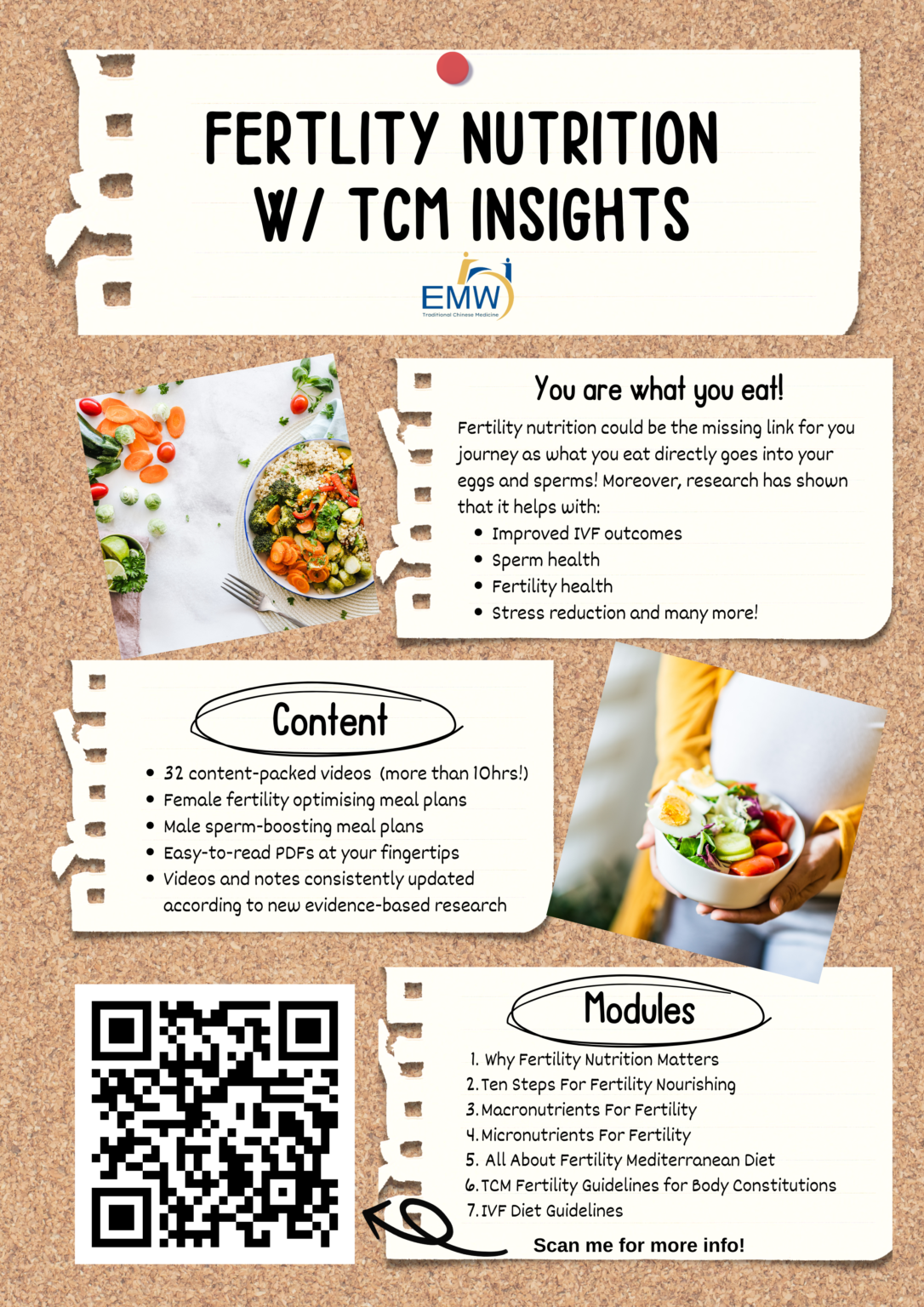
Fertility Nutrition with TCM Insights
https://emwtcm.podia.com/fertility-nutrition-with-tcm-insights
Fertility Support Guide
The Role of Nutrition in TCM Fertility Singapore
Nutrition is a central pillar of fertility care.
At EMW, dietary strategies emphasise:
Whole, minimally processed foods
Adequate protein for hormone production
Anti-inflammatory plant foods
Blood-building nutrients such as iron and folate
Digestive support to enhance nutrient absorption
Unlike generic advice, recommendations are tailored to TCM patterns such as:
Blood deficiency
Dampness
Yang deficiency
Patients can also start with a practical guide here:
https://emwtcm.podia.com/3-ways-to-boost-your-fertility
When Should You Start TCM for Fertility
The earlier TCM is introduced, the more impact it can have.
Ideal timing includes:
3 months before trying to conceive
Before starting IVF
Between IVF cycles
After failed implantation
Even during active IVF cycles, properly timed acupuncture and supportive therapies can still play a meaningful role.
Conclusion
Stress is unavoidable.
Chronic dysregulation is not.
When stress cortisol and fertility are addressed through structured, integrative care, ovulatory rhythm, luteal stability and implantation environment may improve.
The goal is not to eliminate stress.
The goal is to restore resilience.
If you are navigating fertility challenges in Singapore and suspect stress may be contributing, EMW TCM offers evidence-informed, IVF-aligned support grounded in both tradition and modern science.
How EMW TCM Help Your Fertility
From a biomedical perspective, acupuncture for fertility improves ovarian and uterine blood flow, regulates the hypothalamic-pituitary-ovarian axis, lowers cortisol, reduces inflammation, and supports hormonal balance. These effects complement TCM principles and help enhance egg development, implantation, and reproductive function.
1. Comprehensive Assessment
Your first consultation includes:
Cycle assessment
Digestion and hormonal review
Energy and stress evaluation
Sleep and lifestyle factors
Male fertility screening when relevant
2. Evidence-Based TCM Diagnosis
Qi stagnation
Blood deficiency
Spleen Qi weakness
Kidney Yin/Yang imbalance
Liver Qi constraint
Dampness and inflammation
3. Personalised Fertility Treatment Plan
Weekly fertility acupuncture
Customised herbal formulas
Stress reduction strategies
Lifestyle recommendations
TCM Acupuncture for Fertility Treatments
Acupuncture, one of the most researched TCM fertility tools, has been found to influence several physiological pathways related to reproduction.
A review published in Fertility and Sterility (2019) reported that acupuncture may improve blood flow to the uterus and ovaries, modulate stress hormones, and enhance endometrial receptivity. Another meta-analysis in Integrative Medicine Research (2021) concluded that acupuncture used alongside conventional fertility treatment can improve pregnancy outcomes and reduce anxiety levels in women undergoing IVF.
From a clinical standpoint, acupuncture helps regulate the hypothalamic-pituitary-ovarian axis, improving hormone balance and menstrual regularity. It can also reduce cortisol levels, encouraging the parasympathetic or “rest-and-rebuild” state which supports implantation and early pregnancy.
Our Flagship Ebook & Video Course
When to Seek Professional TCM Fertility Help
Fertility is not just a matter of age or hormones. It is a reflection of the body’s internal harmony. Traditional Chinese Medicine provides an integrative and natural way to restore this balance, supporting both physical and emotional readiness for conception.
At EMW TCM Singapore, our team of experienced physicians brings together centuries-old wisdom and modern evidence to guide your fertility journey. Whether you are trying naturally or preparing for IVF, we are here to help you create the best internal environment for new life to begin.
If you have been trying to conceive for more than six to twelve months, experience irregular menses, painful periods, or have been diagnosed with PCOS, endometriosis, or low sperm count, consider a consultation. Professional TCM fertility care aims to correct the underlying imbalance rather than simply forcing ovulation or hormone production.
Check out our links below to book your fertility consultation and begin your holistic journey toward conception.
EMW TCM Clinics
Scotts Medical Centre Branch
9 Scotts Road #10-04, Scotts Medical Centre @ Pacific Plaza,
Singapore 228210
Book Your Appointment With Us Here: +65 89585869
International Building Branch
360 Orchard Road, International Building #02-05/06
Singapore 238869
Book Your Appointment With Us Here: +65 89585869
Our Physicians
Principal TCM Physician
- M.Med(TCM Gynaecology)
- B.Sc(Hons) Biomedical Sciences
- Dip. Naturopath
- Ayurvedic Therapist(500hrs)
- Registered TCM Physician (Singapore MOH)
Senior TCM Physician
- M.Med(TCM Acupuncture & Moxibustion)
- B.Sc(Hons) Biomedical Sciences
- Certified Aromatherapist
- Registered TCM Physician (Singapore MOH)
TCM Physician
- M.Med(TCM Gynaecology)
- B.Sc(Hons) Biomedical Sciences
- Registered TCM Physician (Singapore MOH)
TCM Physician
- B.Med(TCM)
- B.Sc(Hons) Biomedical Sciences
- International Board-Certified Lactation Consultant (IBCLC)
- Registered TCM Physician (Singapore MOH)
References
- Lynch CD et al. Stress biomarkers and time to pregnancy. Hum Reprod. 2014. DOI: 10.1093/humrep/det432
- Coussons-Read ME. Effects of prenatal stress on pregnancy outcomes. Am J Reprod Immunol. 2013. DOI: 10.1111/aji.12072
- Stener-Victorin E et al. Reduction of uterine artery blood flow impedance by electro-acupuncture. Hum Reprod. 1996. DOI: 10.1093/oxfordjournals.humrep.a019187