In Traditional Chinese Medicine (TCM), the confinement period is known as Zuò Yuè Zi (坐月子), translated as “Sitting the Month”. This is a crucial period for both the mother’s physiological restoration and the baby’s early development, as it emphasises seclusion, nourishment, and structured care.
A traditional confinement period typically lasts for 28 days, and it may be extended to 42 days following a Caesarean section, depending on the mother’s recovery. During this delicate time, most mothers tend to feel overwhelmed by emotional and physical stress, the process of physical recovery, and the demands of breastfeeding.
At EMW TCM, we recognise that every mother’s natural rhythm is different. Your constitution, experience of delivery and recovery process are unique, and our postpartum care integrates classical TCM principles with a modern, evidence-informed approach. Confinement herbal formulas form a key part of our personalised care plans, carefully tailored to support each mother’s individual recovery.
The Phases of Confinement Healing
In TCM theory, a recuperative confinement is a gradual process, aiming to restore Qi (气) and Blood (血), which are vital essences temporarily depleted during delivery. Immediately after childbirth, the body is considered more vulnerable to cold, fatigue and stagnation, while the uterus undergoes natural contraction and recovery.
Postpartum TCM care concentrates on warming the body, replenishing Blood and Qi, and supporting lactation, along with emotional health. There are three important phases to be observed in a typical 28-day confinement period:
Uterus Recovery and Cleansing (Days 1 to 7)
In the early phase, soon after delivery, your body is still in a physically and emotionally vulnerable state. During this initial transition, the primary goal is to support natural uterine contraction and the clearing of lochia, while protecting the mother from excessive strain. Herbal support during this phase usually focuses on circulation and recovery, rather than strong tonification.
Regulate and Rebalance Qì (Days 8 to 14)
As your body begins to stabilise, the focus shifts to supporting digestion in the second phase. Qì and Blood are replenished while energy is steadily restored with consistent nutrition, which benefits the liver, spleen, and kidneys. TCM herbs are introduced to support milk flow and “warm” the body to drive away dampness and cold. Gentle physical activity, such as stretching and slow walks, may be resumed, except in cases of recovery from a C-section.
Deep Strengthening and Foundation (Days 15 to 28)
The third phase reinforces your recovery as more food, herbal soups and formulas are included in the diet. The liver and kidneys continue to be supported during this period, setting the stage for long-term recovery. If you are cleared by your doctor, you may slowly take longer walks or practice postnatal yoga.
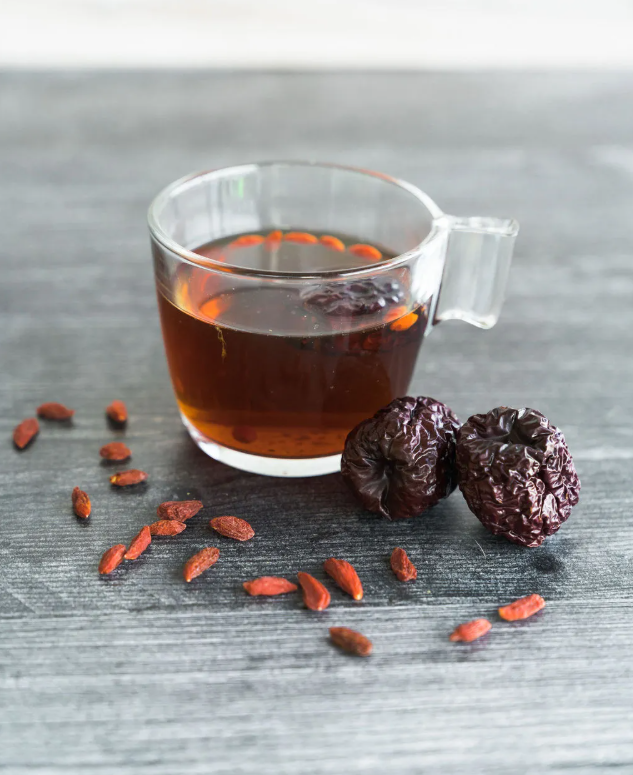
Confinement Herbal Tea
According to TCM principles, iced drinks and excessive cold intake are traditionally discouraged during confinement. This is to prevent the chilling of the internal organs and the buildup of “damp-cold”, a main source of weakness and aches in the postpartum body. Incorporating the following herbs into teas ensures an effective and convenient way to hydrate, as they can be consumed throughout the day:
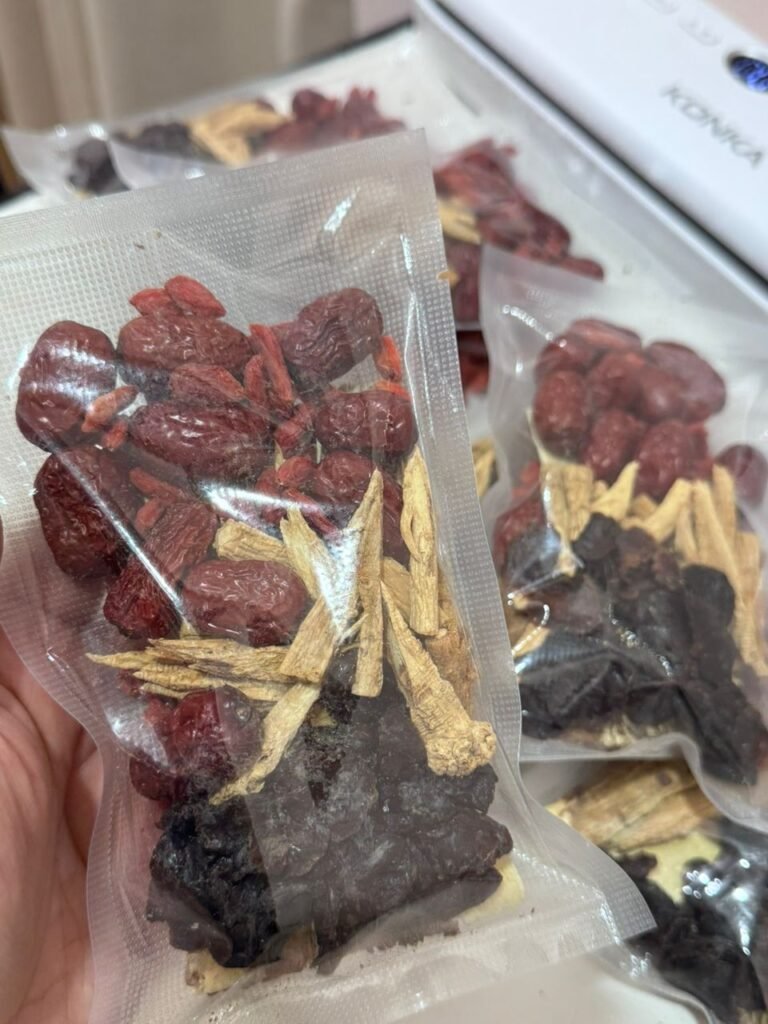
Red Date (Hóng Zǎo 紅枣)
Red date tea replaces plain water for hydration. Clinical studies have shown red date (also known as jujube) replenishes Blood and tonifies Qi [1], while nourishing the spleen and stomach to support digestion. It can be consumed for postpartum anaemia as red dates are high in iron.
Dried Longan (Lóng Yǎn Gān 龙眼干)
Dried longan enhances Blood, calms the mind to support better sleep and emotional well-being.
Goji berries, or Wolfberries (Gǒu Qǐ 枸杞)
A common ingredient in TCM herbal treatments, goji berries have been found to contain high antioxidant levels in clinical analyses [2]. Goji berries support Liver and Kidney health, gently nourish Blood and Yin, and provide a hint of sweetness in teas.
Astragalus (Huáng Qí 黄芪)
Also known as milk vetch, astragalus is traditionally used as a galactogogue to enhance lactation, while strengthening Qi and Blood.
Codonopsis Root (Dǎng Shēn 党参)
Codonopsis root is viewed as a gentler version of ginseng that helps to support digestion, and it is renowned for nourishing Blood, and restoring and invigorating the Spleen [3].
Our caffeine-free TCM confinement tea is ideal for mothers undergoing confinement, and formulated for your daily postpartum nourishment.
(Please note our TCM confinement tea is to be purchased separately from the Personalised Confinement Herbal Package.)
Personalised Confinement Supplement Herbs
Herbal soups are viewed as more than nourishing food in TCM theory, as they have restorative properties while delivering warmth and nourishment that is gentle on digestion. The following list includes the main herbs used in soups that play an essential part in recovery during the confinement period:
Herbs That Support Lactation (Galactogogues)
- Rice Paper Pith (Tōng Cǎo 通草): Enhances lactation and clears blockages.
- Astragalus (Huáng Qí 黄芪): Encourages milk flow by boosting Qi and Blood.
Herbs That Assist in Restoring Qi and Blood
- Chinese Foxglove (Shú Dì Huáng熟地黄): Nourishes Blood and Yin to support kidney function
- Angelica Root (Dāng Guī 当归): Sustains Blood and, by extension, supports uterine health
Herbs that Support Digestion
- Chinese Yam (Huái Shān 淮山): Rich in dietary fibre and essential minerals, Chinese yam supports the appetite and helps to relieve nausea.
- Codonopsis Root (Dǎng Shēn 党参): Restores appetite by supporting the spleen.
Our TCM confinement herbal packages include 28 days of a personalised herbal confinement formula, customised for your unique postpartum health requirements and situation. At EMW TCM, our herbal treatments are reviewed by registered TCM physicians and prepacked into daily sachets for your convenience.
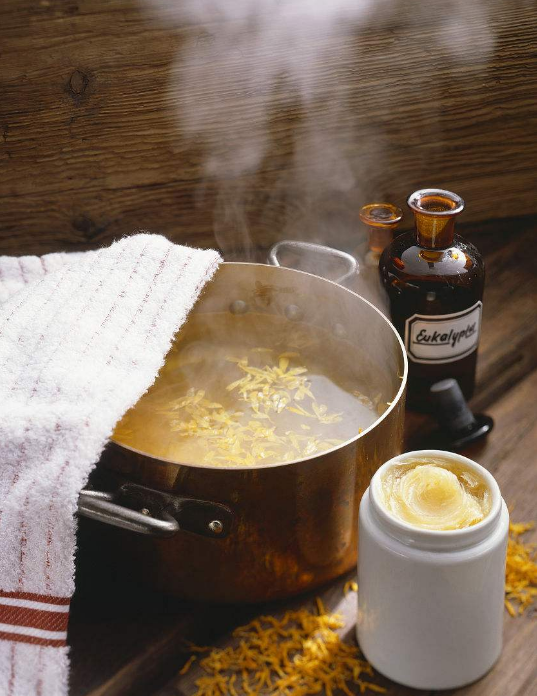
Confinement Herbal Bath
Traditional practices forbade bathing during the confinement period. However, a complete avoidance of bathing for a month is neither practical nor hygienic in Singapore’s tropical climate. A TCM herbal bath strikes the right balance between expelling “wind-dampness” and cleansing the body, by utilising herbal ingredients that dispel excess wind, relieve tension, and soothe aches and pains.
The primary herb in our EMW confinement herbal bath is mugwort leaf (Ài Yè 艾叶), which has warming effects and supports the natural healing process in the body by clearing meridians and balancing blood flow.
In addition, the confinement bath can be used as a soak to soothe stiffness or alleviate fluid buildup in the hands or feet.
Disclaimer On the Use of TCM Herbs During Confinement
Mothers who are currently undergoing the confinement period, or who are planning to undergo confinement, must not begin or continue the use of any TCM herbal treatment or formulas without first consulting a qualified, licensed TCM practitioner or healthcare professional. The information in this article is presented for general educational purposes and should not be used as a substitute for medical advice.
The confinement period remains a traditional and cultural cornerstone, offering a respite from daily life and an opportunity for rest and recuperation. At EMW TCM, we blend a modern approach with ancient wisdom to support you on the journey to motherhood. Contact us today if you have any concerns about postpartum recovery or questions about how TCM can best enhance your confinement routine.
Frequently Asked Questions (FAQ)
Can I Still Consume Regular Food While Taking Confinement Herbs?
Yes, TCM herbs complement a balanced diet, although try to avoid cold or raw foods, such as salads, cut fruit like watermelon, or iced drinks. In TCM, cold foods are believed to slow down uterine healing.
When Should I Begin Taking Confinement Herbs?
It is recommended to start within the first few days after delivery, although this depends on your recovery stage and constitution. Some warming or strongly tonifying herbs may not be suitable immediately after delivery. A TCM consultation helps ensure the right herbs are introduced at the right time.
Are Confinement Herbs Safe for Breastfeeding?
In general, many confinement herbs are safe, but it is crucial to consult a qualified TCM physician to ensure they are used with the correct dosage and at an appropriate time during the confinement period.
Why Choose EMW’s Personalised TCM Confinement Herbal Package
Every woman’s body is different.
Your recovery needs depend on:
Type of delivery (natural or C-section)
Blood and Qi strength
Milk supply
Sleep, stress, and digestion patterns
At EMW TCM, our physician-formulated herbal care is:
Personalised: Herbs are customised after TCM pulse and tongue assessment
Physician-led: All prescriptions are reviewed by registered TCM physicians
Convenient: Herbs are pre-portioned into daily sachets
Safe for breastfeeding: Gentle, non-toxic formulations
Follow-up supported: Post-confinement consultation ensures smooth transition can be requested upon demand.
Our goal: to help you heal deeply, rebuild your vitality, and embrace motherhood with confidence.
There are many benefits to personalized TCM confinement, including:
- Improved recovery: To speed up the healing process after childbirth and reduce the risk of complications.
- Reduced discomfort: To relieve common postpartum symptoms such as pain, fatigue, and anxiety.
- Improved mood: To improve the mother’s mood and reduce the risk of postpartum depression.
- Enhanced lactation: To promote lactation and improve the quality of breast milk.
- Strengthened immune system: To strengthen the mother’s immune system and protect her from illness.
One can easily find 28 days confinement herbal soups off any herbal stores.
However, with EMW Personalised Confinement Herbal Package, herbs prescribed is supplementary to the 28 days confinement herbal soups. It is designed to be brewed into a decoction and to be drank separately outside of meals.
Therefore, confinement herbal soups are catered more towards general body constitution while our Herbal Package herbs are more catered to individual body types hence being more potent as a result.
28 Day Confinement Herbal Tea
During TCM confinement, hydration and warmth are vital for restoring Qi and blood. At EMW TCM, we formulate confinement teas that gently replenish energy, warm the body, and calm emotions.
Our TCM confinement tea blends are handcrafted by our physicians to support:
Blood and Qi replenishment: using Dang Shen (Codonopsis), Hong Zao (Red Dates), and Gou Qi Zi (Goji Berries)
Digestive recovery: Huang Qi to strengthen the Spleen and aid absorption
Mood balance and sleep support: Long Yan Rou (Longan) to soothe the mind and nourish the Heart
- Physical Strengthening: Du Zhong to strengthen Kidney and lower back
Each sachet is pre-portioned for convenience and safety.
Simply steep in warm water and enjoy throughout the day.
Our TCM confinement tea is caffeine-free, gentle for breastfeeding mothers, and an excellent companion for your daily postpartum nourishment.
This will be purchased separately from Personalised Confinement Herbal Package.
TCM Confinement Herbal Bath
In Traditional Chinese Medicine, postpartum women are considered vulnerable to cold invasion. A TCM confinement herbal bath helps expel cold, improve blood circulation, and relieve muscle tension.
At EMW TCM Singapore, our herbal bath formula is carefully balanced to restore warmth while being safe and soothing for new mothers.
Key Benefits of Our TCM Confinement Herbal Bath:
- Promotes blood flow and helps discharge residual lochia
- Warms the body to prevent postpartum chills and joint pain
- Relaxes tired muscles and alleviates neck or back aches
- Gently cleanses without drying or irritating the skin
Main Herbal Ingredient:
Ai Ye (Mugwort Leaf) which supports the body’s natural healing by unblocking meridians and harmonising blood circulation.
How to Use the EMW Herbal Bath:
- Boil the pre-packed herbal sachet in 2–3 litres of water for 15 minutes.
- Pour into a basin or bathtub and mix with warm water (around 40 °C).
- Soak or sponge-bathe for 10–15 minutes daily.
- Keep the body warm and dry immediately after bathing.
Our confinement bath can also be used for hand or foot soaking to relieve swelling or stiffness.
TCM Confinement 101

TCM Lactation
We do pre-delivery lactation consultation at week 37-39 which includes a detailed breast examination, 1-to-1 personalised guidance on latching, positioning techniques and discussion of common concerns, and a post-delivery lactation consultation to addresses major lactation concerns like low milk supply, engorgement, poor letdown, nipple pain/bruising with the help of TCM acupressure together with other treatments.
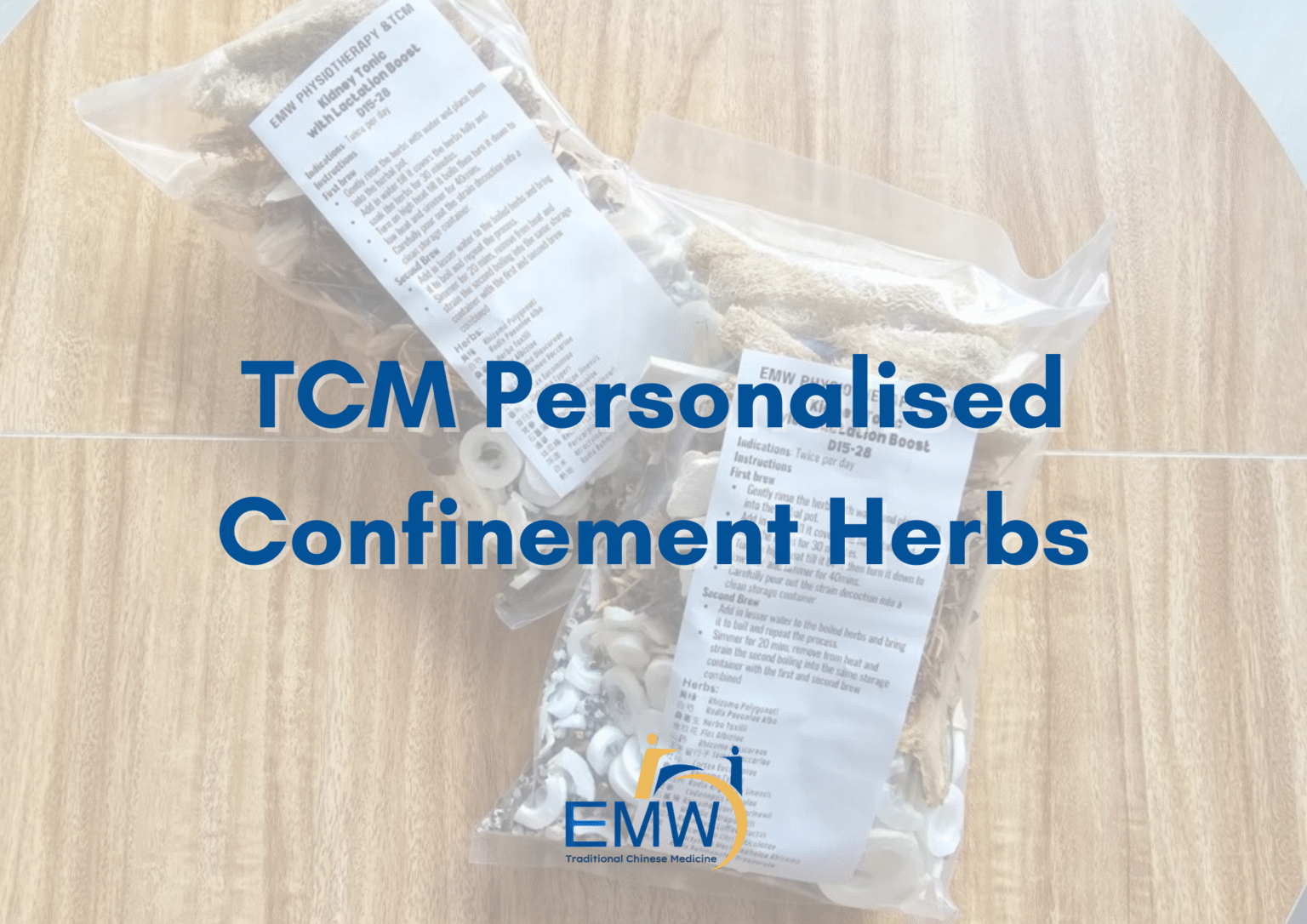
TCM Confinement Herbs
EMW Personalised Confinement Herbal Package is designed to be brewed into a decoction and to be drank separately outside of meals. Therefore, while confinement herbal soups are catered more towards general body constitution while our Herbal Package herbs are more catered to individual body types hence being more potent as a result.
TCM Postartum Acupressure
A 2018 study published in The Journal of Maternal Health found that postpartum massage enhances oxytocin release, which helps with uterine contractions, reduces swelling, and supports emotional well-being. Our specialized EMW TCM postnatal massage Singapore program integrates these evidence-based benefits to ensure a smoother recovery journey for new mothers.
How TCM Supports Postpartum Recovery
At EMW TCM Singapore, we see postpartum care not only as physical healing but also as emotional restoration. Our physicians integrate TCM acupressure, moxibustion acupuncture, and herbal medicine in TCM Confinement Singapore care to help mothers regain balance, replenish energy, and prevent long-term health issues.

EMW TCM Clinics
Scotts Medical Centre Branch
9 Scotts Road #10-04, Scotts Medical Centre @ Pacific Plaza,
Singapore 228210
Book Your Appointment With Us Here: +65 89585869
International Building Branch
360 Orchard Road, International Building #02-05/06
Singapore 238869
Book Your Appointment With Us Here: +65 89585869
Our Physicians
Principal TCM Physician
- M.Med(TCM Gynaecology)
- B.Sc(Hons) Biomedical Sciences
- Dip. Naturopath
- Ayurvedic Therapist(500hrs)
- Registered TCM Physician (Singapore MOH)
Senior TCM Physician
- M.Med(TCM Acupuncture & Moxibustion)
- B.Sc(Hons) Biomedical Sciences
- Certified Aromatherapist
- Registered TCM Physician (Singapore MOH)
TCM Physician
- M.Med(TCM Gynaecology)
- B.Sc(Hons) Biomedical Sciences
- Registered TCM Physician (Singapore MOH)
TCM Physician
- B.Med(TCM)
- B.Sc(Hons) Biomedical Sciences
- International Board-Certified Lactation Consultant (IBCLC)
- Registered TCM Physician (Singapore MOH)
References
- Ruan, J., Han, Y., Kennedy, J. F., Jiang, H., Cao, H., Zhang, Y., & Wang, T. (2022). A review on polysaccharides from jujube and their pharmacological activities. Carbohydrate Polymer Technologies and Applications, 3,00220. https://doi.org/10.1016/j.carpta.2022.100220
- Amagase, H., & Farnsworth, N. R. (2011). A review of botanical characteristics, phytochemistry, clinical relevance in efficacy and safety of Lycium barbarum fruit (Goji). Food Research International, 44(7), 1702–1717. https://doi.org/10.1016/j.foodres.2011.03.027
- Liu, C. Y., Li, Z., Cheng, F. E., Nan, Y., & Li, W. Q. (2025). Radix Codonopsis: a review of anticancer pharmacological activities. Frontiers in pharmacology, 15, 1498707. https://doi.org/10.3389/fphar.2024.1498707