Child Allergic Rhinitis Singapore: 7 Essential Signs Parents Should Know
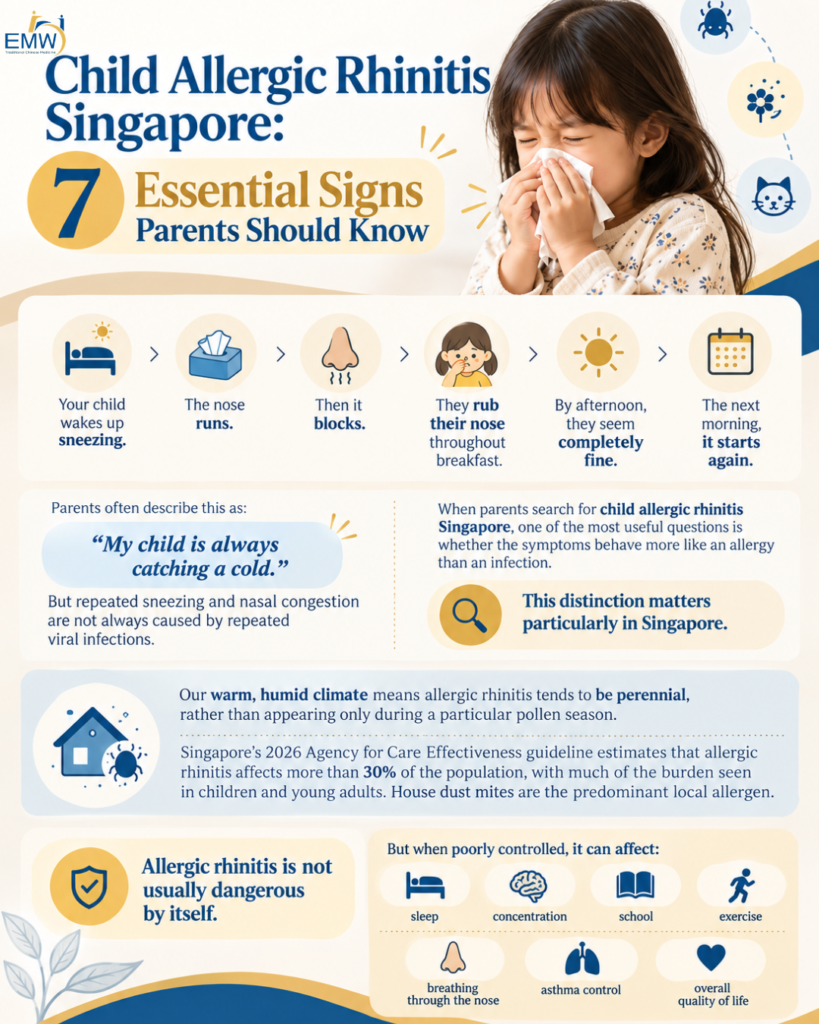
Your child wakes up sneezing.
The nose runs.
Then it blocks.
They rub their nose throughout breakfast.
By afternoon, they seem completely fine.
The next morning, it starts again.
Parents often describe this as:
“My child is always catching a cold.”
But repeated sneezing and nasal congestion are not always caused by repeated viral infections.
When parents search for child allergic rhinitis Singapore, one of the most useful questions is whether the symptoms behave more like an allergy than an infection.
This distinction matters particularly in Singapore.
Our warm, humid climate means allergic rhinitis tends to be perennial, rather than appearing only during a particular pollen season. Singapore’s 2026 Agency for Care Effectiveness guideline estimates that allergic rhinitis affects more than 30% of the population, with much of the burden seen in children and young adults. House dust mites are the predominant local allergen.
Allergic rhinitis is not usually dangerous by itself.
But when poorly controlled, it can affect:
- sleep
- concentration
- school
- exercise
- breathing through the nose
- asthma control
- overall quality of life
So if your child seems to have a “cold” every week, it is worth looking at the pattern more closely.
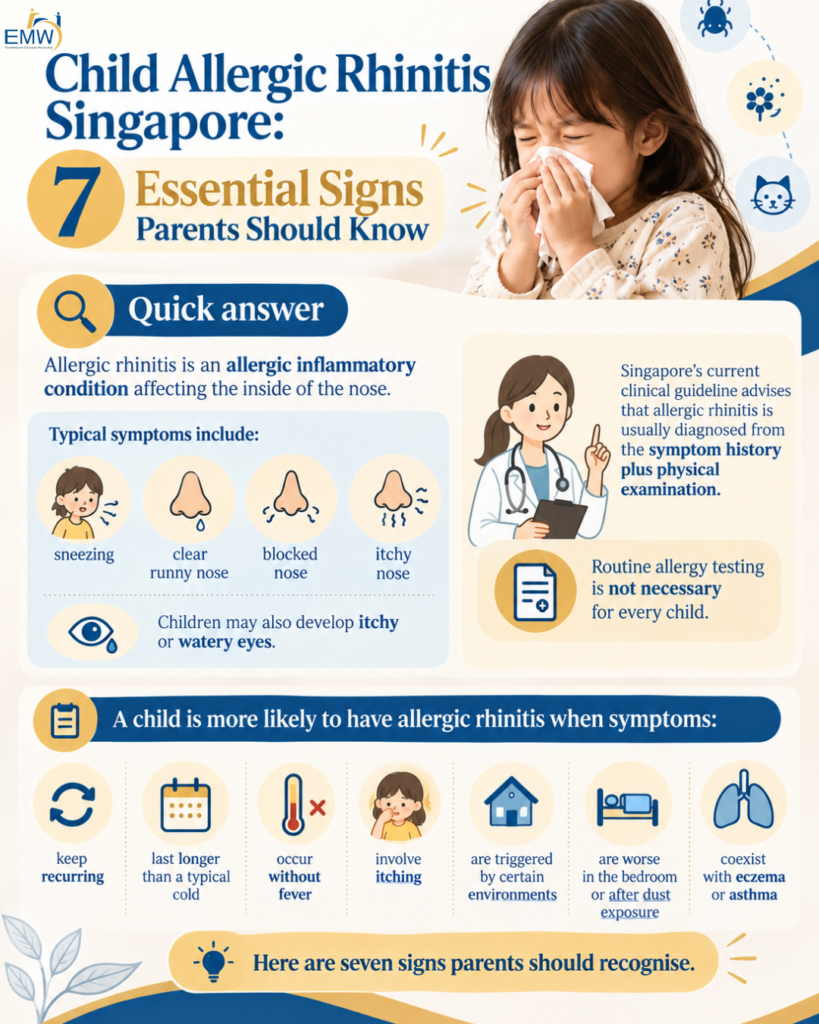
Quick answer
Allergic rhinitis is an allergic inflammatory condition affecting the inside of the nose.
Typical symptoms include:
- sneezing
- clear runny nose
- blocked nose
- itchy nose
Children may also develop itchy or watery eyes.
Singapore’s current clinical guideline advises that allergic rhinitis is usually diagnosed from the symptom history plus physical examination. Routine allergy testing is not necessary for every child.
A child is more likely to have allergic rhinitis when symptoms:
- keep recurring
- last longer than a typical cold
- occur without fever
- involve itching
- are triggered by certain environments
- are worse in the bedroom or after dust exposure
- coexist with eczema or asthma
Here are seven signs parents should recognise.
Child Allergic Rhinitis Singapore: 7 Essential Signs Parents Should Know
1. Repeated sneezing, especially after waking
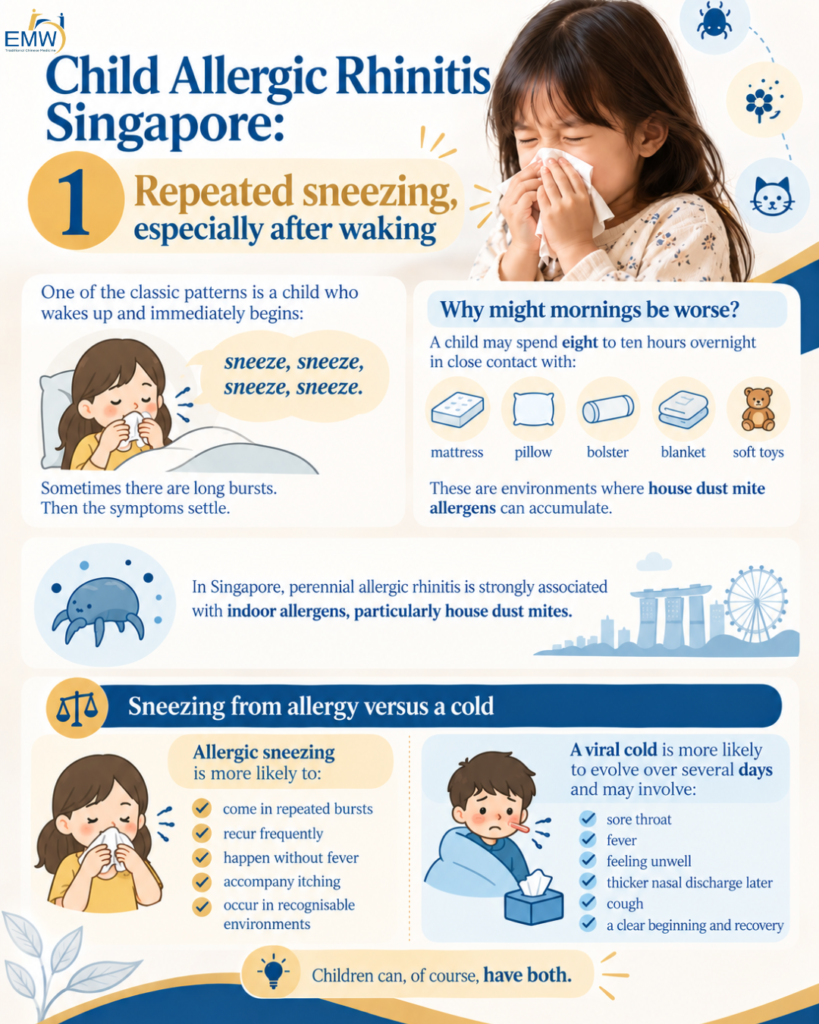
One of the classic patterns is a child who wakes up and immediately begins:
sneeze, sneeze, sneeze, sneeze.
Sometimes there are long bursts.
Then the symptoms settle.
Why might mornings be worse?
A child may spend eight to ten hours overnight in close contact with:
- mattress
- pillow
- bolster
- blanket
- soft toys
These are environments where house dust mite allergens can accumulate.
In Singapore, this is especially relevant because perennial allergic rhinitis is strongly associated with indoor allergens, particularly house dust mites.
An older Singapore study of children attending allergy and ENT clinics found mite sensitisation was extremely common among paediatric allergic-rhinitis patients. That does not mean every child with sneezing has a dust-mite allergy, but it illustrates how important mites are in our local environment.
Sneezing from allergy versus a cold
Allergic sneezing is more likely to:
- come in repeated bursts
- recur frequently
- happen without fever
- accompany itching
- occur in recognisable environments
A viral cold is more likely to evolve over several days and may involve:
- sore throat
- fever
- feeling unwell
- thicker nasal discharge later
- cough
- a clear beginning and recovery
Children can, of course, have both.
2. The nose is runny, but the mucus stays clear
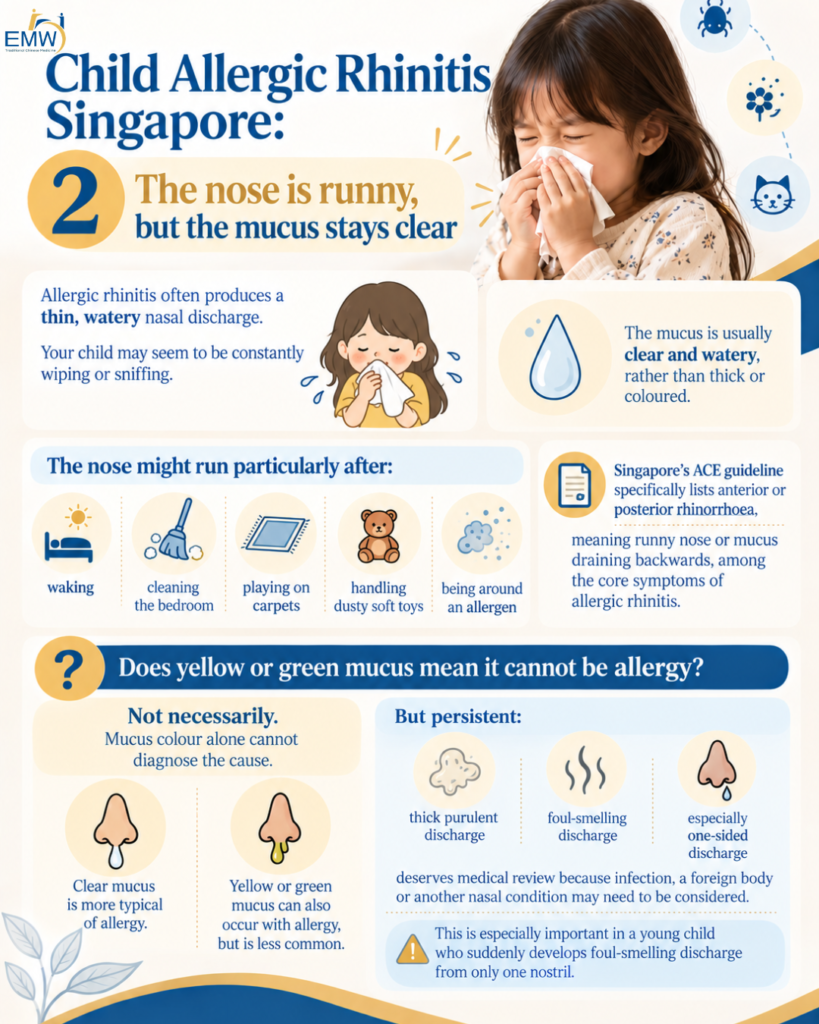
Allergic rhinitis often produces a thin, watery nasal discharge.
Your child may seem to be constantly wiping or sniffing.
The nose might run particularly after:
- waking
- cleaning the bedroom
- playing on carpets
- handling dusty soft toys
- being around an allergen
Singapore’s ACE guideline specifically lists anterior or posterior rhinorrhoea, meaning runny nose or mucus draining backwards, among the core symptoms of allergic rhinitis.
Does yellow or green mucus mean it cannot be allergy?
Not necessarily.
Mucus colour alone cannot diagnose the cause.
But persistent:
- thick purulent discharge
- foul-smelling discharge
- especially one-sided discharge
deserves medical review because infection, a foreign body or another nasal condition may need to be considered.
This is especially important in a young child who suddenly develops foul-smelling discharge from only one nostril.
3. Your child keeps rubbing or wrinkling the nose
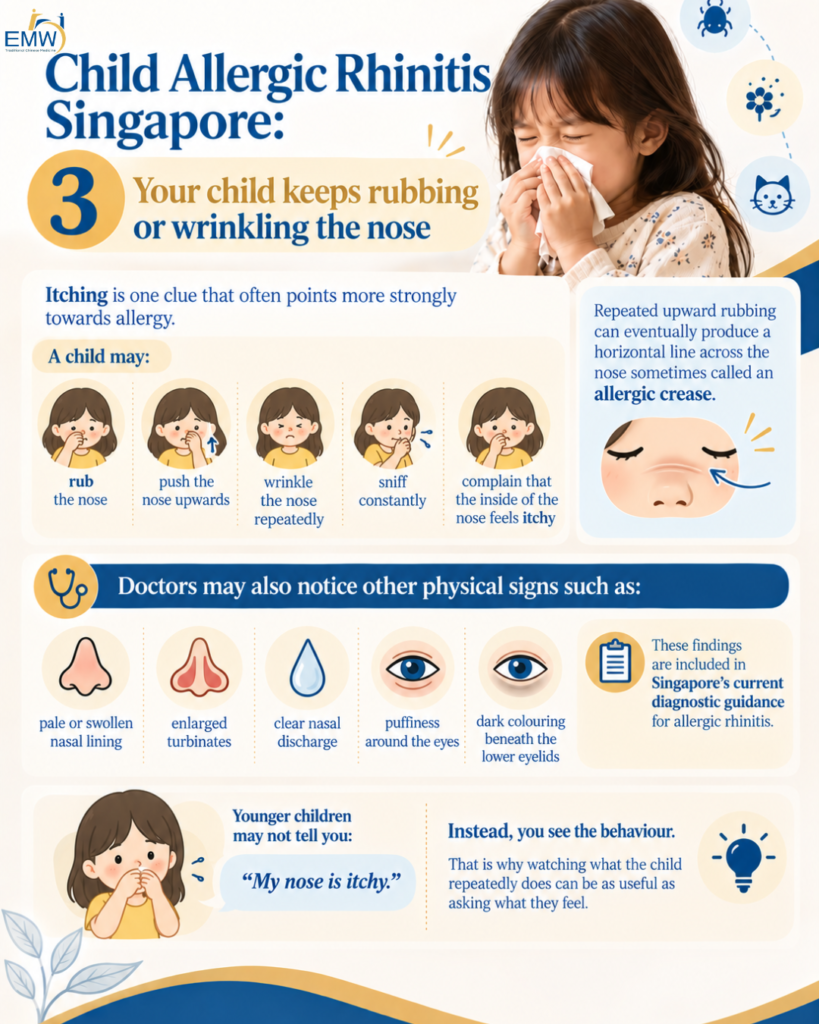
Itching is one clue that often points more strongly towards allergy.
A child may:
- rub the nose
- push the nose upwards
- wrinkle the nose repeatedly
- sniff constantly
- complain that the inside of the nose feels itchy
Repeated upward rubbing can eventually produce a horizontal line across the nose sometimes called an allergic crease.
Doctors may also notice other physical signs such as:
- pale or swollen nasal lining
- enlarged turbinates
- clear nasal discharge
- puffiness around the eyes
- dark colouring beneath the lower eyelids
These findings are included in Singapore’s current diagnostic guidance for allergic rhinitis.
Younger children may not tell you:
“My nose is itchy.”
Instead, you see the behaviour.
That is why watching what the child repeatedly does can be as useful as asking what they feel.
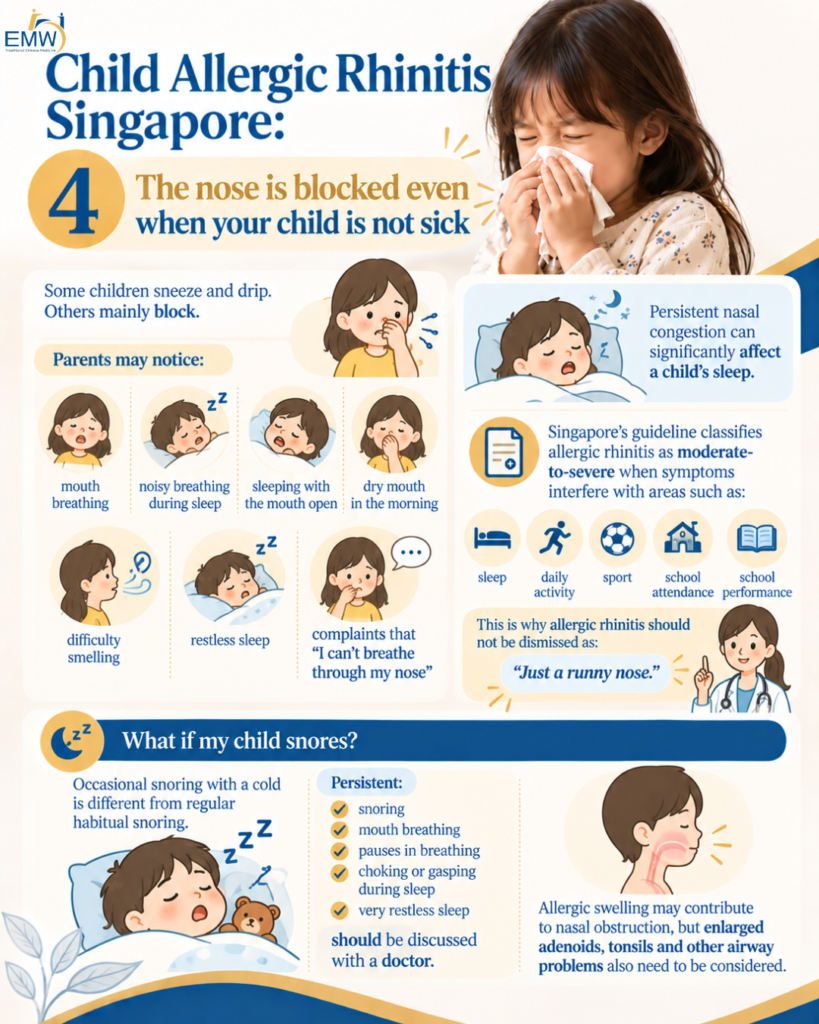
4. The nose is blocked even when your child is not sick
Some children sneeze and drip.
Others mainly block.
Parents may notice:
- mouth breathing
- noisy breathing during sleep
- sleeping with the mouth open
- dry mouth in the morning
- difficulty smelling
- restless sleep
- complaints that “I can’t breathe through my nose”
Persistent nasal congestion can significantly affect a child’s sleep.
Singapore’s guideline classifies allergic rhinitis as moderate-to-severe when symptoms interfere with areas such as:
- sleep
- daily activity
- sport
- school attendance
- school performance
This is why allergic rhinitis should not be dismissed as:
“Just a runny nose.”
What if my child snores?
Occasional snoring with a cold is different from regular habitual snoring.
Persistent:
- snoring
- mouth breathing
- pauses in breathing
- choking or gasping during sleep
- very restless sleep
should be discussed with a doctor.
Allergic swelling may contribute to nasal obstruction, but enlarged adenoids, tonsils and other airway problems also need to be considered.
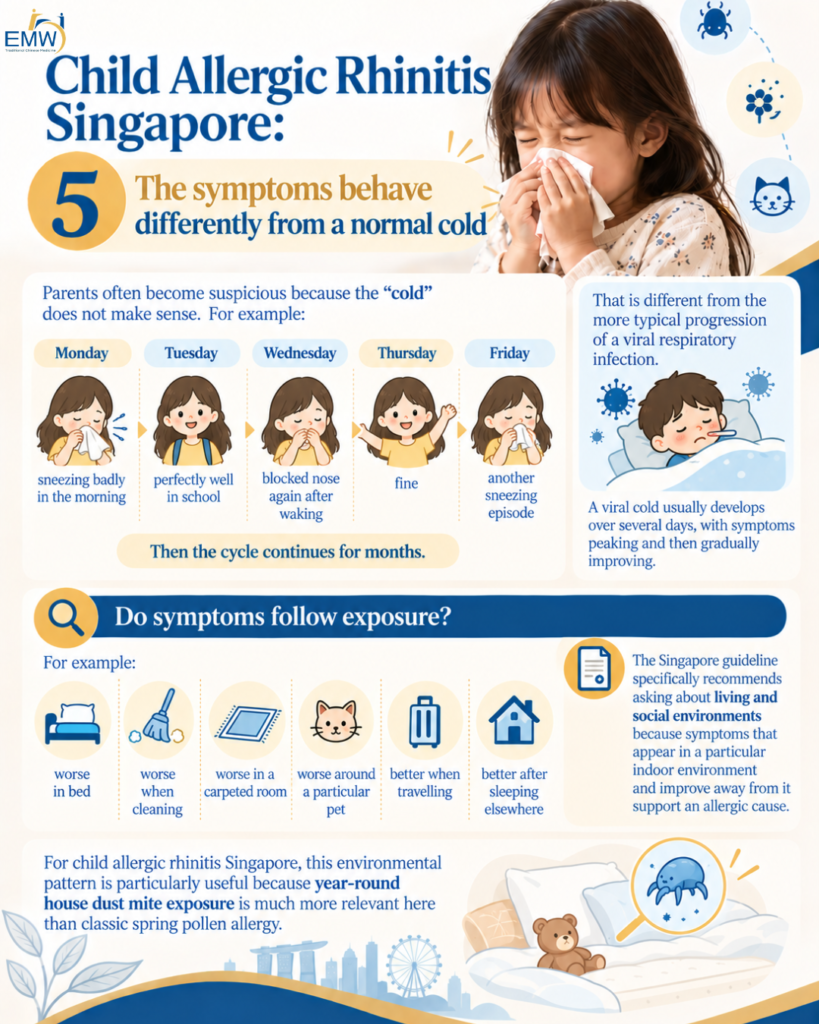
5. The symptoms behave differently from a normal cold
Parents often become suspicious because the “cold” does not make sense.
For example:
Monday: sneezing badly in the morning
Tuesday: perfectly well in school
Wednesday: blocked nose again after waking
Thursday: fine
Friday: another sneezing episode
Then the cycle continues for months.
That is different from the more typical progression of a viral respiratory infection.
A helpful question is:
Do symptoms follow exposure?
For example:
- worse in bed
- worse when cleaning
- worse in a carpeted room
- worse around a particular pet
- better when travelling
- better after sleeping elsewhere
The Singapore guideline specifically recommends asking about living and social environments because symptoms that appear in a particular indoor environment and improve away from it support an allergic cause.
For child allergic rhinitis Singapore, this environmental pattern is particularly useful because year-round house dust mite exposure is much more relevant here than classic spring pollen allergy.
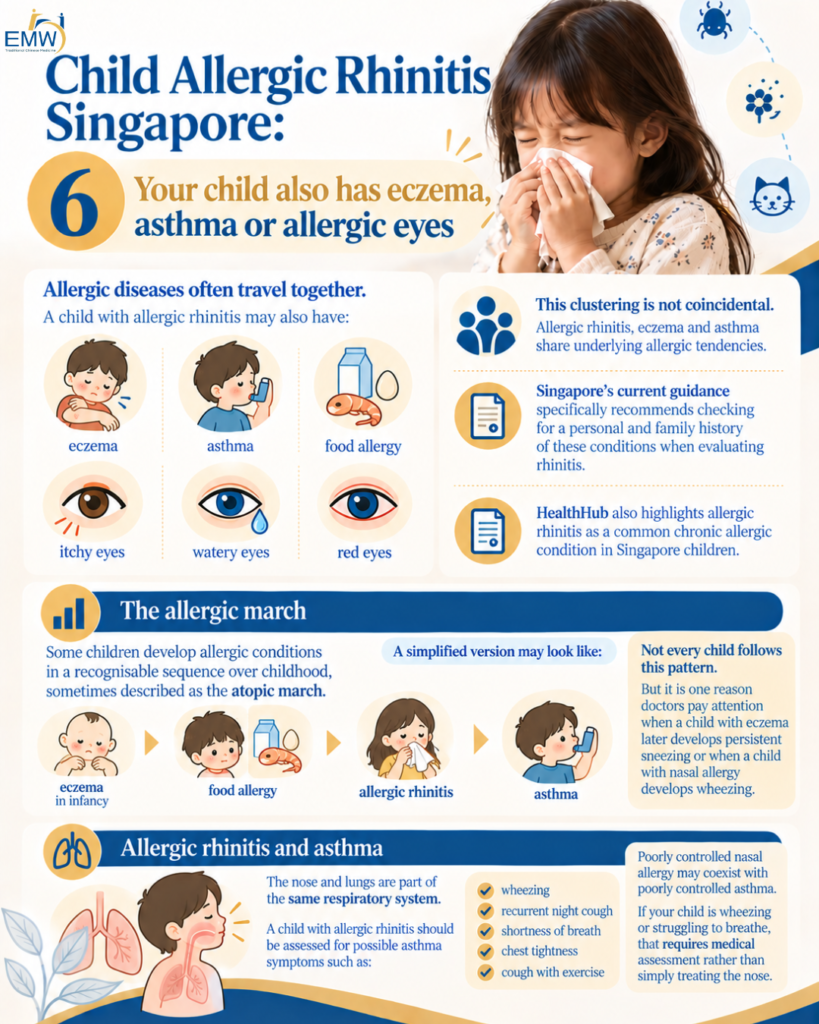
6. Your child also has eczema, asthma or allergic eyes
Allergic diseases often travel together.
A child with allergic rhinitis may also have:
- eczema
- asthma
- food allergy
- itchy eyes
- watery eyes
- red eyes
This clustering is not coincidental.
Allergic rhinitis, eczema and asthma share underlying allergic tendencies.
Singapore’s current guidance specifically recommends checking for a personal and family history of these conditions when evaluating rhinitis.
HealthHub also highlights allergic rhinitis as a common chronic allergic condition in Singapore children.
The allergic march
Some children develop allergic conditions in a recognisable sequence over childhood, sometimes described as the atopic march.
A simplified version may look like:
eczema in infancy → food allergy → allergic rhinitis → asthma
Not every child follows this pattern.
But it is one reason doctors pay attention when a child with eczema later develops persistent sneezing or when a child with nasal allergy develops wheezing.
Allergic rhinitis and asthma
The nose and lungs are part of the same respiratory system.
A child with allergic rhinitis should be assessed for possible asthma symptoms such as:
- wheezing
- recurrent night cough
- shortness of breath
- chest tightness
- cough with exercise
Poorly controlled nasal allergy may coexist with poorly controlled asthma.
If your child is wheezing or struggling to breathe, that requires medical assessment rather than simply treating the nose.
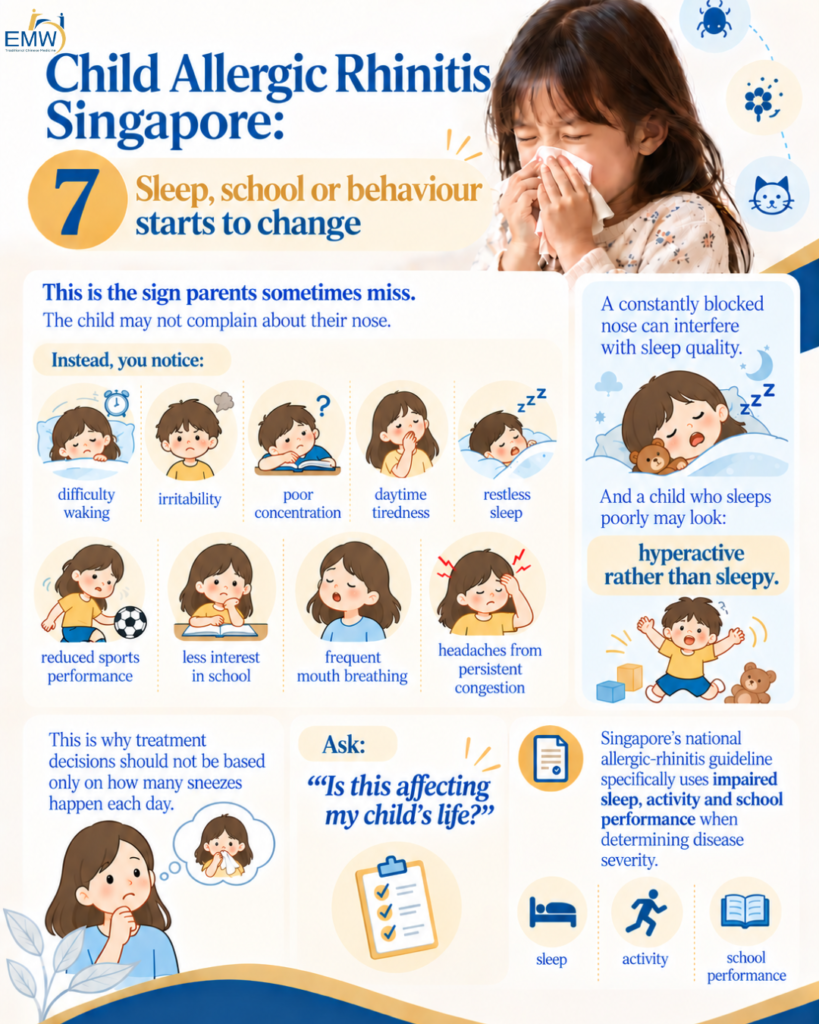
7. Sleep, school or behaviour starts to change
This is the sign parents sometimes miss.
The child may not complain about their nose.
Instead, you notice:
- difficulty waking
- irritability
- poor concentration
- daytime tiredness
- restless sleep
- reduced sports performance
- less interest in school
- frequent mouth breathing
- headaches from persistent congestion
A constantly blocked nose can interfere with sleep quality.
And a child who sleeps poorly may look:
hyperactive rather than sleepy.
This is why treatment decisions should not be based only on how many sneezes happen each day.
Ask:
Is this affecting my child’s life?
Singapore’s national allergic-rhinitis guideline specifically uses impaired sleep, activity and school performance when determining disease severity.
Why allergic rhinitis behaves differently in Singapore
In countries with four seasons, people often associate allergic rhinitis with spring.
Singapore is different.
Our tropical environment means indoor allergens remain present throughout the year.
For families researching child allergic rhinitis Singapore, the most important trigger to understand is usually the house dust mite.
Singapore’s 2026 guideline states that perennial allergic rhinitis predominates locally and identifies house dust mites as the main allergen. Other possible allergens include:
- mould
- pet dander
- some perennial pollens
Tobacco smoke is not itself an allergen detected on an allergy test, but it can aggravate symptoms.
This explains why a child’s allergy may not have a clear “season”.
It may simply seem constant.
Does every child need an allergy test?
No.
This is an important point because parents sometimes assume:
“I need to test everything.”
Current Singapore guidance says allergy testing is not routinely required to diagnose allergic rhinitis.
History and examination are often sufficient.
Testing may become useful when:
- the diagnosis remains unclear
- symptoms persist despite appropriate treatment
- the suspected allergen needs to be identified
- immunotherapy is being considered
- several allergic conditions coexist
Common tests include:
Skin prick testing
Small amounts of allergen are applied to the skin and the reaction is observed.
Specific IgE blood testing
A blood test looks for IgE antibodies directed against particular allergens.
But there is an important limitation.
A positive allergy test shows sensitisation.
It does not automatically prove:
“This allergen is causing all of my child’s symptoms.”
The result still needs to match the history.
That is also why ordering enormous allergy panels without a clinical reason may create more confusion than clarity.
What can parents do about house dust mites?
You cannot completely eliminate house dust mites from a Singapore home.
Nor do you need to turn your home into a laboratory.
The goal is to reduce exposure reasonably.
Practical measures may include:
- use dust-mite-resistant mattress and pillow covers
- wash bedding regularly
- use hot-water washing when practical
- reduce unnecessary soft items on the bed
- limit carpets or rugs where relevant
- avoid aggressively shaking dusty bedding around the child
- keep the bedroom easy to clean
Singapore’s 2026 guideline advises allergen avoidance as an adjunct to treatment while also acknowledging that evidence for individual mite-control measures is limited. No single dust-mite strategy is clearly superior.
That nuance matters.
You do not need to:
- throw away every soft toy
- replace all the furniture
- disinfect the house constantly
- spend thousands on allergy gadgets
Start with practical, sustainable measures.
Can saline help?
Yes, saline nasal sprays or irrigation can be useful as an adjunct.
Singapore’s guideline describes intranasal saline as a safe and effective additional measure that may improve nasal symptoms and quality of life.
For children, the appropriate method depends on age and cooperation.
Younger children may tolerate:
- drops
- gentle sprays
Older children may sometimes manage irrigation with guidance.
Use clean equipment and appropriately prepared saline products.
What medicines are used for allergic rhinitis in children?
Treatment depends on:
- age
- symptom severity
- whether congestion or itching dominates
- frequency
- medical history
- child preference
- ability to use nasal medication correctly
Singapore’s current guideline recommends three main options:
- intranasal corticosteroids
- second-generation or later oral antihistamines
- combined intranasal corticosteroid + intranasal antihistamine
These choices should be individualised.
Intranasal corticosteroids
Nasal steroid sprays are particularly effective for congestion and overall nasal symptom control.
They are different from taking systemic steroid tablets.
The Singapore guideline notes that their safety profile is well established when used at recommended doses.
Technique matters.
If the spray is repeatedly directed towards the middle nasal septum, irritation and nosebleeds may occur.
Parents should ask their doctor or pharmacist to demonstrate correct technique.
Antihistamines
Second-generation antihistamines may help:
- sneezing
- itching
- runny nose
The current local guideline advises against older first-generation antihistamines for routine allergic rhinitis treatment because of their sedating and anticholinergic effects.
Do not choose medication solely because it makes your child sleepy at night.
Sedation is not the same as healthy sleep.
Decongestant sprays
These require caution.
Current guidance recommends limiting intranasal decongestants to very short-term use because prolonged use can cause rebound congestion.
Do not repeatedly use an adult nasal decongestant on a child without medical advice.
What if treatment still does not work?
Before deciding:
“The medicine doesn’t work,”
check:
- Was the diagnosis correct?
- Was the medicine used regularly enough?
- Was the nasal spray technique correct?
- Was treatment used for long enough?
- Is the child still being heavily exposed to a trigger?
- Are adenoids contributing?
- Is there sinus disease?
- Is asthma also poorly controlled?
Singapore’s guideline recommends specialist review when symptoms remain severe despite optimised treatment, particularly when sleep, school or quality of life remains significantly affected.
Allergen immunotherapy may be considered in selected patients.
It is not the first treatment every child needs.
When is it probably not allergic rhinitis?
Not every blocked or runny nose is an allergy.
Medical assessment becomes especially important when symptoms include:
- fever
- persistent thick purulent discharge
- strong facial pain
- symptoms only on one side
- foul-smelling nasal discharge
- recurrent significant nosebleeds
- vision changes
- recurrent sinus infections
- significant breathing difficulty
Singapore’s 2026 guideline lists unilateral obstruction or discharge, recurrent or severe nosebleeds, foul-smelling discharge and severe facial or orbital symptoms among important red flags.
What about children under two?
True allergic rhinitis is relatively unusual below age two because developing an allergy generally requires a period of allergen exposure.
For babies and very young toddlers with persistent nasal symptoms, current Singapore guidance recommends considering other causes as well.
That is an important reason not to label every repeatedly congested infant as “allergic”.
How EMW TCM approaches paediatric allergic rhinitis
At EMW TCM, we treat paediatric allergic-rhinitis care as complementary to proper medical assessment.
For parents looking for child allergic rhinitis Singapore support, our first step is not simply to label every morning sneeze as “weak immunity”.
We look at the pattern.
A paediatric consultation may review:
- age
- frequency of sneezing
- nasal itching
- clear or thick discharge
- blocked nose
- mouth breathing
- sleep
- snoring
- appetite
- digestion
- bowel movements
- sweating
- eczema
- asthma or wheezing history
- frequency of respiratory infections
- environmental triggers
- previous allergy testing
- medication use
In TCM, children with similar Western diagnoses may still present with different patterns.
Treatment may therefore differ.
Depending on the child’s age and presentation, supportive care may include:
- paediatric tuina
- gentle acupressure
- acupuncture in suitable older children
- lifestyle and dietary guidance
- Chinese herbal medicine where clinically appropriate
However, expectations need to remain realistic.
TCM should not replace:
- asthma inhalers
- medically indicated antihistamines
- prescribed nasal corticosteroids
- investigation of persistent obstruction
- ENT review
- allergy specialist care when needed
A child who is wheezing, breathless or experiencing severe airway symptoms requires medical care.
Is allergic rhinitis the same as “low immunity”?
No.
This is a useful misconception to clear up.
Allergic rhinitis is not simply caused by a weak immune system.
It involves an inappropriate immune response to otherwise harmless environmental substances, such as house dust mite allergens.
A child can therefore:
- rarely catch infections
- yet have significant allergic rhinitis.
Likewise, a child can experience:
- frequent viral infections
- without having an allergy.
And some children have both.
So the treatment goals are different.
For allergy, you are trying to control allergic inflammation and relevant exposure.
For recurrent infections, you need to assess the infection pattern separately.
Frequently Asked Questions
Why does my child sneeze every morning?
Morning sneezing commonly occurs in children with allergic rhinitis because of overnight exposure to bedroom allergens such as house dust mites.
However, repeated sneezing alone does not confirm an allergy.
How can I tell allergy from a cold?
Allergy is more likely when symptoms repeatedly involve:
- sneezing
- itching
- clear mucus
- nasal blockage
- no fever
- a recognisable environmental pattern
Colds usually have a clearer onset and recovery and may involve systemic symptoms.
Should my child have an allergy blood test?
Not necessarily.
Current Singapore guidance does not recommend routine allergy testing for every case of allergic rhinitis. Testing is more useful when diagnosis is uncertain, symptoms remain poorly controlled, or allergen identification would change treatment.
Is house dust mite allergy common in Singapore?
Yes.
House dust mites are the main allergen associated with perennial allergic rhinitis locally.
Can allergic rhinitis cause dark circles under the eyes?
Children with allergic rhinitis may develop dark colouring beneath the eyes, sometimes called allergic shiners. They can also develop puffiness around the eyes.
Can allergic rhinitis affect school performance?
Yes.
When symptoms disturb sleep or remain poorly controlled, concentration, school attendance and performance can be affected.
Can my child grow out of allergic rhinitis?
Symptoms may change with age, but allergic rhinitis can persist for years.
The goal should be appropriate symptom control rather than simply waiting for the child to outgrow it.
Can TCM cure my child’s dust mite allergy?
TCM should not be presented as a proven cure for dust-mite sensitisation.
It may be used as complementary care for selected children while medically indicated allergy management continues.
Do not assume every runny nose is "another cold"
If your child seems to catch a cold every week, start watching the pattern.
Does it always happen in the morning?
Is the mucus clear?
Is the nose itchy?
Is your child rubbing the nose constantly?
Does it improve away from home?
Is there eczema or asthma too?
And is nasal congestion interfering with sleep?
These clues can make the difference between repeatedly treating “colds” and recognising an ongoing allergic condition.
For families researching child allergic rhinitis Singapore, the bigger message is simple:
Do not count only the sneezes. Look at the pattern, triggers and impact on the child’s life.
Allergic rhinitis is common.
But common does not mean it has to remain poorly controlled.
Continue reading
We publish practical, evidence-informed guides on paediatric health, breastfeeding, postpartum recovery, fertility and gut health.
👉 Read more on the EMW TCM blog:
This article is educational and does not replace assessment by your child’s paediatrician, family doctor, ENT specialist or allergist. Seek prompt medical attention for breathing difficulty, wheezing, severe facial or eye pain, visual symptoms, persistent one-sided nasal symptoms or other concerning features.
References
- Agency for Care Effectiveness, Ministry of Health Singapore. Allergic Rhinitis: Diagnosis and Management. ACE Clinical Guideline. 2026.
- ARIA-EAACI. Allergic Rhinitis and Its Impact on Asthma Guidelines 2024–2025 Revision: Part I, Intranasal Treatments.
- ARIA-EAACI. Allergic Rhinitis and Its Impact on Asthma Guidelines 2024–2025 Revision: Part II, Oral and Ocular Treatments.
- HealthHub Singapore. Allergic Rhinitis.
- HealthHub Singapore. Guide to Common Toddler Conditions: Allergic Rhinitis.
- Kidon MI, et al. Sensitization to dust mites in children with allergic rhinitis in Singapore. Clinical & Experimental Allergy. 2005.
- Goh DYT, et al. Prevalence of asthma and comorbid allergy symptoms in Singaporean preschoolers.
- Wang XS, et al. Prevalence and severity of asthma, rhinitis and eczema in Singapore schoolchildren.
Our TCM Physicians

Principal TCM Physician
- M.Med(TCM Gynaecology)
- B.Sc(Hons) Biomedical Sciences
- Dip. Naturopath
- Ayurvedic Therapist(500hrs)
- Registered TCM Physician (Singapore MOH)

Senior TCM Physician
- M.Med(TCM Acupuncture & Moxibustion)
- B.Sc(Hons) Biomedical Sciences
- Certified Aromatherapist
- Registered TCM Physician (Singapore MOH)

TCM Physician
- M.Med(TCM Gynaecology)
- B.Sc(Hons) Biomedical Sciences
- Registered TCM Physician (Singapore MOH)

TCM Physician
- M.Med(TCM Acupuncture & Moxibustion)
- B.Sc(Hons) Biomedical Sciences
- Registered TCM Physician (Singapore MOH)
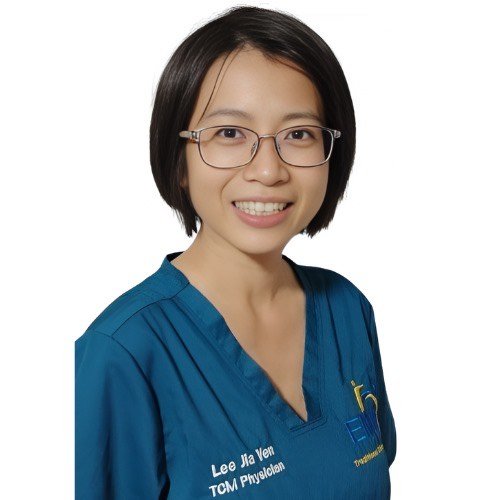
TCM Physician
- B.Med(TCM)
- B.Sc(Hons) Biomedical Sciences
- International Board-Certified Lactation Consultant (IBCLC)
- Registered TCM Physician (Singapore MOH)