
After pregnancy, many mothers expect their abdomen to take time to recover. What can be more surprising is noticing a persistent gap along the middle of the abdomen, a ridge when sitting up, or a belly that continues to protrude despite losing pregnancy weight.
This may be diastasis recti abdominis (DRA), commonly called abdominal separation.
Diastasis recti is extremely common after pregnancy. It occurs when the two sides of the rectus abdominis, the “six-pack” muscles, move further apart as the connective tissue between them, known as the linea alba, stretches during pregnancy.
For many women, the separation gradually improves after childbirth. For others, it can remain months or even years later.
Importantly, postpartum diastasis recti is not simply a cosmetic issue. The width of the gap is only one part of the picture. We also need to consider how well the abdominal wall generates tension, whether the abdomen bulges or “cones” under pressure, core coordination and whether there are associated symptoms such as back discomfort or difficulty returning to exercise.
At EMW TCM Singapore, we approach postpartum abdominal recovery as part of a mother’s overall recovery rather than focusing only on the number of centimetres between the abdominal muscles.
What Is Diastasis Recti?
The rectus abdominis consists of two vertical bands of muscle running down the front of the abdomen.
Between them is the linea alba, a band of connective tissue that helps transfer force across the abdominal wall.
As the uterus enlarges during pregnancy, the abdominal wall adapts to accommodate the growing baby. The rectus muscles move apart and the linea alba becomes longer, wider and thinner.
This is a normal physiological adaptation during pregnancy.
After delivery, the uterus gradually decreases in size and the abdominal wall begins to recover. However, the linea alba and abdominal muscles do not always return immediately to their pre-pregnancy position or function.
The European Hernia Society defines rectus diastasis as a separation of more than 2 cm, although the significance of the separation should not be judged by width alone.[1]
A mother with a wider separation but good abdominal tension and function may experience fewer problems than someone with a narrower gap but poor pressure control, significant bulging or weakness.
Diastasis recti is also not the same as an abdominal hernia. In diastasis, the linea alba is stretched and widened rather than having a true defect or hole through which abdominal contents protrude.
A hernia can, however, occur together with diastasis recti.
How Common Is Diastasis Recti After Pregnancy?
It is very common, especially during the first few months after delivery.
A prospective study following 300 first time mothers found diastasis recti in approximately:
- 60% at 6 weeks postpartum
- 45% at 6 months postpartum
- 33% at 12 months postpartum.[2]
This tells us two important things.
First, abdominal separation during the early postpartum period is common and does not automatically mean something has gone wrong.
Second, recovery continues for many months after childbirth. There is no rule that your abdomen must have completely recovered by the end of the traditional 28 day confinement period.
Some mothers still have measurable separation one year postpartum, and we also see women several years after childbirth who have never had their abdominal wall properly assessed.
It is therefore not “too late” to work on postpartum core recovery simply because your baby is no longer a newborn.
Why Does Diastasis Recti Happen?
Diastasis recti usually develops because of a combination of pregnancy related stretching and changes in abdominal pressure rather than one single cause.
1. Stretching of the Abdominal Wall During Pregnancy
As the uterus grows, the abdominal wall must expand.
The rectus muscles move laterally while the linea alba stretches to create additional space.
This is a normal part of pregnancy, particularly during the later trimesters.
2. Increased Intra-Abdominal Pressure
Anything that repeatedly raises pressure inside the abdomen places additional load on the abdominal wall.
During pregnancy this includes the growing uterus itself. After delivery it may include:
- repeated heavy lifting
- straining with constipation
- chronic coughing
- breath-holding during exercise
- lifting a baby or toddler without coordinating the core
- returning to demanding abdominal exercise before pressure control has recovered
This does not mean mothers should be afraid of using their abdominal muscles. Rather, the aim is to gradually restore the abdominal wall’s ability to manage pressure.
3. Multiple Pregnancies
The abdominal wall undergoes stretching with every pregnancy.
Mothers who have had several pregnancies may therefore notice that their abdomen takes longer to regain strength and tension.
However, parity alone does not determine whether someone will develop persistent diastasis recti.
4. A Larger Abdominal Expansion
Twin or multiple pregnancies, a larger baby, increased amniotic fluid and other factors that create greater abdominal expansion may increase mechanical loading on the abdominal wall.
Research into individual risk factors remains inconsistent, however, and there is no single profile that predicts who will develop persistent DRA.
5. Connective Tissue Differences
Every woman’s connective tissue behaves differently.
Hormonal changes during pregnancy also increase tissue flexibility to allow the body to accommodate pregnancy and childbirth.
Some women may therefore naturally experience greater stretching of the linea alba than others.
6. Reduced Core Coordination After Pregnancy
Pregnancy changes how the diaphragm, abdominal wall, pelvic floor and spinal muscles work together.
After delivery, a mother may have difficulty coordinating these structures efficiently, particularly when getting out of bed, carrying her baby, coughing, exercising or lifting.
The abdomen may then bulge forward rather than developing firm tension through the linea alba.
7. Incomplete Postpartum Rehabilitation
Rest is important after childbirth, but rest alone does not necessarily rebuild abdominal strength.
Once medically appropriate, a progressive rehabilitation programme can help retrain the abdominal wall and restore strength.
Recent systematic reviews suggest that structured abdominal exercise can reduce inter-recti distance, although researchers have not yet established one “best” exercise programme for every woman.[3–5]
What Are the Signs of Postpartum Diastasis Recti?
The most recognisable sign is a gap along the middle of the abdomen, but not everyone will notice it.
You may instead observe:
- a visible ridge along the centre of the abdomen when sitting up
- doming or coning when getting out of bed or exercising
- a belly that continues to protrude despite weight loss
- a soft or poorly tensioned area around the navel
- difficulty generating abdominal strength
- reduced trunk stability
- feeling weak during lifting or exercise
- difficulty returning to pre-pregnancy exercise
- changes in body confidence
Some mothers with diastasis also report low-back discomfort or pelvic floor symptoms.
However, it is important not to assume that diastasis recti is the cause of every postpartum back or pelvic-floor problem. Research examining these relationships has produced mixed findings.[2]
This is one reason a proper assessment is more useful than simply measuring the gap yourself.
What Does Doming or Coning Mean?
Doming or coning describes a ridge that appears along the centre of the abdomen when pressure increases.
You may notice it when:
- sitting up from bed
- performing a crunch
- lifting both legs
- carrying something heavy
- coughing
- doing planks
- exercising
The ridge appears because pressure is being transmitted forward through the linea alba.
Occasional doming does not mean you have damaged your abdomen. However, repeated or pronounced doming can be a useful sign that an exercise or activity currently exceeds your abdominal wall’s ability to manage pressure efficiently.
Instead of avoiding movement altogether, the goal is usually to modify the movement, improve breathing and abdominal coordination, then progressively increase difficulty.
When Should Diastasis Recti Be Assessed After Delivery?
At EMW TCM, a more meaningful postpartum abdominal assessment can generally begin from approximately Week 6 postpartum onwards, once the earliest stage of postpartum healing has taken place.
Recovery after a vaginal birth and recovery after a Caesarean section are different, so assessment and treatment are adjusted accordingly.
For Caesarean mothers, wound healing, pain and medical clearance must also be considered before progressing abdominal treatment or exercise.
During an assessment, we may look at:
Width: the distance between the rectus muscles at different points along the abdomen.
Depth: how far the examining fingers sink into the separation.
Tension: whether the linea alba firms appropriately when the abdominal muscles activate.
Doming or coning: whether pressure causes the midline to bulge during movement.
Breathing and pressure control: how the diaphragm and abdominal wall coordinate.
Functional movement: for example, getting up from lying, lifting, coughing or performing basic abdominal movements.
This provides a more complete picture than saying simply, “You have a two-finger gap.”
Does Diastasis Recti Heal Naturally?
Often, yes, at least partially.
The abdominal wall undergoes significant natural recovery during the first postpartum months, particularly as the uterus involutes and pregnancy-related tissue changes gradually settle.
This explains why prevalence falls between 6 weeks and 12 months postpartum.[2]
However, natural recovery varies considerably.
For some mothers, the gap becomes smaller but abdominal tension remains poor. Others regain excellent abdominal function even though a small separation remains.
The goal should therefore not always be:
“I need the gap to become zero.”
A better goal is:
“I want an abdominal wall that can generate tension, manage pressure and support the movements I need in everyday life.”
2 Simple Exercises That May Support Postpartum Core Recovery
There is currently no single exercise proven to be best for all women with diastasis recti.
Exercise should be progressed according to symptoms, postpartum stage and your ability to control abdominal pressure.
1. Breathing With Gentle Core Activation
Lie comfortably with your knees bent.
Inhale gently, allowing the rib cage and abdomen to expand naturally.
As you exhale, gently engage the lower abdomen as though narrowing the waist slightly. Avoid aggressively sucking the stomach in or holding your breath.
Repeat slowly for several breaths.
The purpose is to reconnect breathing with abdominal-wall activation rather than to forcefully flatten the stomach.
2. Heel Slides
Begin on your back with both knees bent.
Exhale and gently engage the abdominal wall. Slowly slide one heel away from the body while maintaining control through the abdomen.
Return and repeat on the opposite side.
If the abdomen significantly bulges or cones, shorten the distance or return to the breathing exercise until control improves.
What Treatments Can Help Diastasis Recti?
Exercise and Rehabilitation
Progressive abdominal rehabilitation remains the foundation of conservative management.
A 2025 systematic review of postpartum exercise found evidence that abdominal exercise training can reduce inter-recti distance, although certainty regarding the optimal type and dose remains limited.[3]
More recent analyses have similarly found improvement with structured exercise compared with minimal or no treatment.[4,5]
This means rehabilitation is important, but there is no need to become obsessed with one particular “diastasis recti exercise.”
The programme needs to progress as the abdominal wall becomes stronger.
Pelvic Floor Physiotherapy
A women’s-health or pelvic-floor physiotherapist may be particularly useful when diastasis occurs alongside:
- urinary leakage
- pelvic heaviness
- pelvic or back pain
- difficulty returning to sport
- significant core weakness
- Caesarean scar restriction
- suspected pelvic-floor dysfunction
Physiotherapy may include breathing and pressure management, progressive abdominal strengthening, functional rehabilitation and pelvic-floor assessment.
Neuromuscular Electrical Stimulation
Electrical stimulation has been investigated as an adjunct to abdominal exercise.
Recent reviews suggest that combining exercise with neuromuscular electrical stimulation may improve inter-recti distance more than exercise alone in some studies.[5,8]
This does not replace active rehabilitation. Rather, electrical stimulation may be incorporated alongside progressive muscle retraining where appropriate.
Acupuncture and Electroacupuncture
Acupuncture is also being studied in postpartum diastasis recti rehabilitation.
A randomised controlled trial involving 110 postpartum women investigated electroacupuncture together with exercise and reported improvements in several measures of diastasis and abdominal-wall function during follow-up.[9]
A later network meta-analysis also identified acupuncture combined with rehabilitation among the non-surgical interventions associated with reductions in inter-recti distance.[8]
The evidence is promising but remains considerably smaller than the body of research on exercise rehabilitation. Larger, high-quality trials are still required.
How EMW TCM Supports Diastasis Recti Recovery
At EMW TCM Singapore, postpartum diastasis recti is treated as one component of the mother’s overall recovery.
Rather than simply measuring a gap and repeatedly trying to “close” it, we consider abdominal function together with posture, muscle tension, fatigue, sleep, bowel habits, postpartum pain and the mother’s general recovery after childbirth.
Depending on the assessment and postpartum stage, care may include a combination of the following.
1. Postpartum Abdominal Assessment
From around Week 6 postpartum onwards, we can assess:
- width of the separation
- depth
- linea alba tension
- location of the separation
- doming or coning
- basic abdominal activation
- breathing and pressure control
Follow-up assessments can then monitor changes in function rather than relying solely on appearance.
2. Acupuncture and Electroacupuncture
Acupuncture may be incorporated into a wider postpartum recovery programme.
For selected mothers, electroacupuncture may be used around appropriate abdominal points to provide electrical stimulation alongside acupuncture.
The aim is to complement active rehabilitation rather than replace abdominal exercise.
Treatment is modified for Caesarean recovery, individual sensitivity and the mother’s postpartum stage.
3. Electrical Muscle Stimulation
Where appropriate, electrical muscle stimulation may be used to encourage abdominal muscle activation as part of rehabilitation.
Research increasingly suggests that electrical stimulation combined with exercise may offer additional benefit compared with exercise alone, although protocols differ considerably between studies.[5,8]
4. Postpartum Massage and Abdominal Care
Pregnancy and caring for a newborn place significant mechanical stress on the back, hips, shoulders and abdominal region.
EMW’s postpartum massage programme can therefore be used alongside core rehabilitation to address associated muscle tension and postpartum discomfort.
Abdominal care and traditional postpartum binding may also be incorporated where suitable, depending on the mother’s stage of recovery.
Suggested internal link: Postnatal/Postpartum Massage in Singapore
5. Moxibustion
In TCM practice, moxibustion may be used selectively for mothers presenting with signs of postpartum deficiency and cold.
It is important to distinguish its role clearly: moxibustion is not proven to mechanically reduce the abdominal separation itself.
Instead, it may form part of a broader TCM treatment plan for postpartum recovery, fatigue, cold sensitivity, digestive weakness or musculoskeletal discomfort where clinically appropriate.
6. Cupping
Cupping may sometimes be used for associated muscular tightness, particularly around the back and paraspinal region.
Like massage and moxibustion, it should be regarded as supportive postpartum care rather than a direct method of repairing the linea alba.
Understanding Diastasis Recti From a TCM Perspective
Traditional Chinese Medicine does not describe diastasis recti using the modern anatomical concept of inter-recti distance.
Instead, postpartum assessment considers the broader state of recovery following pregnancy and childbirth.
Childbirth may consume substantial Qi and Blood (气血). Sleep deprivation, breastfeeding demands, irregular meals and the physical workload of caring for a newborn may further challenge recovery.
Three patterns may be particularly relevant.
气血亏虚 Qi and Blood Deficiency
After delivery, some mothers experience fatigue, weakness, dizziness, paleness, poor sleep or slow overall recovery.
From a TCM perspective, sufficient Qi and Blood are important for restoring strength after childbirth.
脾虚 Spleen Deficiency
The Spleen in TCM is traditionally associated with transforming nutrients and supporting the muscles.
Postpartum women presenting with fatigue, poor appetite, bloating, loose stools or a sense of muscular weakness may therefore be assessed for Spleen deficiency.
肾虚 Kidney Deficiency
Pregnancy, childbirth and prolonged physical demands are traditionally considered capable of taxing the Kidney system.
Kidney deficiency may be considered when recovery is accompanied by pronounced lower-back weakness, fatigue or a sense of physical depletion.
These TCM patterns should not be interpreted as anatomical explanations for why the rectus muscles separate.
Instead, they provide a framework for individualising the mother’s wider postpartum care while abdominal rehabilitation addresses the mechanical and functional aspects of diastasis recti.
Can Diastasis Recti Still Be Treated Years After Pregnancy?
Yes.
Although much of the research focuses on women during the first year postpartum, there is no biological deadline after which the abdominal muscles can no longer become stronger.
If your youngest child is three, five or even ten years old, progressive strength training can still improve abdominal function.
The treatment priorities may simply be different from those of a woman who is six weeks postpartum.
Long-standing cases may require greater emphasis on:
- progressive abdominal loading
- functional strength
- breathing and pressure management
- pelvic-floor coordination
- posture and movement habits
- returning safely to higher-level exercise
If a significant separation is accompanied by substantial functional problems or a suspected hernia, medical or surgical assessment may also be appropriate.
When Should You See a Physiotherapist or Doctor?
Seek further medical or physiotherapy assessment if you experience:
- a painful or firm abdominal lump
- suspected umbilical or abdominal hernia
- significant or worsening abdominal pain
- persistent pelvic heaviness
- urinary or faecal incontinence
- substantial back or pelvic pain
- major difficulty performing normal daily activities
- progressive rather than improving abdominal bulging
- difficulty returning to exercise despite rehabilitation
- severe or persistent diastasis affecting function or quality of life
Current European guidance suggests physiotherapy may be considered before surgical management for rectus diastasis.[1]
For selected women with substantial persistent symptoms, surgical repair may eventually be discussed with an appropriate specialist.
Postpartum Recovery Is More Than Closing a Gap
It is very easy to become fixated on whether your abdominal separation measures two centimetres, three centimetres or four centimetres.
But postpartum recovery is more complex than a single measurement.
We want to see:
- better abdominal-wall tension
- less uncontrolled doming
- improved strength
- better breathing and pressure management
- increased confidence with lifting and exercise
- reduced discomfort
- gradual return to normal activity
A small residual gap with a strong, functional abdominal wall is not necessarily a treatment failure.
Likewise, simply reducing the gap without restoring strength and coordination does not necessarily mean rehabilitation is complete.
EMW TCM Clinics
International Building Branch
360 Orchard Road, International Building #02-05/06
Singapore 238869
Book Your Appointment With Us Here: +65 89585869
Our Physicians

Principal TCM Physician
- M.Med(TCM Gynaecology)
- B.Sc(Hons) Biomedical Sciences
- Dip. Naturopath
- Ayurvedic Therapist(500hrs)
- Registered TCM Physician (Singapore MOH)

Senior TCM Physician
- M.Med(TCM Acupuncture & Moxibustion)
- B.Sc(Hons) Biomedical Sciences
- Certified Aromatherapist
- Registered TCM Physician (Singapore MOH)

TCM Physician
- M.Med(TCM Gynaecology)
- B.Sc(Hons) Biomedical Sciences
- Registered TCM Physician (Singapore MOH)
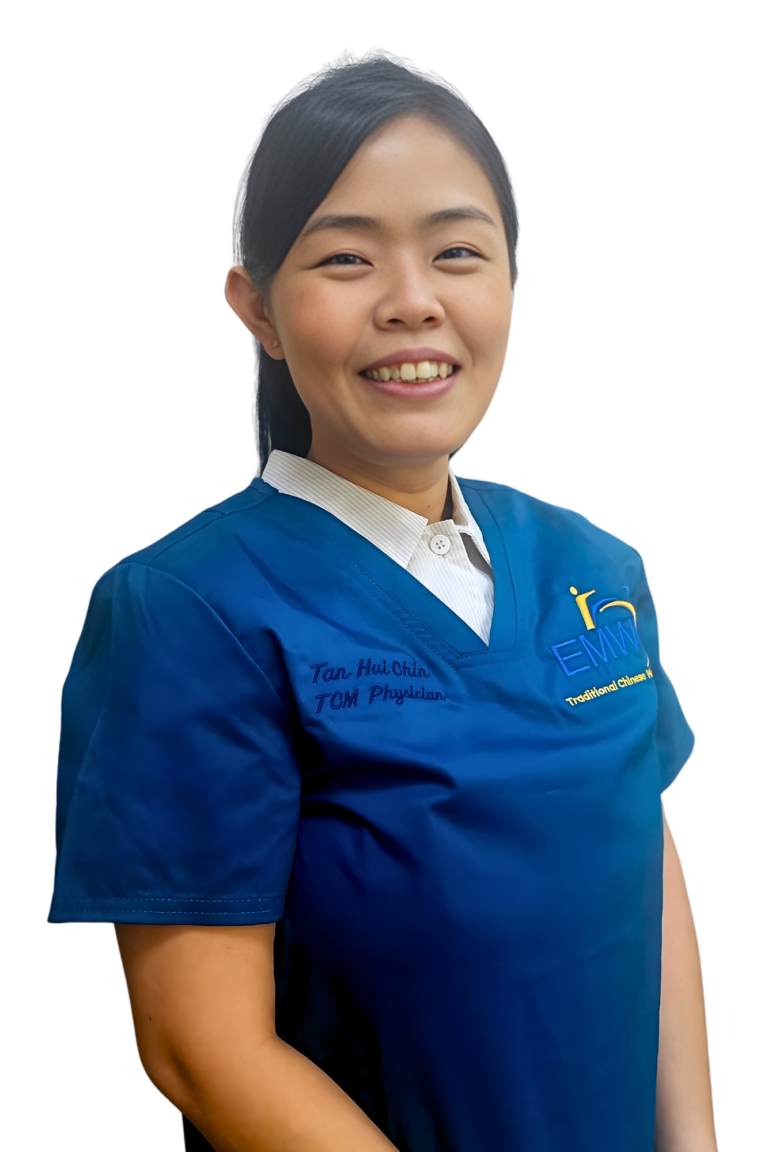
TCM Physician
- M.Med(TCM Acupuncture & Moxibustion)
- B.Sc(Hons) Biomedical Sciences
- Registered TCM Physician (Singapore MOH)

TCM Physician
- B.Med(TCM)
- B.Sc(Hons) Biomedical Sciences
- International Board-Certified Lactation Consultant (IBCLC)
- Registered TCM Physician (Singapore MOH)