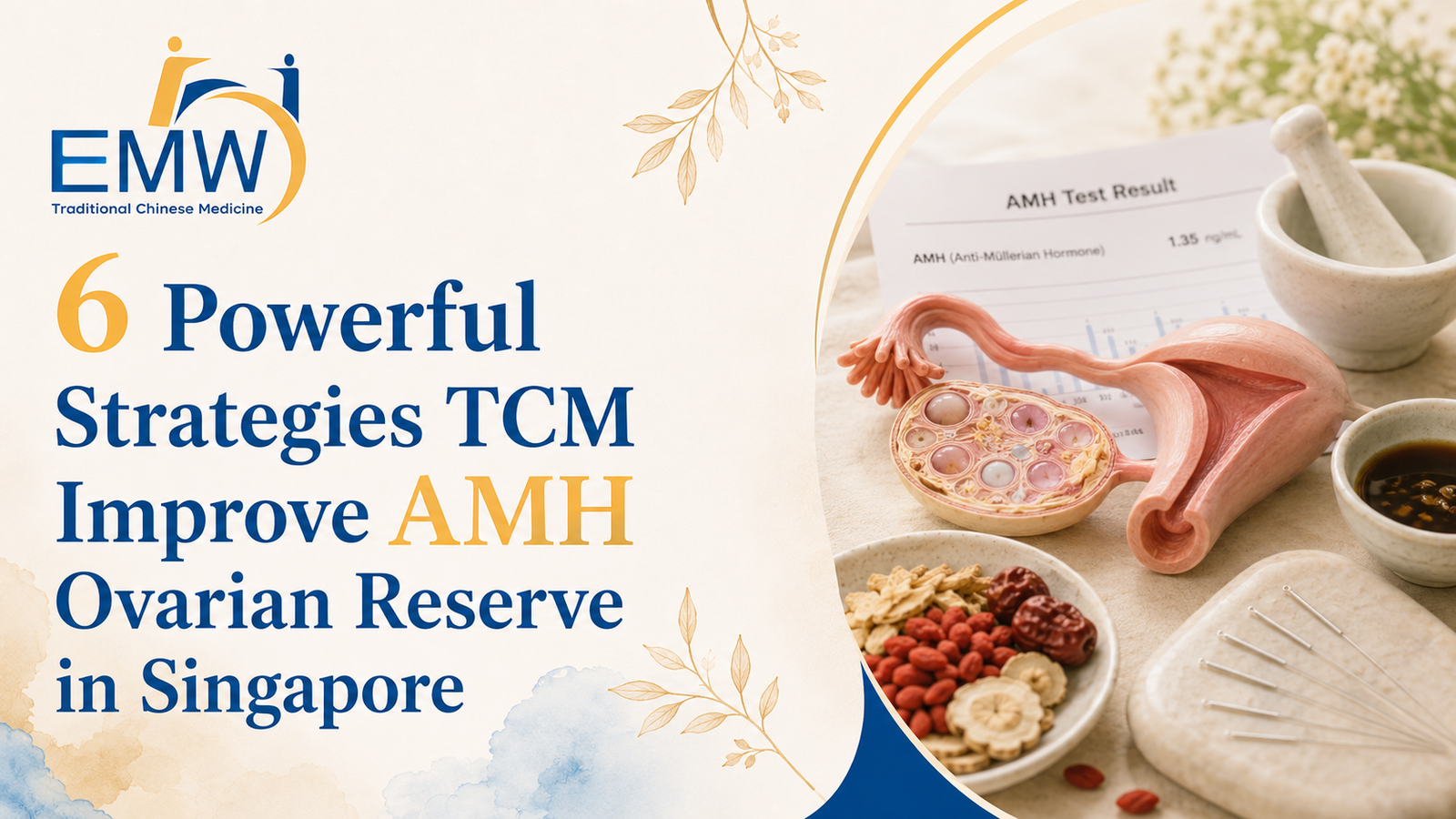
6 Powerful TCM Strategies to Improve AMH and Ovarian Reserve Naturally in Singapore
Receiving a low AMH result is one of the most anxiety-inducing moments in a woman’s fertility journey.
Anti-Mullerian Hormone (AMH) is produced by granulosa cells in early-stage follicles and serves as the most reliable marker of ovarian reserve in current clinical practice.
A low result does not mean conception is impossible.
It does mean the window for egg development may be narrower, and that optimising the follicular environment becomes critically important.
This is where TCM for ovarian reserve has a clinically relevant role.
Not by manufacturing new eggs, but by improving the quality and developmental environment of the eggs that remain.
At EMW TCM Singapore, we work with women who have been told their AMH is low, their egg quality is poor, or their ovarian reserve is diminished.
Our approach is structured, evidence-informed, and integrated with IVF timing when applicable.
Understanding AMH and Ovarian Reserve
AMH levels decline with age, but age is not the only driver.
Other factors that reduce ovarian reserve include:
- Endometriosis and ovarian endometriomas
- Prior ovarian surgery
- Autoimmune conditions affecting the ovaries
- Chronic oxidative stress
- Mitochondrial dysfunction in oocytes
- Poor pelvic and ovarian microcirculation
Many of these drivers are modifiable.
This is the foundation of the TCM approach to improving ovarian reserve.
The TCM View: Kidney Essence and Follicular Health
In Traditional Chinese Medicine, ovarian reserve corresponds to Kidney Jing (Essence).
Kidney Jing is the constitutional foundation of reproductive vitality.
When Jing is depleted, follicular development suffers, hormonal signalling becomes erratic, and the environment for egg maturation becomes suboptimal.
Contributing patterns in TCM include:
- Kidney Yin deficiency: night sweats, dryness, short cycles
- Kidney Yang deficiency: cold extremities, fatigue, poor ovulation
- Spleen Qi deficiency: poor nutrient absorption affecting egg nourishment
- Blood deficiency: thin endometrium, scanty menses
- Blood Stasis: poor ovarian microcirculation
Each pattern requires different herbal and acupuncture strategies.

6 Powerful TCM Strategies to Improve AMH and Ovarian Reserve
1. Tonifying Kidney Jing with Classical Herbal Formulas
The most direct TCM approach to improving ovarian reserve is Kidney Essence tonification.
Key herbs used in this context include:
- Shu Di Huang (Rehmannia glutinosa): nourishes Kidney Yin, supports oocyte development
- Tu Si Zi (Cuscuta chinensis): tonifies both Kidney Yin and Yang, supports FSH regulation
- Gou Qi Zi (Lycium barbarum): Kidney and Liver tonic with antioxidant polysaccharides
- Du Zhong (Eucommia ulmoides): strengthens Kidney Yang
Clinical studies have shown that Lycium barbarum polysaccharides exhibit antioxidant effects on granulosa cells in vitro.
Reference: Chao JC et al. Antioxidant effects of Lycium barbarum polysaccharides. J Sci Food Agric. 2006. DOI: 10.1002/jsfa.2362
2. Improving Ovarian Blood Flow with Acupuncture
Follicular growth depends on adequate blood supply.
Ovarian and uterine blood flow parameters measured by Doppler ultrasound have been shown to improve with acupuncture treatment in some clinical studies.
In TCM, this corresponds to moving Blood and clearing Stasis to restore free flow of Qi and Blood to the reproductive organs.
At EMW TCM, we use both body acupuncture and ear acupuncture (auricular therapy) in our ovarian reserve support protocols, timed with the follicular phase of the menstrual cycle.
Reference: Stener-Victorin E et al. Uterine blood flow impedance and acupuncture. Hum Reprod. 1996. DOI: 10.1093/oxfordjournals.humrep.a019187
3. Reducing Oxidative Stress Through Targeted Nutrition
Oocyte quality is heavily influenced by oxidative stress within the follicular environment.
Mitochondria in oocytes require robust antioxidant defence to sustain the energy demands of meiosis and fertilisation.
Key nutritional strategies we emphasise at EMW TCM include:
- CoQ10-rich food sources and targeted supplementation guidance
- Colourful plant diversity for polyphenol intake
- Omega-3 fatty acids (found in oily fish, flaxseed) for membrane integrity
- Vitamin D optimisation, commonly deficient in Singapore women
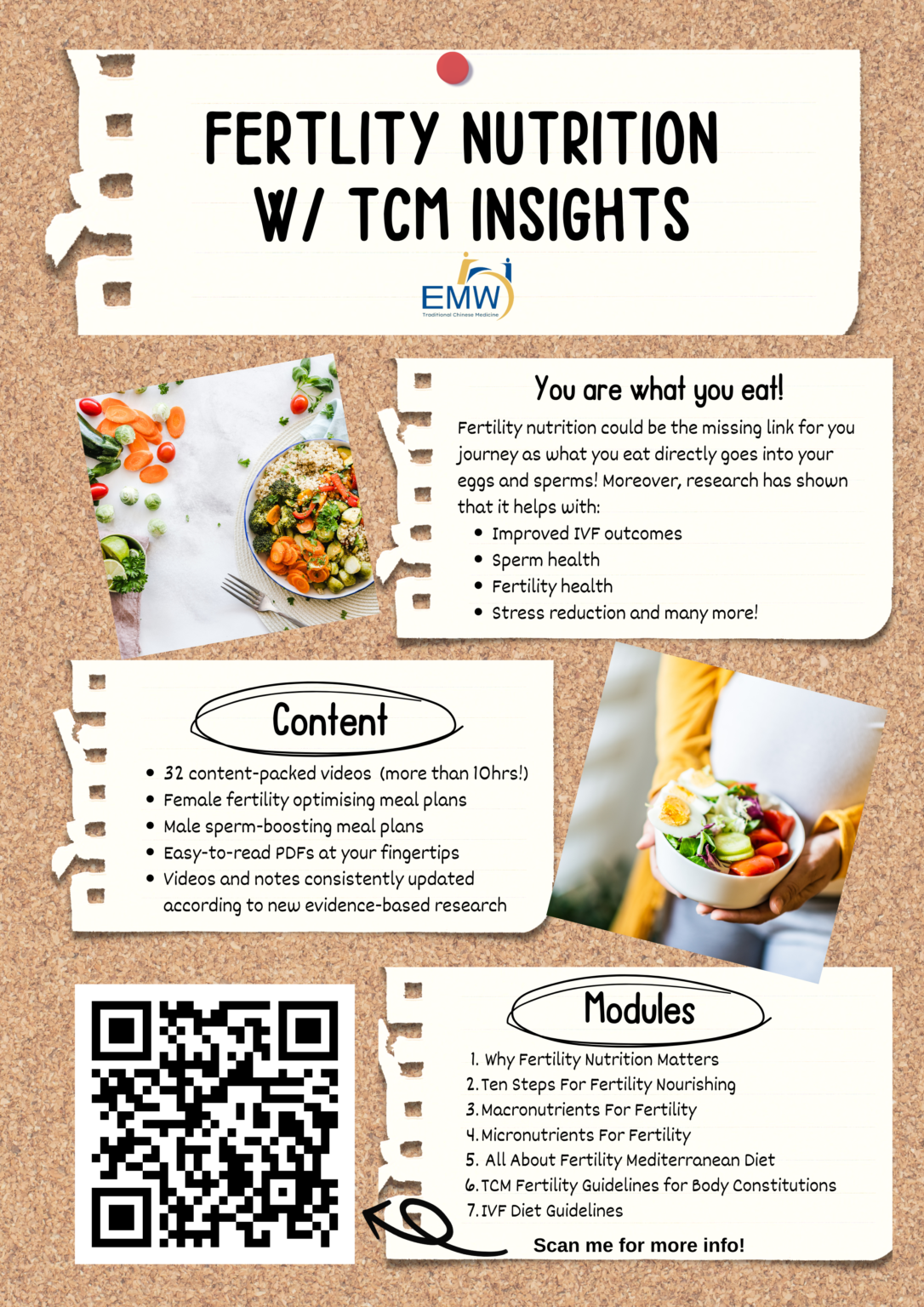
These nutrition strategies are taught in detail in our Fertility Nutrition with TCM Insights course.
4. Supporting Mitochondrial Health in Oocytes
Emerging research identifies mitochondrial dysfunction as a key driver of poor egg quality and reduced ovarian reserve.
In TCM, mitochondrial energy maps closely to the concept of Yuan Qi (Source Qi), which is governed by the Kidney.
Herbal approaches to supporting mitochondrial function include herbs that improve cellular energy metabolism and reduce inflammation within the follicular environment.
At EMW TCM, we integrate mitochondrial nutrition awareness with classical Kidney tonification.
Reference: May-Panloup P et al. Mitochondrial biogenesis and oocyte quality. Hum Reprod Update. 2016. DOI: 10.1093/humupd/dmw006
5. Regulating the Hypothalamic-Pituitary-Ovarian (HPO) Axis
Low AMH is often accompanied by elevated FSH, a sign that the pituitary is working harder to stimulate poorly responding ovaries.
Acupuncture has been shown in multiple studies to modulate HPO axis function, influencing GnRH pulsatility and gonadotropin release patterns.
This neuroendocrine modulation effect may help restore more balanced FSH-LH signalling and improve ovarian responsiveness.
Reference: Stener-Victorin E & Wu X. Effects and mechanisms of acupuncture in the reproductive system. Auton Neurosci. 2010. DOI: 10.1016/j.autneu.2009.12.001
6. Addressing Stress, Sleep, and Ovarian Aging
Chronic stress accelerates reproductive aging.
Cortisol directly inhibits GnRH and impairs ovarian responsiveness.
Sleep deprivation reduces melatonin, which has documented antioxidant effects within ovarian follicles.
In Singapore’s demanding work culture, chronic under-sleep and high cortisol are among the most common drivers of accelerated ovarian aging we see in clinical practice.
TCM addresses this through:
- Acupuncture for HPA axis regulation and sleep quality
- Kidney Yin nourishing herbs that reduce internal Heat and restlessness
- Structured lifestyle medicine guidance
Reference: Tamura H et al. Melatonin and female reproduction. J Obstet Gynaecol Res. 2014. DOI: 10.1111/jog.12317
How Long Does TCM Take to Improve Ovarian Reserve?
This is the most common question we receive.
Folliculogenesis, the development of a mature follicle, takes approximately 90 days from primordial follicle recruitment to ovulation.
This means that any intervention needs at least three full cycles to begin showing its effects on egg quality and follicular development.
At EMW TCM, we recommend a minimum 3-month preparation protocol before attempting IVF retrieval when working on ovarian reserve.
Longer preparation is sometimes appropriate, particularly when the patient is also addressing inflammation, gut health, or stress physiology.
Our Approach at EMW TCM
We do not provide generic protocols.
Each patient undergoes root-cause fertility mapping that includes:
- Cycle assessment and pain characterisation
- Tongue and pulse TCM pattern differentiation
- Biomedical review of AMH, AFC, and hormonal panels
- IVF cycle coordination when applicable
- Nutrition and inflammatory load assessment
We are conservative in the post-ovulatory and early pregnancy phases.
We do not use Blood-moving herbs once a transfer has occurred.
Patient safety drives every clinical decision we make.
If you are navigating fertility challenges in Singapore, we are here to support you with clarity, structure, and evidence-informed care.
The Role of Nutrition in TCM Fertility Singapore
Nutrition is a central pillar of fertility care.
At EMW, dietary strategies emphasise:
Whole, minimally processed foods
Adequate protein for hormone production
Anti-inflammatory plant foods
Blood-building nutrients such as iron and folate
Digestive support to enhance nutrient absorption
Unlike generic advice, recommendations are tailored to TCM patterns such as:
Blood deficiency
Dampness
Yang deficiency
Patients can also start with a practical guide here:
https://emwtcm.podia.com/3-ways-to-boost-your-fertility
When Should You Start TCM for Fertility
The earlier TCM is introduced, the more impact it can have.
Ideal timing includes:
3 months before trying to conceive
Before starting IVF
Between IVF cycles
After failed implantation
Even during active IVF cycles, properly timed acupuncture and supportive therapies can still play a meaningful role.
Conclusion
Stress is unavoidable.
Chronic dysregulation is not.
When stress cortisol and fertility are addressed through structured, integrative care, ovulatory rhythm, luteal stability and implantation environment may improve.
The goal is not to eliminate stress.
The goal is to restore resilience.
If you are navigating fertility challenges in Singapore and suspect stress may be contributing, EMW TCM offers evidence-informed, IVF-aligned support grounded in both tradition and modern science.
How EMW TCM Help Your Fertility
From a biomedical perspective, acupuncture for fertility improves ovarian and uterine blood flow, regulates the hypothalamic-pituitary-ovarian axis, lowers cortisol, reduces inflammation, and supports hormonal balance. These effects complement TCM principles and help enhance egg development, implantation, and reproductive function.
1. Comprehensive Assessment
Your first consultation includes:
Cycle assessment
Digestion and hormonal review
Energy and stress evaluation
Sleep and lifestyle factors
Male fertility screening when relevant
2. Evidence-Based TCM Diagnosis
Qi stagnation
Blood deficiency
Spleen Qi weakness
Kidney Yin/Yang imbalance
Liver Qi constraint
Dampness and inflammation
3. Personalised Fertility Treatment Plan
Weekly fertility acupuncture
Customised herbal formulas
Stress reduction strategies
Lifestyle recommendations
TCM Acupuncture for Fertility Treatments
Acupuncture, one of the most researched TCM fertility tools, has been found to influence several physiological pathways related to reproduction.
A review published in Fertility and Sterility (2019) reported that acupuncture may improve blood flow to the uterus and ovaries, modulate stress hormones, and enhance endometrial receptivity. Another meta-analysis in Integrative Medicine Research (2021) concluded that acupuncture used alongside conventional fertility treatment can improve pregnancy outcomes and reduce anxiety levels in women undergoing IVF.
From a clinical standpoint, acupuncture helps regulate the hypothalamic-pituitary-ovarian axis, improving hormone balance and menstrual regularity. It can also reduce cortisol levels, encouraging the parasympathetic or “rest-and-rebuild” state which supports implantation and early pregnancy.
Our Flagship Ebook & Video Course
When to Seek Professional TCM Fertility Help
Fertility is not just a matter of age or hormones. It is a reflection of the body’s internal harmony. Traditional Chinese Medicine provides an integrative and natural way to restore this balance, supporting both physical and emotional readiness for conception.
At EMW TCM Singapore, our team of experienced physicians brings together centuries-old wisdom and modern evidence to guide your fertility journey. Whether you are trying naturally or preparing for IVF, we are here to help you create the best internal environment for new life to begin.
If you have been trying to conceive for more than six to twelve months, experience irregular menses, painful periods, or have been diagnosed with PCOS, endometriosis, or low sperm count, consider a consultation. Professional TCM fertility care aims to correct the underlying imbalance rather than simply forcing ovulation or hormone production.
Check out our links below to book your fertility consultation and begin your holistic journey toward conception.
EMW TCM Clinics
Scotts Medical Centre Branch
9 Scotts Road #10-04, Scotts Medical Centre @ Pacific Plaza,
Singapore 228210
Book Your Appointment With Us Here: +65 89585869
International Building Branch
360 Orchard Road, International Building #02-05/06
Singapore 238869
Book Your Appointment With Us Here: +65 89585869
Our Physicians
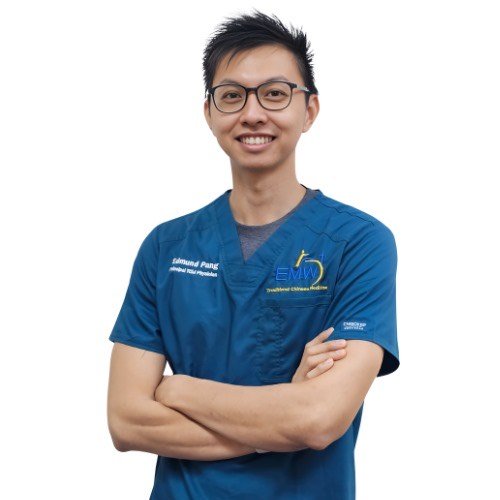
Principal TCM Physician
- M.Med(TCM Gynaecology)
- B.Sc(Hons) Biomedical Sciences
- Dip. Naturopath
- Ayurvedic Therapist(500hrs)
- Registered TCM Physician (Singapore MOH)
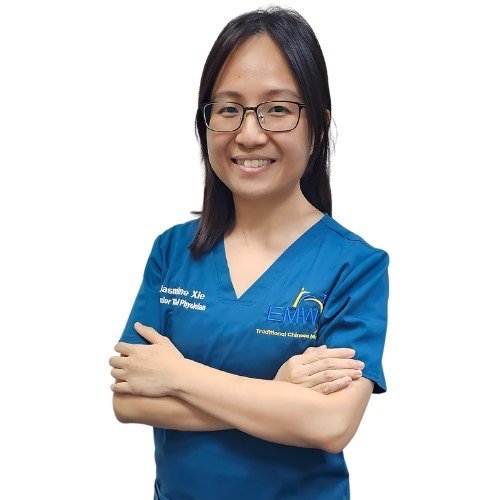
Senior TCM Physician
- M.Med(TCM Acupuncture & Moxibustion)
- B.Sc(Hons) Biomedical Sciences
- Certified Aromatherapist
- Registered TCM Physician (Singapore MOH)

TCM Physician
- M.Med(TCM Gynaecology)
- B.Sc(Hons) Biomedical Sciences
- Registered TCM Physician (Singapore MOH)
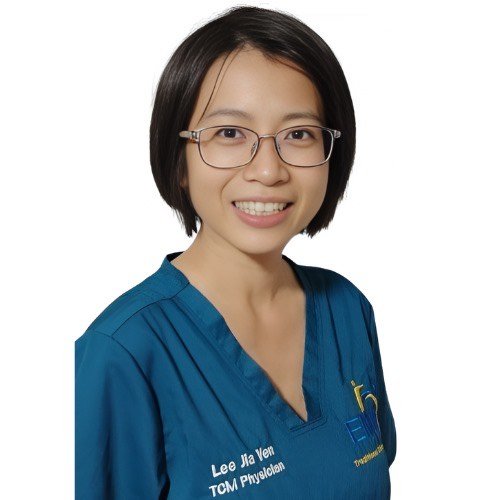
TCM Physician
- B.Med(TCM)
- B.Sc(Hons) Biomedical Sciences
- International Board-Certified Lactation Consultant (IBCLC)
- Registered TCM Physician (Singapore MOH)
References
- Chao JC et al. Antioxidant effects of Lycium barbarum polysaccharides. J Sci Food Agric. 2006. DOI: 10.1002/jsfa.2362
- Stener-Victorin E et al. Reduction of uterine artery blood flow impedance. Hum Reprod. 1996. DOI: 10.1093/oxfordjournals.humrep.a019187
- May-Panloup P et al. Mitochondrial biogenesis and oocyte quality. Hum Reprod Update. 2016. DOI: 10.1093/humupd/dmw006
- Stener-Victorin E & Wu X. Acupuncture effects on the reproductive system. Auton Neurosci. 2010. DOI: 10.1016/j.autneu.2009.12.001
- Tamura H et al. Melatonin and female reproduction. J Obstet Gynaecol Res. 2014. DOI: 10.1111/jog.12317